
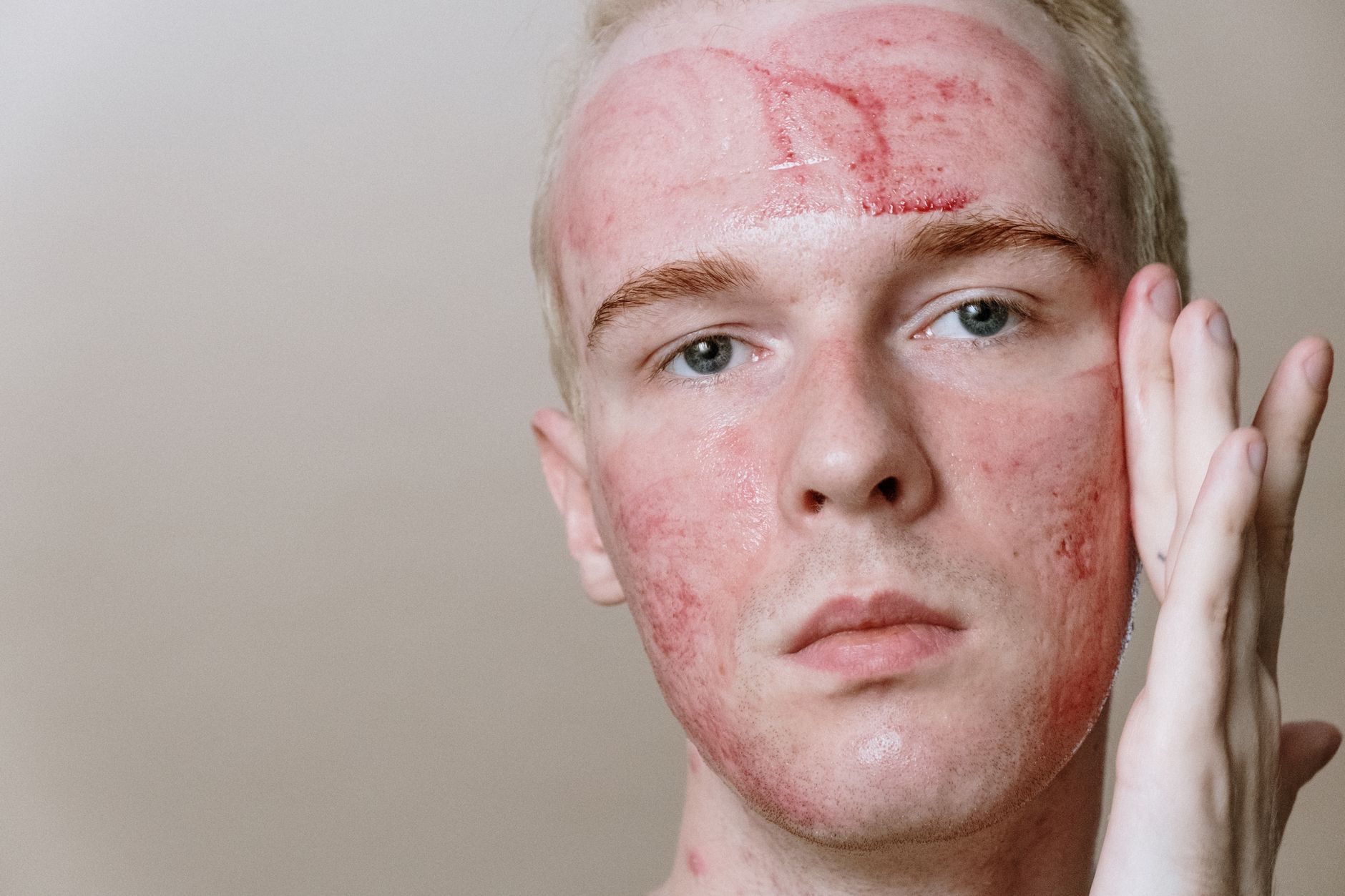
Fungal acne and perioral dermatitis are two different conditions that both get mistaken for ordinary acne, and location is the fastest way to separate them. Fungal acne clusters on the upper back, chest, shoulders and forehead as small, identical, itchy bumps; perioral dermatitis clusters around the mouth as tiny red papules, with a narrow clear ring of untouched skin right at the lip edge. Getting the call right matters more here than with most look-alikes, because the two conditions respond to opposite treatments. The antibiotics that are first-line for perioral dermatitis are usually ineffective for fungal acne and may make it worse, and steroid creams aggravate both while temporarily hiding either one.
Medical information disclaimer: This article is for general educational purposes only and does not provide medical advice, diagnosis, or treatment. Always consult a physician or other qualified health professional about symptoms, medications, tests, or treatment decisions.
Table of Contents
- What fungal acne actually is
- What perioral dermatitis looks like
- The side-by-side checklist
- Why the steroid question is the one to answer first
- Treatments that cross-cancel
- The limits of looking
- Frequently Asked Questions
What fungal acne actually is
"Fungal acne" is the common name for Malassezia folliculitis, an inflammation of hair follicles caused by overgrowth of Malassezia yeast, which lives on normal skin. It is not acne at all. Acne vulgaris involves clogged pores and the bacterium *Cutibacterium acnes*; this is a yeast problem inside the follicle.
According to DermNet NZ's overview of Malassezia folliculitis, it appears as small, uniform itchy follicular papules and pustules on the upper back, chest, shoulders, forehead and hairline, and comedones are absent — that missing-blackhead feature is what separates it from acne vulgaris. A 2025 review in the *Journal of Fungi* lists three distinguishing features: monomorphic lesions (every bump the same size and shape), no comedones, and itch. The same review calls the condition an underdiagnosed mimicker of acneiform eruptions, which is why people often spend months on acne products that do nothing.
What perioral dermatitis looks like
Perioral dermatitis is a persistent acneiform rash of tiny 2–3 mm red papules or papulopustules clustered around the mouth, frequently beginning at the nasolabial folds beside the nose, as described by the Merck Manual Professional Edition. The bumps often sit on a background of mild redness and scaling. The single most useful sign is the spared zone. Merck notes that a narrow strip of normal skin — the Grenz zone — sits immediately around the vermilion border of the lips, so the rash appears to stop short of the lip line rather than running into it.
Like fungal acne, it has no comedones, which rules out plain acne. It also differs from rosacea, which spares the areas around the mouth and eyes instead of targeting them. Who gets it narrows the field a little but not much. A ScienceDirect topic overview reports it most often affects women aged roughly 16 to 45, with cases in children from about 7 months to 13 years — meaning it overlaps with the same young-adult population that develops fungal acne.
The side-by-side checklist
Run through these before buying anything:.
- **Where it is.** Mouth, chin and nasolabial folds point to perioral dermatitis. Upper back, chest, shoulders, forehead and hairline point to fungal acne.
- **The lip margin.** A clear, untouched band of skin right at the lip border is the classic perioral dermatitis sign.
- **Itch.** Significant itching favors fungal acne; perioral dermatitis more often burns or stings.
- **Uniformity.** Fungal acne bumps are monomorphic — one size, one shape, repeated. Perioral dermatitis mixes papules and papulopustules on red, sometimes flaky skin.
- **Blackheads and whiteheads.** Absent in both. If you see them, acne vulgaris is in the picture, and the two can coexist with it.
Why the steroid question is the one to answer first
StatPearls documents a strong association between perioral dermatitis and topical corticosteroid use on the face, including nasal and inhaled corticosteroids, and names discontinuing the steroid as the primary recommendation. Critically, the taper matters: stopping abruptly causes a rebound flare, which is exactly what convinces people the steroid was helping. Steroids make fungal acne worse too, and they can erase the diagnosis.
Patients get transient relief followed by rebound flaring, and a case report in the *Journal of Clinical and Aesthetic Dermatology* documents Malassezia folliculitis "incognito", where topical steroid therapy obscured the diagnosis entirely. The practical consequence: if you have been applying a steroid cream to your face, say so at the appointment and bring the tube. That one piece of history reshapes both the diagnosis and the plan.
Treatments that cross-cancel
First-line perioral dermatitis therapy, per StatPearls, is topical metronidazole, clindamycin, erythromycin, sulfur or azelaic acid, with oral tetracyclines reserved for extensive or resistant disease. Topical therapy is slow — peak effect may not arrive until roughly three months of daily use — so patience is part of the treatment, not a sign it has failed. Those same antibiotics are the wrong move for fungal acne.
The *Journal of Fungi* review and DermNet both report that systemic antibiotics are almost always ineffective for Malassezia folliculitis and may worsen it by disrupting skin microbiota and promoting yeast overgrowth. The fix there is stopping the antibiotic and using topical or oral antifungals for several weeks. This is the real cost of a wrong guess. Treating fungal acne as perioral dermatitis can extend the eruption rather than clear it, and treating perioral dermatitis as fungal acne leaves the steroid link unaddressed.
The limits of looking
Appearance alone is not a reliable diagnosis. For fungal acne, the most accessible confirmatory test is a KOH preparation, in which a skin scraping is examined under a microscope for yeast cells and short hyphae. Even that has a ceiling.
A 2023 European position statement by Henning and colleagues in *JEADV* found KOH sensitivity of only 81.6% in one cohort, against 100% for MGG staining. A negative KOH therefore does not rule out Malassezia folliculitis, so if the clinical picture fits — monomorphic itchy bumps, no comedones, trunk and hairline distribution — a single negative scraping is not a reason to abandon antifungal treatment. If you are unsure which condition you have, the one action worth taking today is stopping any facial steroid in consultation with the prescriber rather than cold, since abrupt withdrawal triggers the rebound flare that muddies the picture further.
Frequently Asked Questions
Can I have fungal acne and regular acne at the same time?
Yes. The distinguishing feature of Malassezia folliculitis is the absence of comedones, so if you see blackheads and whiteheads alongside uniform itchy bumps, acne vulgaris is likely present as well and both may need treating.
How long before perioral dermatitis treatment works?
StatPearls notes topical therapy may not reach peak effect until about three months of daily use, so improvement is gradual rather than immediate.
Why did my face get worse after I stopped the steroid cream?
That is the documented rebound flare. StatPearls recommends tapering rather than stopping abruptly for exactly this reason.