
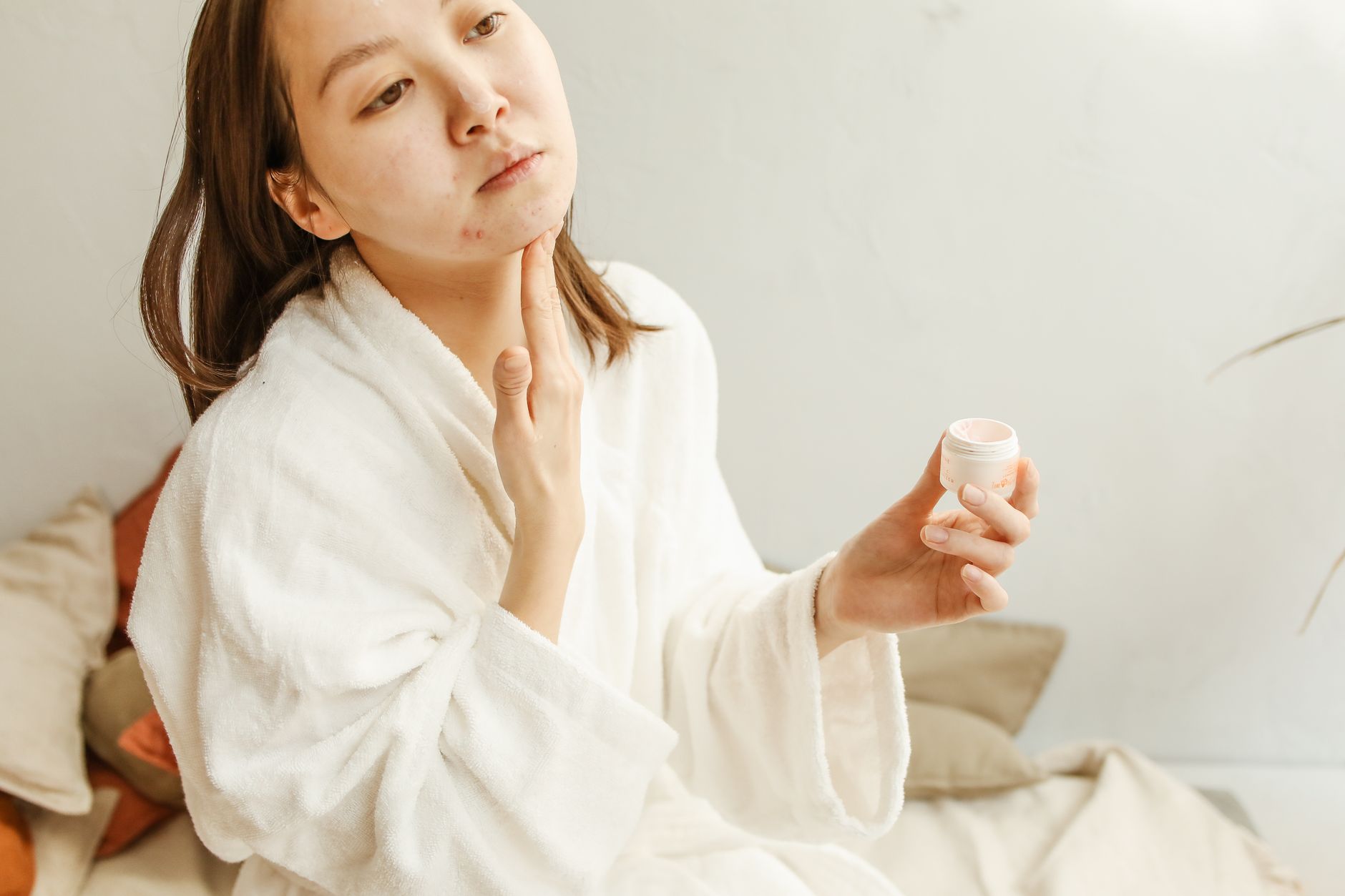
Fungal acne looks like a dense sprinkle of small, same-sized red bumps and tiny pus-topped spots, usually 1 to 2 millimetres across, clustered on the forehead and hairline, the chest and the upper back. The giveaway is what is missing: there are no blackheads or whiteheads, and the bumps usually itch. The condition's real name is *Malassezia* folliculitis (older papers call it pityrosporum folliculitis). It is a yeast infection of the hair follicle, not a bacterial acne breakout, and that difference decides which treatments work.
Medical information disclaimer: This article is for general educational purposes only and does not provide medical advice, diagnosis, or treatment. Always consult a physician or other qualified health professional about symptoms, medications, tests, or treatment decisions.
Table of Contents
- The look: uniform, dome-shaped, and itchy
- Does fungal acne always itch?
- Why it gets mistaken for ordinary acne
- Who tends to get it
- How a diagnosis is actually confirmed
- Expect it to come back
- Frequently Asked Questions
The look: uniform, dome-shaped, and itchy
The word dermatologists use is monomorphic — every lesion is roughly the same shape and size. Ordinary acne is the opposite: a single patch of skin carries blackheads, whiteheads, small papules and the occasional deep nodule all at once. According to DermNet NZ's overview of Malassezia folliculitis, the fungal version presents as numerous small uniform itchy papules and pustules, mostly on the upper back and chest, with comedones absent — and that absence of blackheads and whiteheads is the main clinical dividing line from acne vulgaris.
The bumps sit directly over follicles and are dome-shaped rather than flat or crusted. A 2025 review in the *Journal of Fungi* by Chalupczak and Lipner describes the eruption as follicular and concentrated in seborrheic areas — the oily zones — with the trunk most affected, followed by the upper limbs. Size is worth measuring. In a retrospective review of 110 patients with KOH-confirmed disease, Prindaville and colleagues reported 1- to 2-mm monomorphic papules and pustules, typically on the forehead extending into the hairline and on the upper back.
Does fungal acne always itch?
No. Itch is the most useful symptom but it is not universal. In that 110-patient series, 72 patients — 65% — reported pruritus.
A separate dermoscopy study published in *Actas Dermo-Sifiliográficas* in 2022 found itch in 29 of 45 patients, or 64.4%. So roughly a third of people with it do not itch at all. If you have the uniform bumps and the seborrheic distribution but no itching, fungal folliculitis is still on the table. Treat itch as a strong hint when present and as uninformative when absent.
Why it gets mistaken for ordinary acne
The papules and pustules mimic acne vulgaris closely enough that misdiagnosis is routine, and the usual consequence is a course of antibiotics that cannot help. Chalupczak and Lipner note that the yeasts responsible — lipid-dependent species including *M. globosa*, *M. sympodialis* and *M. restricta* — infect the pilosebaceous unit, while acne vulgaris involves *Cutibacterium acnes*.
An antibacterial drug has nothing to act on. The scale of the error is documented. In the 110-case series, more than 75% of patients arrived with "acne" that had recently been treated with antibiotics. Oral antibiotics can even make things worse, because they are listed among the predisposing factors for the yeast overgrowth in the first place. Signs that should make you question an acne diagnosis:.
- Bumps all the same size, with no blackheads or whiteheads anywhere in the patch
- Itching, especially after sweating
- Forehead and hairline, chest, upper back — rather than the cheeks and jawline
- Months of standard acne treatment with no improvement, or worsening on antibiotics
Who tends to get it
It is more common in males, and it tracks with age and sebum production — which is why it clusters around adolescence and early adulthood, when oil output peaks. Warm, humid climates raise the risk, as do sweating and occlusion from tight or non-breathable clothing. Immunosuppression matters more than most readers expect.
Chalupczak and Lipner cite a study in which *Malassezia furfur* was isolated from 16.7% of HIV-seropositive individuals compared with 1.3% of seronegative ones. One caveat about the strongest numbers on this page. The 110-case review was a single-centre chart review of patients aged 0 to 21, seen between 2010 and 2015; individual providers described the lesions and read the KOH preparations, and no standard grading system was used. Its percentages describe a paediatric and young-adult clinic population, not every patient with the condition.
How a diagnosis is actually confirmed
Appearance narrows the field; it does not settle it. Clinicians confirm by scraping the skin and examining it under a microscope with potassium hydroxide, looking for budding yeasts.
A Wood's lamp may show yellow-green fluorescence, but it is the weaker test: reported sensitivities are 81.6% for KOH and 66.7% for the Wood's lamp when measured against cytology, so a lamp that shows nothing does not rule the condition out. Treatment response is informative too. Ketoconazole shampoo — an antifungal, applied to the affected skin, not just the scalp — was the commonest treatment in the 110-case series and improved or resolved most cases, with roughly half of patients clear within one to two follow-up visits.
Expect it to come back
Recurrence after clearance is common, which is why dermatologists treat the predisposing factors as part of the management plan rather than as optional aftercare. The list is practical: sweating, occlusion, humid conditions, antibiotics and corticosteroids.
Concretely, that means showering and changing out of damp workout clothes promptly, avoiding heavy occlusive layers over the chest and back in hot weather, and flagging any oral antibiotic or steroid course to the clinician treating your skin. If the uniform itchy bumps return weeks after clearing, that pattern is expected behaviour for *Malassezia* folliculitis rather than evidence the original diagnosis was wrong.
Frequently Asked Questions
Can I have fungal acne and regular acne at the same time?
Yes. The distinguishing feature of *Malassezia* folliculitis is that its own lesions are uniform and comedone-free, so a patch with scattered blackheads among larger bumps points to acne vulgaris in that area. A clinician looks at each region separately, and a KOH preparation settles whether yeast is involved.
Where on the body is it most likely to appear?
The trunk is the most affected region, followed by the upper limbs, with the forehead and hairline also common. The chest and upper back are the classic sites, according to DermNet NZ.
Does a negative Wood's lamp test mean I don't have it?
No. The Wood's lamp has a reported sensitivity of 66.7% against cytology, compared with 81.6% for a KOH preparation, so it misses roughly a third of cases. A KOH scraping is the test that carries the diagnosis.