
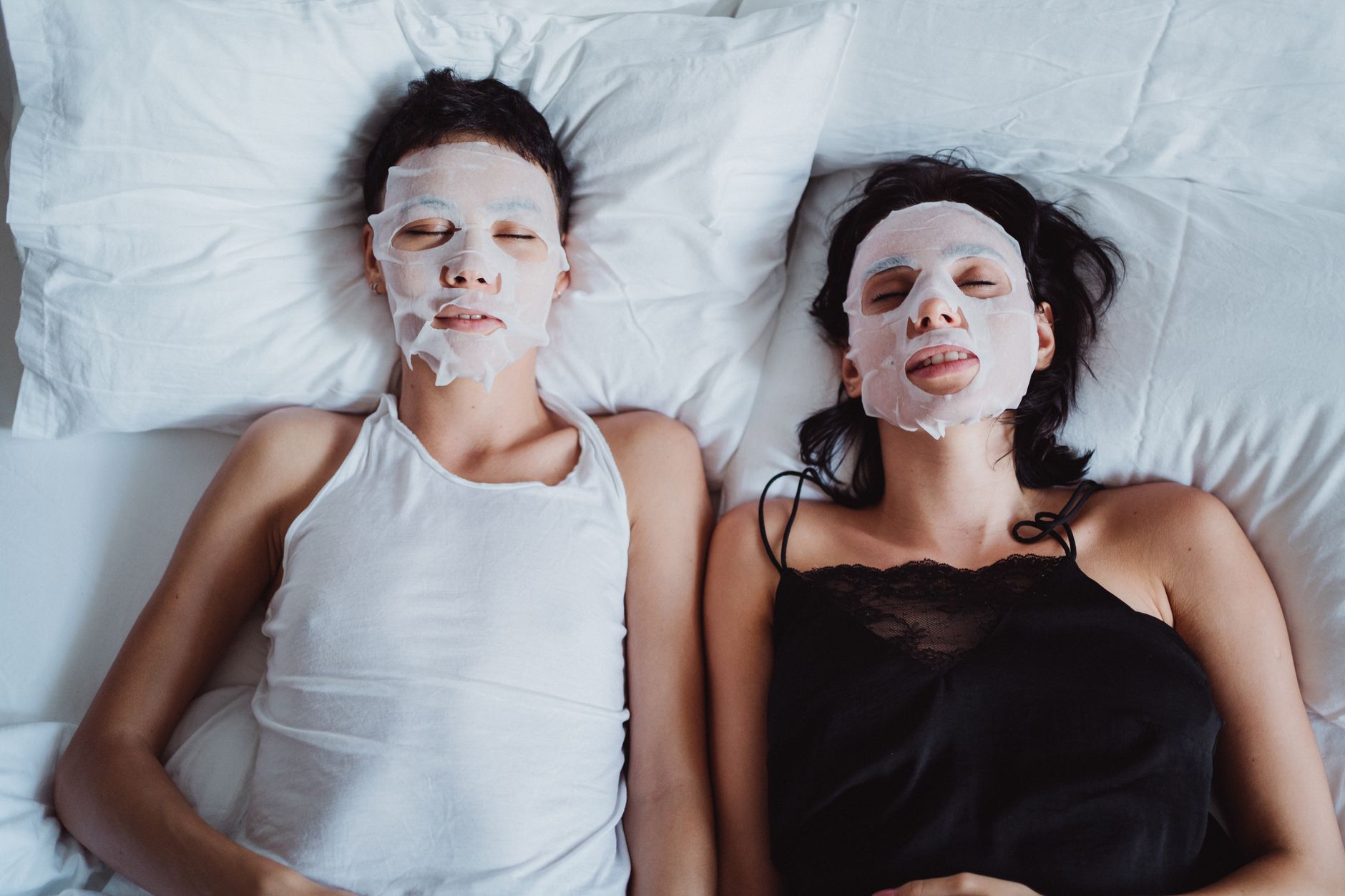
Sleeping in makeup does raise your risk of breakouts, and dermatologists treat it as a habit worth breaking — but the bumps it produces are usually clogged pores rather than a sudden wave of inflamed pimples. The American Academy of Dermatology's guidance for acne-prone skin tells people to remove all makeup, including eye makeup, before bed, and notes that even products labeled non-comedogenic can contribute to breakouts if slept in. That last point is the important one: what dermatologists target is the hours of contact, not the label on the bottle. The honest limit on any "more than usual" answer is that no controlled trial has pitted sleeping in makeup against washing it off, so the advice rests on occlusion experiments, studies of cosmetic use, and clinical consensus rather than a head-to-head test.
Medical information disclaimer: This article is for general educational purposes only and does not provide medical advice, diagnosis, or treatment. Always consult a physician or other qualified health professional about symptoms, medications, tests, or treatment decisions.
Table of Contents
- What a makeup-related breakout actually looks like
- Why overnight contact is the part that counts
- The evidence is more mixed than the advice suggests
- Your eyes have a stronger case against overnight makeup
- What to do differently tonight
- Frequently Asked Questions
What a makeup-related breakout actually looks like
The classic pattern has a name. Albert Kligman and Otto Mills coined "acne cosmetica" in a December 1972 paper in *Archives of Dermatology*, describing persistent closed comedones — whiteheads, pores plugged beneath intact skin — with little inflammation, concentrated on the lower cheeks and chin of women over 20, with the forehead typically spared. That distribution matters for self-diagnosis.
If your breakouts are deep, painful cysts along the jaw that flare on a monthly cycle, makeup is probably not the main driver. If they are small, stubborn, flesh-colored bumps where foundation sits heaviest, the overnight habit is a reasonable suspect. A 2025 review in *JAAD Reviews* describes the condition as mainly affecting women aged 20 to 40, with minimal inflammatory lesions and no scarring, and notes that diagnoses are now relatively uncommon — credited largely to reformulated products. Modern cosmetics are not the heavy occlusive creams of the 1970s.
Why overnight contact is the part that counts
Comedogenicity testing explains the mechanism. Researchers applied cosmetics under occlusive patches to men's backs — roughly 0.2 to 0.5 mL, three times weekly for four weeks — then counted microcomedones. Lanolin, petrolatum, some vegetable oils, butyl stearate, lauryl alcohol and oleic acid plugged follicles under those conditions. Read the method and you see the two ingredients of the problem: occlusion and sustained contact.
A night of unwashed foundation, pressed against a pillowcase for seven or eight hours, supplies both in a way a workday application followed by cleansing does not. What the test does not supply is a prediction about your specific product. The same *Journal of the American Academy of Dermatology* re-evaluation of comedogenicity concluded that products containing comedogenic ingredients are not necessarily comedogenic themselves, and that rabbit-ear testing rated about half of 25 facial creams only mildly comedogenic — far weaker than potent acnegens. A heavy foundation worn overnight is not interchangeable with a tested irritant.
The evidence is more mixed than the advice suggests
Studies of cosmetic use and adult acne do not line up neatly. A 2025 case-control study of 151 participants in *Clinical, Cosmetic and Investigational Dermatology* found that comedogenic-ingredient facial cleansers were associated with acne after adjustment (odds ratio 2.49, 95% confidence interval 1.23–4.90), with powder use showing a stronger association (OR 3.47, CI 1.58–7.59). Other work points the opposite way.
An "acne cosmetica revisited" case-control study in 2013 reported a dose-dependent *inverse* association between overall cosmetic use and post-adolescent acne, and a 2023 study of 70 adult-onset acne patients against 70 controls found cosmetic use linked to lower odds of acne (OR 0.45, CI 0.22–0.90). Both sets of findings are case-control designs, which show association rather than causation, and the confidence intervals are wide. The reasonable synthesis: makeup use in general is not a reliable predictor of adult acne, while specific products and specific habits — long contact, occlusive formulas, heavy powders — plausibly are.
Your eyes have a stronger case against overnight makeup
The best-documented harm from sleeping in makeup is not acne at all. A 2019 cross-sectional study of 42 women found that regular eyeliner users had shorter tear breakup times and higher meibomian gland grades than non-users, with the authors concluding that eyeliner induces tear film instability and meibomian gland dysfunction. Meibomian glands line the lash margin and secrete the oil layer that keeps tears from evaporating too fast.
Block them and eyes feel gritty, dry, and tired — a different complaint from a breakout, and one that creeps up gradually. The reassuring part is that it responds to cleaning. A 2015 study of makeup-related ocular problems reported that eyelid cleansing with an eye shampoo plus artificial tears improved symptoms and meibomian orifice obstruction in young people whose glands were blocked by eye makeup. That is a concrete reason to be deliberate at the lash line specifically, not just across the cheeks.
What to do differently tonight
The practical response is narrower than "never sleep in makeup," because most people already know that and sometimes do it anyway. Target the parts of the habit that the evidence actually implicates: If bumps persist for months after you have fixed the habit, the cause is likely something else — hormonal acne, a prescription, or a condition that looks like acne. A dermatologist can tell closed comedones apart from the lookalikes that will not respond to a cleansing routine at all.
- Treat the lash line as its own step. Residue there affects the oil glands, not just the skin, and a quick pass with a cleanser over the whole face does not reach it.
- Watch for closed comedones on the lower cheeks and chin. That is the signature pattern, and a forehead spared while the jaw stays bumpy is a useful clue.
- Reconsider heavy powders if you break out. Powder use carried the strongest association in the 2025 case-control study, though the interval was wide.
- Do not rely on a "non-comedogenic" label as permission to leave it on. The AAD states plainly that such products can still contribute to breakouts when slept in.
- Check your cleanser as well as your makeup. The same study implicated comedogenic ingredients in cleansers, which stay on the skin by design for less time but touch every pore.
Frequently Asked Questions
Is one night of sleeping in makeup going to cause a breakout?
Acne cosmetica is described in the literature as persistent closed comedones from prolonged cosmetic contact, not as a single-night event. The comedogenicity experiments that established the mechanism ran applications three times weekly for four weeks before counting microcomedones, so repetition is what the evidence addresses.
Does non-comedogenic makeup make it safe to sleep in?
No. The American Academy of Dermatology states that even makeup labeled non-comedogenic can contribute to breakouts if slept in, and researchers have found that products containing comedogenic ingredients are not necessarily comedogenic — the label does not predict finished-product behavior in either direction.
Why do my breakouts cluster on my chin rather than my forehead?
That is the distribution Kligman and Mills recorded in 1972 for acne cosmetica: lower cheeks and chin affected, forehead typically spared. It tracks where cosmetics sit longest and heaviest.
Will removing eye makeup fix dry, irritated eyes?
Partly. The 2015 study found that eyelid cleansing with an eye shampoo plus artificial tears improved both symptoms and gland obstruction in young people whose meibomian glands were blocked by eye makeup, which suggests the effect is at least partly reversible with consistent lid hygiene.