
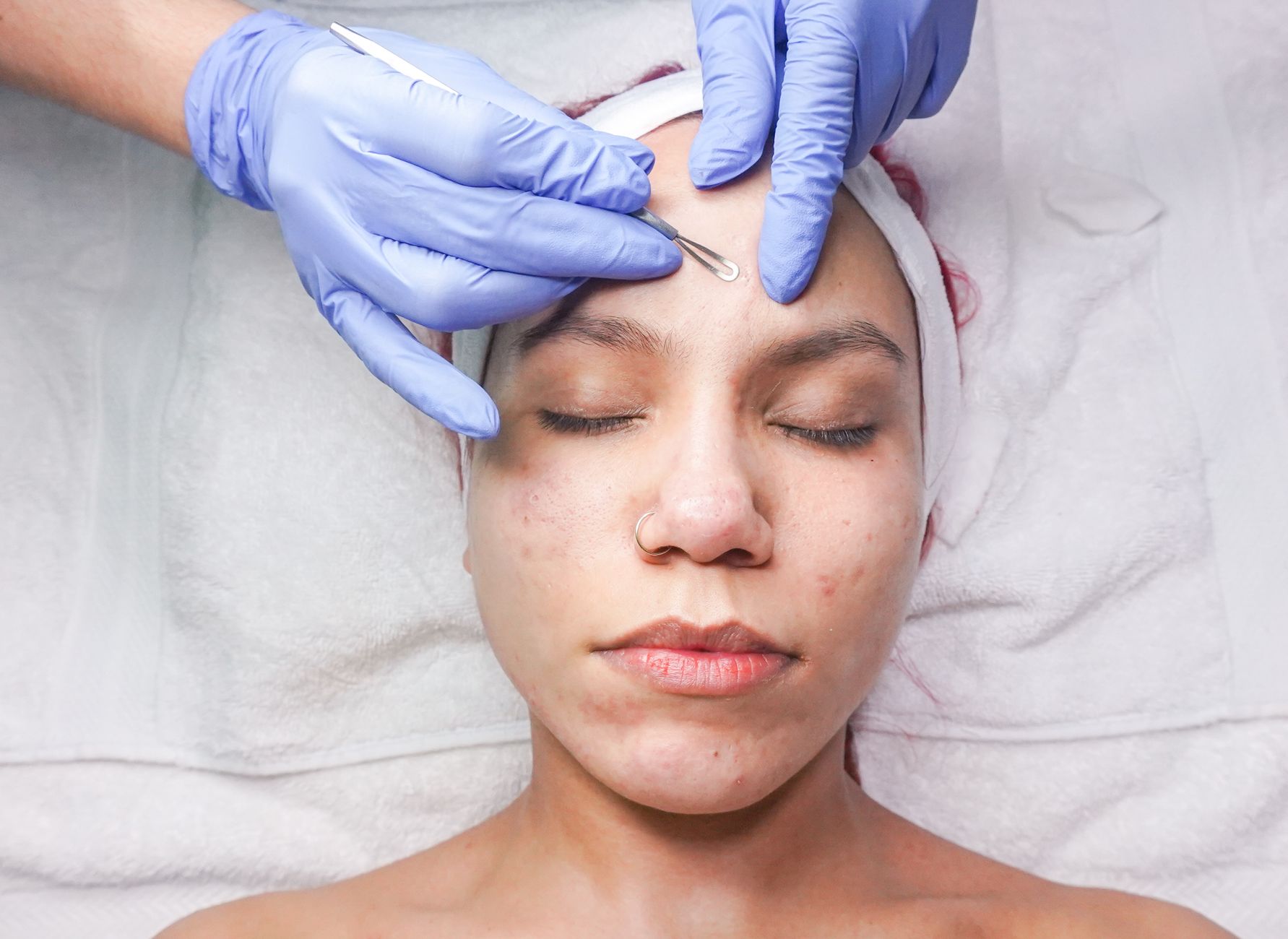
Forehead acne mostly means your forehead has more oil glands than the rest of your face — not that your whole face is "oily skin." The forehead, nose and chin form the T-zone, the region with the highest density of sebaceous (oil-producing) glands on the body, so breakouts concentrate there regardless of your overall skin type. Where a pimple appears is a poor tool for classifying skin. Skin typing systems measure oil output, hydration and barrier function directly, and a cluster of forehead bumps can just as easily point to a hair product, or to a fungal condition that is not acne at all.
Medical information disclaimer: This article is for general educational purposes only and does not provide medical advice, diagnosis, or treatment. Always consult a physician or other qualified health professional about symptoms, medications, tests, or treatment decisions.
Table of Contents
- Why the forehead breaks out more than the cheeks
- What forehead acne does not tell you about oiliness
- Hair products are a leading cause of forehead and temple breakouts
- When forehead bumps are not acne
- Face mapping is not a skin assessment
- Frequently Asked Questions
Why the forehead breaks out more than the cheeks
The forehead is simply denser in oil glands. Research by Ludovici and colleagues, published in Scientific Reports in 2018, puts facial sebaceous gland density at roughly 400–900 glands per square centimetre, against under 100 per square centimetre across most other skin. More glands means more sebum reaching more follicles, and more follicles that can plug. Acne itself works the same way everywhere on the body.
A 2023 review in Heliyon describes four interlocking mechanisms: excess sebum, hyperkeratinization (dead cells plugging the follicle opening), colonization by the bacterium *Cutibacterium acnes*, and inflammation. A forehead lesion is that shared process happening where the raw material is most abundant. So the honest reading of forehead acne is positional, not diagnostic. It tells you which part of your face has the most fuel for the process — which is true of nearly everyone.
What forehead acne does not tell you about oiliness
Pimple count is not a sebum measurement. The same Scientific Reports study cautions that gland density and measured oil output are not interchangeable: sebum abundance tracks gland density in general, but sebometer readings and follicle counts are not linearly correlated. Two people with identical forehead breakouts can have very different oil production. Formal skin typing reflects that.
In the Baumann Skin Type system, described in the Journal of Cosmetic Dermatology, "oily" means a measured rate of at least 1 mg of sebum per 10 cm² every three hours, and dryness is judged from the stratum corneum, natural moisturizing factor and hyaluronic acid as well. That is a four-way determination across oiliness, sensitivity, pigmentation and wrinkling — none of which a lesion map supplies. A Sebumeter study by Youn and colleagues in Skin Research and Technology found the forehead, nose and chin secrete significantly more sebum than either cheek, and proposed that this regional gap is what actually defines combination skin. The authors also noted that no accepted objective standard for skin typing existed. In other words, the T-zone/cheek difference is the real signal — acne location is a stand-in for it at best.
Hair products are a leading cause of forehead and temple breakouts
Before concluding anything about skin type, look at what sits above the hairline. Pomade acne — breakouts caused by oil-containing hair products — characteristically occupies the forehead and temples. A classic study by Plewig and colleagues in Archives of Dermatology found about 70% of long-term pomade users had a recognizable acneiform eruption there, histologically indistinguishable from ordinary acne vulgaris.
The culprit list is wider than pomade. The American Academy of Dermatology notes that shampoos, conditioners, gels, waxes, pastes and sprays commonly contain pore-clogging oils, and advises washing pillowcases, sheets and hats, since residue transfers to them and back onto skin. A practical test, run for a few weeks: If the breakouts fade, the cause was topical, and your skin type never changed.
- Switch to products labelled non-comedogenic, oil-free or won't clog pores.
- Rinse conditioner off thoroughly, and wash your face after rinsing your hair, not before.
- Apply styling product to hair away from the hairline, not scalp-first.
- Launder pillowcases, headbands and hat linings frequently.
- Keep fringes and bangs off the forehead while you test.
When forehead bumps are not acne
Itchy, uniform bumps that run up into the hairline are often *Malassezia* folliculitis — an overgrowth of a yeast inside the follicle. A retrospective review of 110 cases in the Journal of the American Academy of Dermatology documented 1–2 mm monomorphic papules and pustules, typically on the forehead extending into the hairline and on the upper back, confirmed by KOH preparation and clearing with azole antifungals rather than acne treatment. The distinguishing features are uniformity, itch and the absence of comedones (blackheads and whiteheads).
A 2025 review by Chalupczak and Lipner in the Journal of Fungi found the condition is routinely misdiagnosed, which leads to inappropriate antibiotic courses; a 320-patient acne-clinic study found itch 7.38 times more likely in *Malassezia* folliculitis than in acne vulgaris. This matters practically: if weeks of acne treatment have done nothing for itchy forehead bumps of identical size, the working diagnosis may be wrong, and the fix is a different drug class entirely. That is a question for a clinician who can run a KOH test, not a reason to layer on more benzoyl peroxide.
Face mapping is not a skin assessment
Face mapping reads forehead acne as a message from the digestive system or another internal organ. McGill University's Office for Science and Society classifies the practice as largely pseudoscience and notes that diet's effect on breakouts is quite small. The clinical view is that acne is nearly always multifactorial and is not treated by location.
Forehead acne and chin acne respond to the same tools — topical retinoids, benzoyl peroxide, salicylic acid, and prescription options where those fall short — because the underlying mechanism is the same. The useful version of paying attention to location is narrow and concrete: forehead and temples point you toward hair products and the hairline, and uniform itchy bumps point you toward a possible fungal cause. Neither one assigns you a skin type.
Frequently Asked Questions
Does forehead acne mean I should stop moisturizing?
No. Oiliness and dryness are judged separately from acne, and the Baumann system assesses hydration through stratum corneum and natural moisturizing factor measurements, not lesion counts. Use a non-comedogenic moisturizer.
How do I tell pomade acne from regular acne?
By distribution and timing. Pomade acne clusters on the forehead and temples near the hairline and improves when oily hair products stop; under a microscope, Plewig and colleagues found it indistinguishable from acne vulgaris.
Can a dermatologist measure my skin type objectively?
Partly. Sebumeter devices measure oil output directly, as in the Youn study, but the Skin Research and Technology authors noted there is no accepted objective standard for skin typing overall.