
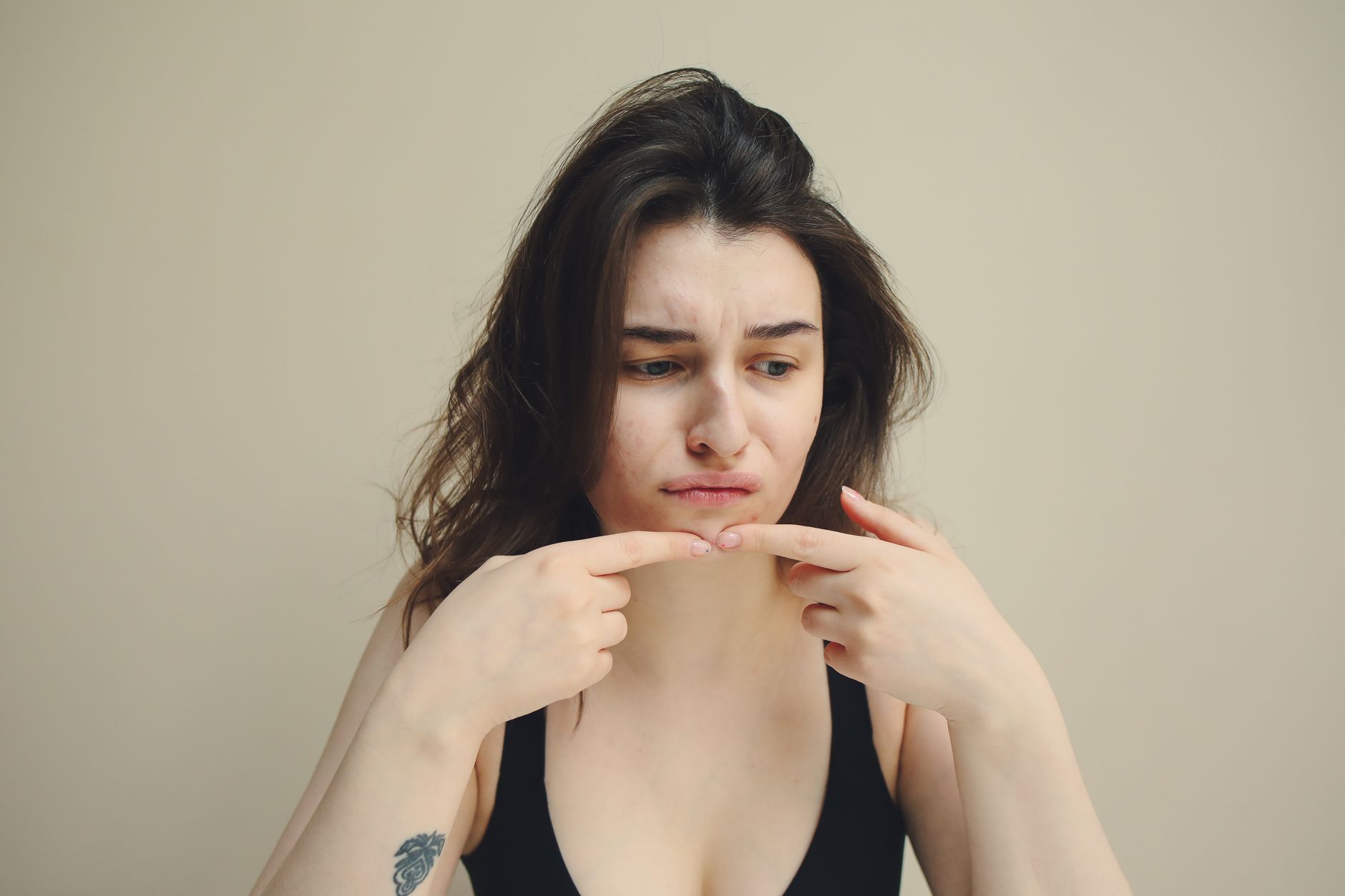
Jawline acne is a weak signal about your hormones on its own. Androgens — testosterone and related hormones that drive oil production — influence almost all acne, not just the kind that sits along your jaw, and most people with jawline breakouts have ordinary hormone levels.
What the location does tell you is worth knowing anyway. Acne that clusters on the lower face, flares before a period, and resists standard topical treatment often responds to hormone-directed therapy, even when blood tests come back normal. The pattern is a treatment clue, not a diagnosis.
Medical information disclaimer: This article is for general educational purposes only and does not provide medical advice, diagnosis, or treatment. Always consult a physician or other qualified health professional about symptoms, medications, tests, or treatment decisions.
Table of Contents
- The jawline pattern is less common than its reputation
- Why the hormone link is still real
- When jawline acne becomes an endocrine question
- What blood tests actually look for
- Normal labs do not rule out hormonal treatment
- Where hormonal treatment sits among the options
- Frequently Asked Questions
The jawline pattern is less common than its reputation
The idea that adult acne is a jawline condition comes from clinical impression rather than measurement. When researchers actually counted, the picture changed. In an international study of adult women seen in dermatology offices, published by Dréno and colleagues in the Journal of the European Academy of Dermatology and Venereology, only 11.2% had acne confined to the mandibular area — the jaw and lower cheeks. That subgroup was also the mildest.
Just 7.1% of the jawline-only group had moderate or worse acne overall, against 51.9% of everyone else. If your breakouts are limited to your jaw, you are statistically in the less severe group. The same study found mixed disease — inflamed pimples together with blackheads and whiteheads — was the commonest presentation, with only 6.4% having inflammatory lesions alone. The authors concluded the stereotype of adult female acne as hormonal, inflammatory and jaw-confined did not hold for most patients.
Why the hormone link is still real
Androgens are not a hypothesis about acne. They are an established drug target. On 26 August 2020 the FDA approved clascoterone cream 1%, sold as Winlevi, a topical androgen receptor inhibitor for acne vulgaris in patients aged 12 and up. It was the first acne drug with a genuinely new mechanism in roughly four decades.
That matters for interpretation. A cream that blocks androgen receptors in the skin works because oil glands respond to androgens locally — in normal people, at normal hormone levels. Your sebaceous glands can be androgen-sensitive without your bloodstream being abnormal. So "hormonal acne" describes a mechanism far more often than it describes a disorder. The hormones are involved in nearly everyone's acne; a measurable excess is a separate and much rarer finding.
When jawline acne becomes an endocrine question
Certain accompanying signs shift the problem from skin to hormones. The American Acne & Rosacea Society's status report on acne in adult women names the features that warrant looking for androgen excess: Acne with none of these is usually just acne. The same report states that laboratory testing is not mandatory in every case, and that the clinician should judge each one individually.
Specialties disagree on how freely to test. An Androgen Excess and PCOS Society task force paper, available through PubMed Central, recommends measuring total testosterone, free testosterone and DHEAS with high-quality assays in all women with adult acne, drawn when ovulation is not occurring — just before or during menses. Dermatology guidance is more selective. If you want testing and your dermatologist declines, that difference is the reason.
- Hirsutism — coarse hair growth in a male pattern, such as the chin, upper lip or chest
- Androgenetic alopecia, meaning thinning hair at the crown or a widening part
- Virilization, including a deepening voice or increased muscle bulk
- Periods that are infrequent (oligomenorrhea) or absent (amenorrhea)
- Difficulty conceiving
What blood tests actually look for
The basic panel is small. The AARS report describes DHEAS plus total and free testosterone as the starting point. DHEAS is an adrenal androgen; markedly raised levels point toward late-onset congenital adrenal hyperplasia, an inherited enzyme defect in the adrenal glands. A modest testosterone elevation more often reflects polycystic ovary syndrome, sometimes accompanied by an LH:FSH ratio of roughly 2.5:1 to 3:1.
Those are pituitary hormones that regulate ovulation, and the skewed ratio is a supporting clue rather than a requirement. Acne by itself does not diagnose PCOS. The 2023 International Evidence-Based PCOS Guideline, published in Human Reproduction, requires two of three features: irregular cycles, hyperandrogenism on examination or blood testing, and polycystic ovarian morphology on ultrasound — with mimicking disorders ruled out. The guideline puts PCOS prevalence at 10–13%, so it is common, but it is not what most jawline acne represents.
Normal labs do not rule out hormonal treatment
This is the part that confuses people most. Anti-androgen therapy can work when hormone levels are unremarkable, which is why many clinicians prescribe it without testing at all. The SAFA trial, reported in the BMJ by Santer and colleagues, randomised 410 women to spironolactone — a diuretic with anti-androgen effects — at 50 mg daily, rising to 100 mg at week six. Investigator-rated treatment success at week 12 was 19% versus 6% on placebo.
By week 24, 81.9% reported their acne had improved, against 63.3% on placebo. Headaches were more frequent on the drug: 20% versus 12%. Note the shape of those numbers. The investigator-rated success rate was modest and slow to arrive; the patient-reported benefit was much larger. Hormone-directed treatment here is a gradual improvement, not a clearance, and judging it before three months is premature.
Where hormonal treatment sits among the options
It is not the first thing to try. The 2024 American Academy of Dermatology acne guideline, summarised in the AAD's own announcement of the update, gives combined oral contraceptives and spironolactone only *conditional* recommendations — meaning the benefits are closely balanced against risks, cost and burden. What earns strong recommendations is more ordinary: topical benzoyl peroxide, topical retinoids, topical antibiotics and oral doxycycline.
A reader whose jawline acne has never been treated with a consistent retinoid plus benzoyl peroxide has not yet reached the point where the hormonal question is the useful one. A practical sequence follows from that. Treat the acne properly for twelve weeks with strongly recommended topicals; track your cycle and your breakouts on the same calendar; check yourself against the red-flag list above; and raise hormone testing specifically if any of those signs are present or your periods are irregular.
Frequently Asked Questions
Does acne on my chin and jaw mean I have PCOS?
Not by itself. PCOS diagnosis requires two of three features under the 2023 international guideline — irregular cycles, hyperandrogenism, and polycystic ovarian morphology — with other causes excluded. Acne is one possible sign of hyperandrogenism, not a standalone criterion.
Should I ask for a hormone blood test before trying treatment?
Guidance splits. Dermatology bodies treat testing as selective, reserved for cases with red flags such as hirsutism or irregular periods; the Androgen Excess and PCOS Society recommends it for all women with adult acne. Either way, normal results do not stop anti-androgen treatment from working.
How long before spironolactone shows an effect?
In the SAFA trial, the clear separation from placebo in patient-reported improvement came at 24 weeks, with a smaller investigator-rated difference at 12 weeks. Expect months, not weeks.
Is clascoterone cream an alternative to pills?
It is a topical androgen receptor inhibitor, FDA-approved in 2020 for ages 12 and older, so it acts on androgen signalling in the skin rather than body-wide. Whether it suits your case is a prescribing decision for your clinician.