
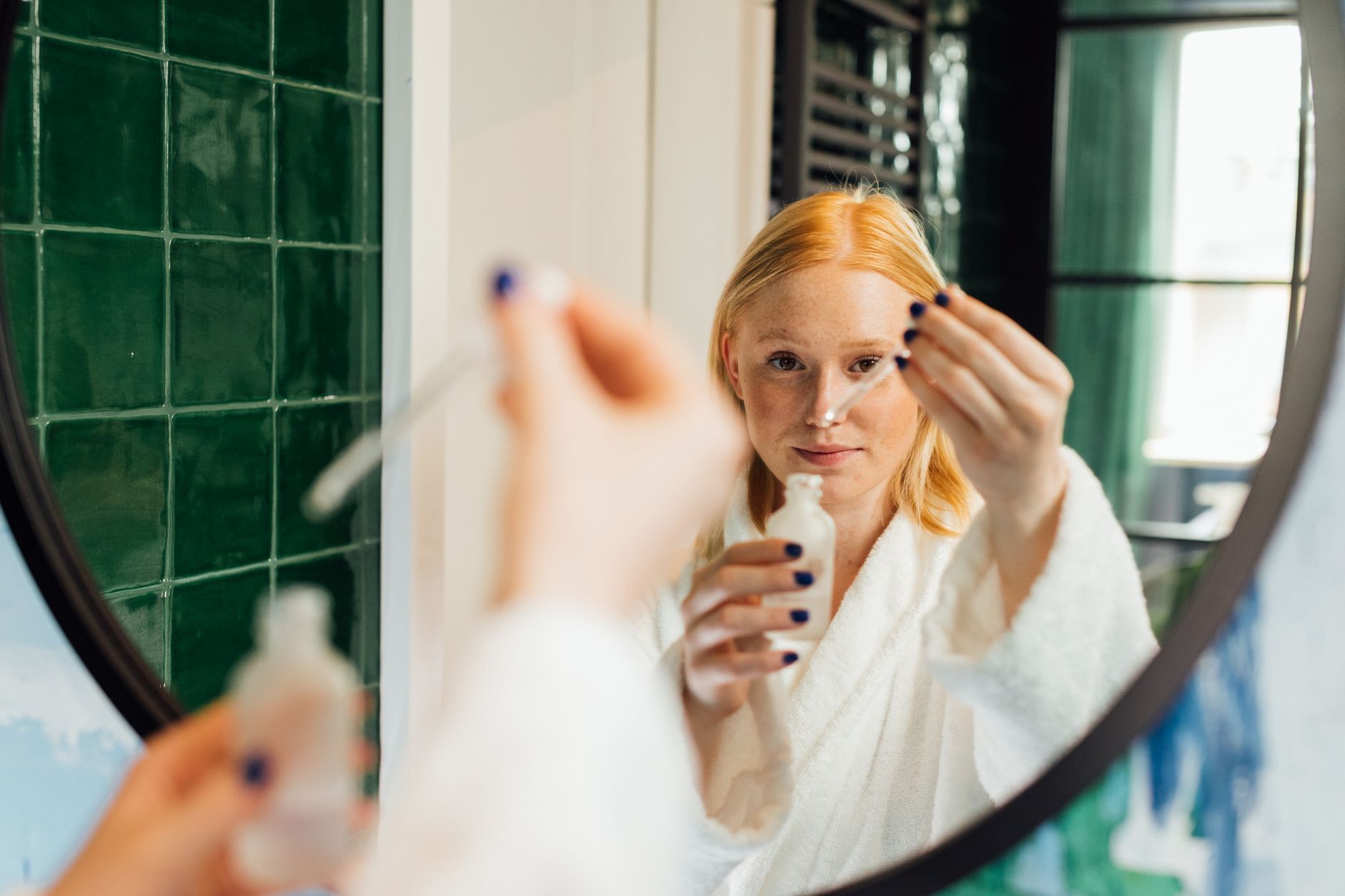
Salicylic acid is the better first choice for forehead breakouts caused by hairline contact — hair oils, pomades, sweat under hats, and dirty phone screens — because it works at the skin's surface to clear pores without the sun sensitivity retinoids carry. Retinol and prescription-strength retinoids work deeper, normalizing skin-cell turnover, and pull ahead for ongoing, widespread acne that isn't tied to a surface trigger. The forehead has its own common cause worth naming before picking an ingredient: contact with hair products. That changes which ingredient does more good, and it changes how you use either one.
Medical information disclaimer: This article is for general educational purposes only and does not provide medical advice, diagnosis, or treatment. Always consult a physician or other qualified health professional about symptoms, medications, tests, or treatment decisions.
Table of Contents
- What Each Ingredient Actually Does
- Why the Forehead Breaks Out Differently
- Which One Should You Start With
- Using Them Together, and What to Watch For
- What In-Office Treatment Adds
- Frequently Asked Questions
What Each Ingredient Actually Does
Salicylic acid is a beta-hydroxy acid that the FDA classifies, at concentrations of 0.5% to 2%, as a safe-and-effective single active ingredient for acne, alongside benzoyl peroxide and sulfur, under the FDA's OTC acne drug monograph. It dissolves the oil and dead-skin buildup inside a pore, which is why it works fast on surface-level clogged pores and blackheads. Retinol is a cosmetic, lower-strength form of vitamin A; the FDA does not regulate it as an acne drug.
The acne drug version is a topical retinoid — adapalene, sold as Differin Gel 0.1%, became the first retinoid the FDA approved for over-the-counter sale without a prescription, in July 2016, for ages 12 and up, according to the FDA's approval announcement. Retinoids bind receptors inside skin cells to speed up cell turnover, which stops microcomedones (the earliest, invisible stage of a clogged pore) from forming in the first place and calms existing inflammation. A 2005 review in the Journal of Drugs in Dermatology notes they don't reduce oil production directly the way oral retinoids do — they work on the pore lining, not the oil gland. That distinction matters for the forehead specifically: salicylic acid clears what's already clogging a pore, while a retinoid prevents the next clog from forming.
Why the Forehead Breaks Out Differently
Hair products are a documented, forehead-specific acne trigger. A study of 735 men who used hair pomades and oils long-term found about 70% developed an acne eruption concentrated on the forehead and temples, and under a microscope it was identical to ordinary acne, according to the original Archives of Dermatology study. This pattern has a name — pomade acne — and it explains why someone can have clear skin everywhere except a stubborn strip along the hairline.
A patient survey cited in a Journal of Drugs in Dermatology review found that among acne patients who used hair oil or pomade, 70.3% had forehead acne, out of 46.2% of all patients reporting hair-product use. That's a strong enough overlap that forehead breakouts deserve a different first question than breakouts elsewhere: what's touching your hairline, not just what's in your skincare routine. If one of these applies, switching products or washing the contact point more often addresses the cause; salicylic acid treats what's already there.
- Hair oils, pomades, and heavy styling creams that migrate onto the forehead
- Sweatbands, hat brims, and helmet straps that trap product and sweat against the hairline
- Bangs or a fringe resting directly on the skin
- Unwashed pillowcases picking up hair product overnight
Which One Should You Start With
For surface-level, contact-triggered forehead bumps, start with salicylic acid. It needs no sun precautions, and the FDA's monograph backs 0.5%–2% as a standalone treatment. For acne that isn't clearly tied to hair-product contact — spread across the forehead and other areas, or recurring regardless of what touches your hairline — a retinoid is the stronger long-term choice.
The American Academy of Dermatology's 2024 acne-management guideline gives topical retinoids a "strong recommendation," grouping them with benzoyl peroxide, topical antibiotics, and oral doxycycline. Salicylic acid, by contrast, gets only a "conditional recommendation," grouped with azelaic acid and clascoterone, according to the AAD guideline published in the Journal of the American Academy of Dermatology. That gap in recommendation strength reflects a larger body of evidence behind retinoids for acne overall, not a verdict on forehead breakouts specifically.
- Pick salicylic acid first if: breakouts track with hair products, hats, or sweat along the hairline
- Pick a retinoid first if: breakouts are ongoing, spread beyond the hairline, or haven't responded to spot treatment
- Expect a retinoid to take longer to show results, since it works on cell turnover rather than dissolving existing buildup
Using Them Together, and What to Watch For
The AAD's guideline includes a good-practice recommendation to combine agents with different mechanisms rather than lean on one ingredient alone — the clinical rationale for pairing a retinoid with salicylic acid or benzoyl peroxide. Applied to the forehead, that can mean salicylic acid as a cleanser or spot treatment where hair products make contact, with a retinoid applied more broadly at night.
Sun sensitivity is the key difference in daily use. The FDA's approval for Differin Gel specifically advises users to apply sunscreen and avoid sunburn, because retinoids increase the skin's sensitivity to sun — a precaution salicylic acid alone doesn't require. If you combine the two, that sunscreen requirement still applies.
- Start a retinoid a few nights a week before going nightly, since irritation is more common early on
- Keep salicylic acid as the hairline-specific step if hair products are the trigger
- Apply sunscreen every morning once a retinoid is in the routine
- Avoid applying both on irritated or broken skin at the same time
What In-Office Treatment Adds
For acne that doesn't respond to either ingredient at home, a split-face trial of 30 patients with inflammatory acne compared an in-office 5% retinoic-acid peel on one side of the face against a 30% salicylic-acid peel on the other. Across repeated sessions, the retinoic-acid side performed better on acne-severity scores and patient satisfaction, according to the trial published in BMFJ. This was a professional peel, not a daily leave-on product, so it doesn't change the at-home comparison — but it points to a provider-administered retinoid as the next step if OTC treatment on the forehead stalls.
Frequently Asked Questions
Can I use salicylic acid and retinol on the same day?
Yes, but apply them at different times (one AM, one PM, or salicylic acid as a rinse-off cleanser) to limit irritation, and use sunscreen daily once a retinoid is in the mix.
Is cosmetic retinol as strong as a prescription retinoid for forehead acne?
No. Retinol is a weaker vitamin-A derivative the FDA doesn't regulate as an acne drug, while adapalene (Differin) is an FDA-approved retinoid drug for acne.
My forehead acne only shows up along my hairline — does that change the answer?
Yes. A hairline-only pattern points toward hair-product contact as the trigger, which salicylic acid addresses directly; spreading beyond the hairline points toward a retinoid.