
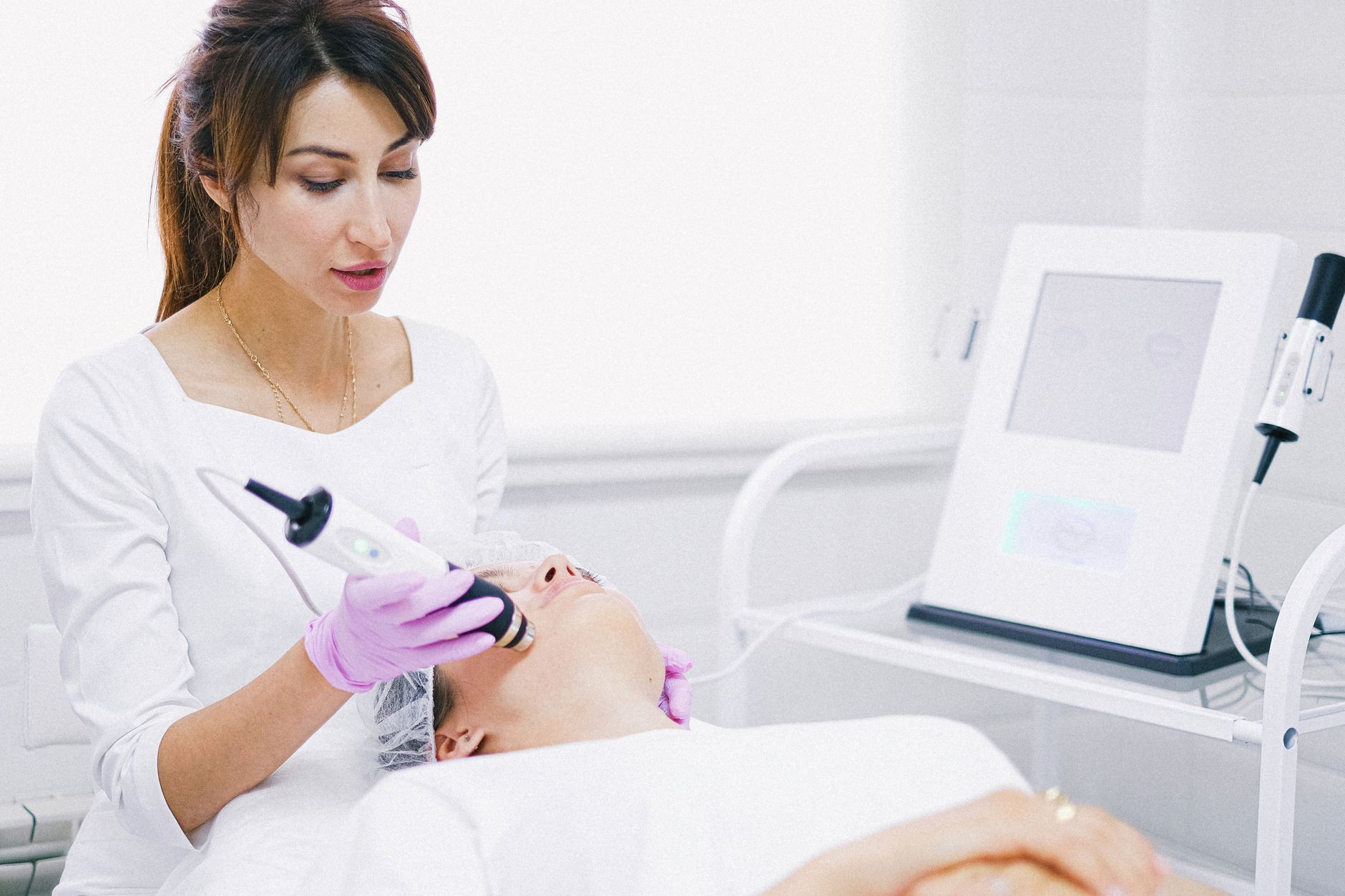
Current evidence supports laser treatment for acne scars, with the clearest benefit for fractional CO2 laser on indented scars. Deep icepick scars improve least with laser alone and often need combination treatment. Atrophic scars are indented scars that form when inflamed acne destroys collagen. Fractional resurfacing treats tiny columns of skin and leaves nearby skin intact, which triggers new collagen and smoother texture.
Medical information disclaimer: This article is for general educational purposes only and does not provide medical advice, diagnosis, or treatment. Always consult a physician or other qualified health professional about symptoms, medications, tests, or treatment decisions.
Table of Contents
- Which indented scars improve most?
- How does fractional CO2 compare with other energy options?
- What helps raised, red scars?
- What are the main risks and recovery issues?
- What does a typical treatment course involve?
Which indented scars improve most?
Rolling scars have broad, sloping dips. Superficial boxcar scars have round or oval dips with defined edges. The Journal of Cutaneous and Aesthetic Surgery reports that these two types respond best to fractional CO2 alone, in a 2014 scar-type review. Deep pitted scars and icepick scars are narrow and sharply recessed.
They respond least to single-method laser treatment. People with mainly these scars should expect a plan that adds another procedure. Blinded ratings show measurable change in depth and texture after fractional CO2. MDedge Dermatology, reporting a split-face trial, found lower texture and atrophy scores on treated skin at 1, 3 and 6 months, in a split-face trial report. Patients in that trial rated texture as mildly or moderately improved.
How does fractional CO2 compare with other energy options?
A Dermatologic Surgery meta-analysis of 8 studies found no significant difference between fractional CO2 and non-CO2 laser therapies. Clinical improvement, observer ratings, patient ratings, and post-inflammatory hyperpigmentation were similar across groups. A retrospective analysis citing a Cochrane review, published in Life MDPI, places fractional lasers about equal to fractional radiofrequency for acne scars. The same analysis finds fractional lasers superior to non-fractional non-ablative lasers.
Ablative CO2 and Er:YAG lasers remain preferred for deeper scars, despite longer recovery. The practical point is match, not brand. Shallow rolling and boxcar scars give several fractional options a fair chance. Deeper scars need stronger ablation or combination care, plus more downtime.
What helps raised, red scars?
Raised acne scars sit above the skin surface. Redness, itching, and pain can persist around them. Pulsed-dye laser targets blood vessels that keep these scars red and thick.
The American Academy of Dermatology states that pulsed-dye laser safely flattens raised acne scars and reduces redness, itching, and pain across skin colors, in its acne scar treatment guideline. Multiple sessions are often necessary for better results. Ask how many visits your scar type usually needs before you start.
What are the main risks and recovery issues?
Post-inflammatory hyperpigmentation, darkening after inflammation, is the main limitation of fractional CO2 treatment. The Indian Dermatology Online Journal reports about 30% affected on fractional-CO2-treated sides versus 6.7% for microneedling in skin of color, in a skin-of-color comparison. Transient redness, crusting, and swelling also occur. Risk is higher with darker skin tone, recent sun exposure, and aggressive settings.
Strict sun protection lowers the chance of prolonged pigment change. Tell your dermatologist about prior dark marks, melasma, and keloids. Recovery often involves several days of redness and flaking. Crusts should fall off on their own without picking. Call promptly for spreading pain, pus, blistering, or pigment change that worsens after two weeks.
What does a typical treatment course involve?
A prospective Cureus protocol used 3 fractional CO2 sessions spaced 4 weeks apart. At 3-month follow-up, scar texture, pigmentation, and overall appearance had improved, with only minimal self-limited side effects.
Single-trial results do not promise the same result for every scar pattern. Bring these checks to your visit:.
- Ask which scar types dominate your cheeks, temples, or jawline.
- Ask whether laser alone fits, or whether icepick scars need another method.
- Ask how many sessions, what interval, and what downtime to expect.
- Ask how pigment risk will be managed for your skin tone.