
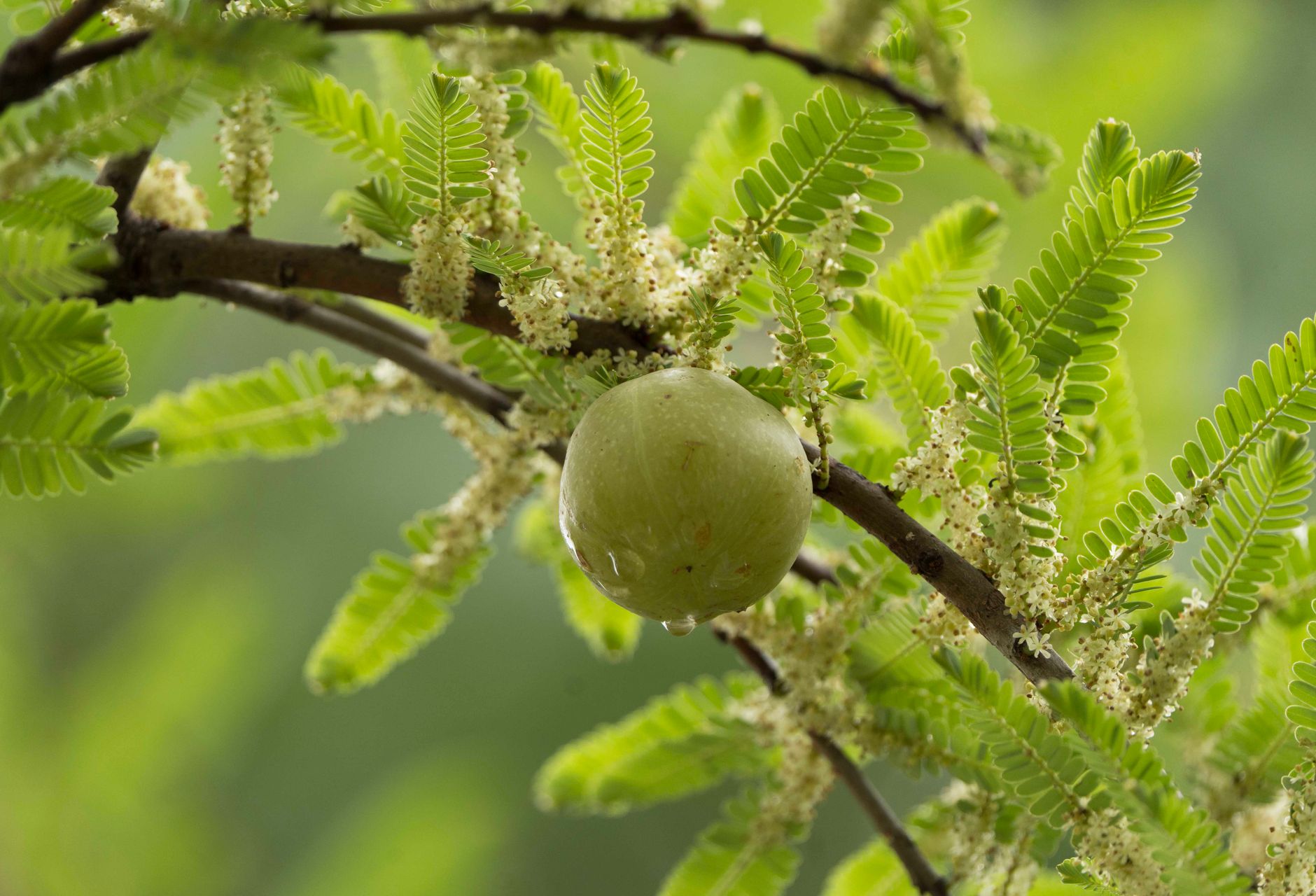
A 2026 randomized, double-blind, placebo-controlled trial tested an oral Ayurvedic preparation of *Phyllanthus emblica* (Nelli, or amla) and *Tinospora cordifolia* (Rasakinda, or guduchi) in adults with postadolescent acne — and it did not show a significant benefit over placebo on its main outcome. Lesion counts fell in a dose-dependent way, but the gap between the herbal product and placebo was not statistically significant, so the trial cannot be read as evidence that the supplement clears acne.
What it did establish is safety. Across 12 weeks, blood work stayed within normal ranges and no serious or treatment-related side effects were reported. That is a real result, and it matters for a plant product many adults already take — but safety is not efficacy, and the two are easy to blur when a study is summarized.
Medical information disclaimer: This article is for general educational purposes only and does not provide medical advice, diagnosis, or treatment. Always consult a physician or other qualified health professional about symptoms, medications, tests, or treatment decisions.
Table of Contents
- What was actually tested, and in whom
- Why a dose-dependent drop still isn't proof
- The size problem cuts both ways
- The safety result is the usable finding
- Why this doesn't transfer to the amla capsules on the shelf
- What to do with this if you have adult acne
- Frequently Asked Questions
What was actually tested, and in whom
The trial, published in 2026 and indexed in PubMed as "Efficacy and Safety of Phyllanthus Emblica and Tinospora Cordifolia in Postadolescence Acne," randomized 88 volunteers to one of four arms: a standardized oral decoction product called Link Natural Swastha Amurtha (LNSA) at 300 mg, 400 mg or 500 mg total solids daily, or placebo, for 12 weeks. A decoction is a water extract made by simmering plant material — here, dried Nelli fruit and fresh Rasakinda stem. The participants were narrowly defined.
Per the Sri Lanka Clinical Trials Registry record, eligibility required men and non-pregnant, non-nursing women over 25 years old with mild-to-moderate facial acne and at least five lesions — whiteheads, blackheads, papules or pustules. "Postadolescent acne" means acne that persists or begins after the teenage years, a pattern that disproportionately affects adult women. That framing sets the boundary. Nothing in this trial speaks to severe or nodulocystic acne, to teenagers, or to acne on the back and chest.
Why a dose-dependent drop still isn't proof
The primary endpoint was change in total lesion count from baseline to week 12. Lesion counts did fall in a dose-dependent pattern with LNSA — more drug, more reduction — which is the shape you expect from a real pharmacological effect. But the difference against placebo did not reach statistical significance, meaning the result is compatible with chance. Placebo arms in acne trials routinely improve.
Acne fluctuates on its own, people enrolled in a study wash their faces more carefully and stop picking, and lesion counting has measurement noise. That is exactly why the placebo comparison, not the before-and-after change, is the number that counts. The same logic applies to the quality-of-life finding. All three LNSA dose groups improved significantly on patient-reported quality of life compared with their *own baseline* — a within-group comparison with no control arm attached. Feeling better about your skin after twelve weeks of taking something and being watched by a research team is precisely what a placebo produces.
The size problem cuts both ways
With 88 participants split across four arms — roughly 22 per group — this was a dose-ranging study, not a definitive efficacy trial. Dose-ranging studies exist to find a tolerable dose and look for a signal worth pursuing, and they are typically too small to detect modest differences reliably. So the null result should not be read as proof the product does nothing.
A real but modest effect could easily hide in a trial this size. The honest summary is that the trial did not demonstrate efficacy, which is a different statement from "demonstrated no efficacy." The methodology was otherwise sound in ways that make the result more trustworthy, not less. The study was registered prospectively as SLCTR/2022/025 in a WHO ICTRP primary registry and approved by the Ethics Review Committee of the Faculty of Medicine, University of Colombo, with recruitment and follow-up running January to June 2023. Prospective registration matters because it fixes the primary endpoint in advance, making it much harder to quietly promote a secondary finding after the fact.
The safety result is the usable finding
Laboratory parameters stayed within normal reference ranges for the full 12 weeks, and no serious or treatment-related adverse events were reported. The authors concluded LNSA was safe and well tolerated with dose-related beneficial effects. That is worth something on its own.
Oral herbal products are frequently taken for skin without any controlled safety data behind them, and liver enzymes in particular are a live concern with botanical supplements. A 12-week placebo-controlled study with clean bloodwork is better evidence of tolerability than most supplements on a pharmacy shelf can point to. It still has limits. Twelve weeks says little about a year of daily use, 88 people cannot detect rare reactions, and the trial excluded pregnant and nursing women outright — so it offers no reassurance for that group.
Why this doesn't transfer to the amla capsules on the shelf
The product tested was a specific commercial preparation made by traditional decoction of dried Nelli fruit and fresh Rasakinda stem, standardized by total solids. Per the trial registry record, the doses were defined that way — 300, 400 or 500 mg of total solids daily — not as grams of raw herb. Herbal products are not interchangeable across formats.
A capsule of dried amla powder, a guduchi tincture and a water decoction contain different compounds at different concentrations, and a topical made from either plant is a different intervention entirely. Results from this trial do not carry over to amla or guduchi capsules, powders or topicals of different composition and dose. If you are considering one of these products, it helps to be concrete about what you are buying:.
- Check whether the label names a standardized extract and a dose, or just an herb and a weight — the trial used the former.
- Note that this study combined two plants; a single-herb amla product was not tested.
- Be aware that oral herbal products can interact with prescription medication, including some acne treatments.
- Keep any existing treatment going rather than substituting; nothing here showed the supplement matched a proven therapy.
What to do with this if you have adult acne
The practical read is that this trial does not give a reason to change an acne regimen. If a topical retinoid, benzoyl peroxide, a prescription, or a dermatologist-directed plan is working, this evidence does not compete with it, and a null primary endpoint is not a reason to swap anything out. If you are already taking a Nelli-and-Rasakinda preparation and finding it tolerable, the safety data is mildly reassuring for that specific kind of product over about three months.
It is not a reason to raise the dose chasing the dose-response pattern, since that pattern never separated from placebo. The result most worth watching for is a larger, adequately powered trial of the same product. A dose-ranging study that shows safety and a directional signal is exactly the setup that justifies one — and that is where the question of whether this actually works will be settled. Anyone tracking it can follow the record at the published study's DOI listing.
Frequently Asked Questions
Does the trial mean the supplement definitely doesn't work for acne?
No. It means efficacy was not demonstrated. With roughly 22 people per arm, the study was too small to rule out a modest real effect, so the question is open rather than answered.
Why did the quality-of-life improvement not count as a win?
Because it compared each group against its own baseline instead of against placebo. People in placebo arms report feeling better too, so an uncontrolled before-and-after change cannot show the product caused the improvement.
Were there side effects?
None serious or treatment-related were reported, and laboratory values stayed within normal ranges across the 12 weeks. That applies to this specific preparation at up to 500 mg total solids daily, over three months.
Would this apply to acne on the chest or back, or to cystic acne?
No. Eligibility was limited to mild-to-moderate facial acne with at least five lesions in adults over 25, so severe and nodulocystic acne fall outside what was studied.
You Might Also Like
- The 2026 Trial of Phyllanthus Emblica and Tinospora for Acne: Who Was Studied and Who Was Not for Adults With Persistent Acne
- The 2026 Trial of Phyllanthus Emblica and Tinospora for Acne: How Adults With Persistent Acne Can Compare Treatment Options
- The 2026 Trial of Phyllanthus Emblica and Tinospora for Acne: How Adults With Persistent Acne Can Avoid Overreading the Headline