
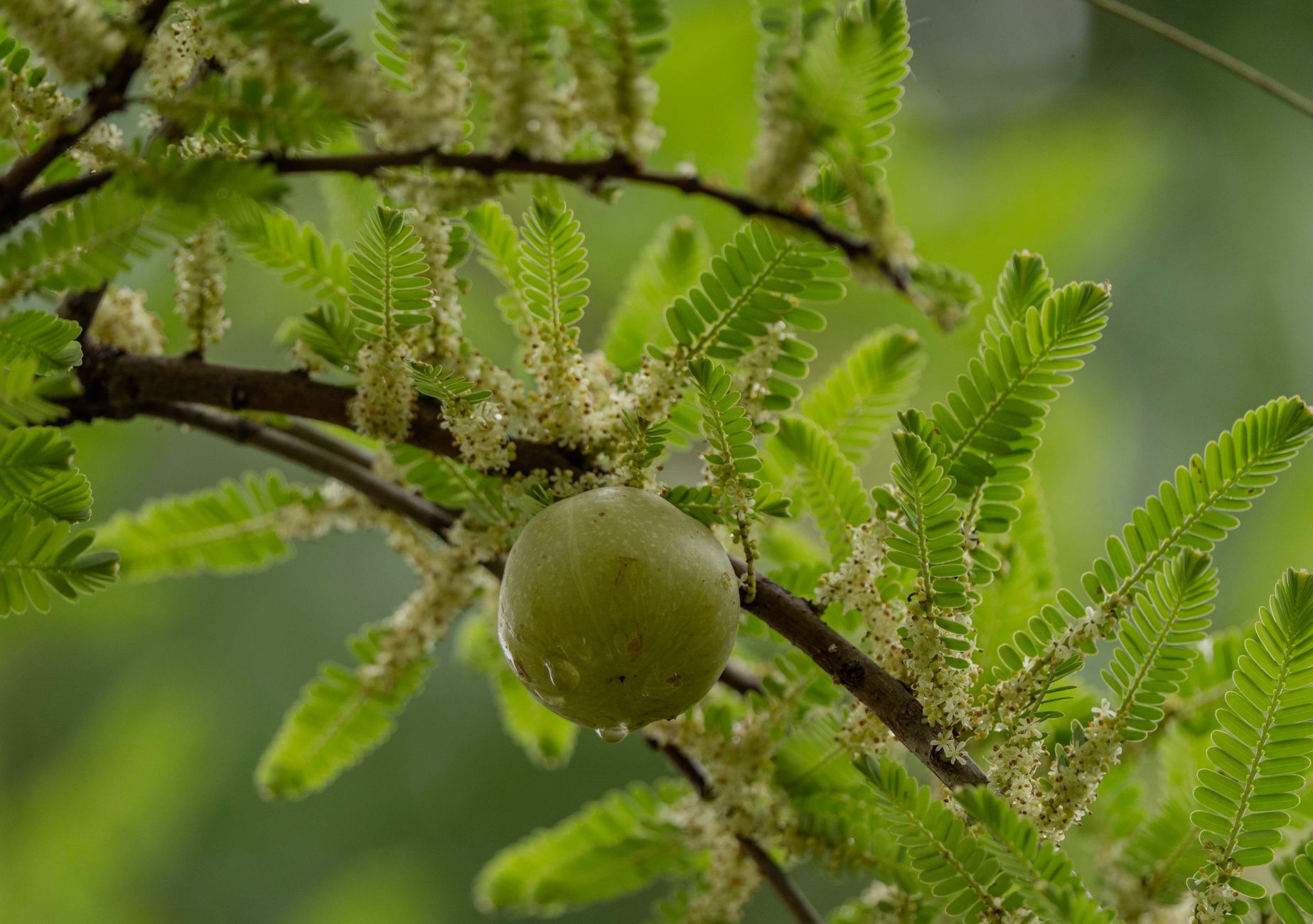
A 2026 randomized, double-blind, placebo-controlled trial tested an oral herbal formulation of *Phyllanthus emblica* (Indian gooseberry, or nelli) and *Tinospora cordifolia* (rasakinda) in adults over 25 with persistent acne — and the active doses did not beat placebo on lesion counts. The people studied were men and non-pregnant, non-nursing women above 25 with mild-to-moderate facial acne; the people excluded were anyone on isotretinoin or retinoids in the prior six months and anyone on hormonal therapy, including oral contraceptives, in the prior three months. That exclusion matters more than the headline result. It removes the two groups whose adult acne is most often managed by a dermatologist, which means the trial speaks to a narrower reader than the title suggests.
Medical information disclaimer: This article is for general educational purposes only and does not provide medical advice, diagnosis, or treatment. Always consult a physician or other qualified health professional about symptoms, medications, tests, or treatment decisions.
Table of Contents
- What the trial actually tested
- Who was eligible, and who was screened out
- The result, stated plainly
- The quality-of-life finding
- Where and when it was run
- What to do with this if you are over 25 with persistent acne
- Frequently Asked Questions
What the trial actually tested
The study was an investigator-initiated, randomized, double-blind, placebo-controlled dose-ranging trial in postadolescence acne, published in 2026 by Achala Liyanage, Nuwan Darshana, Nadeeka Chandraratne and Jennifer Perera in SAGE's Journal of Integrative and Complementary Medicine. "Dose-ranging" means the goal was to find which dose, if any, produces an effect — not to confirm one already known to work. Eighty-eight volunteers were randomized to the standardized formulation at 300 mg, 400 mg or 500 mg daily, or to placebo, for 12 weeks.
According to the PubMed record of the trial, the primary endpoint was the change in total acne lesion count from baseline to week 12. The product is LNSA (Link Natural Swastha Amurtha), a traditional decoction of dried nelli fruit and fresh rasakinda stem, manufactured by Link Natural Products (Pvt) Ltd. Its registration on the Sri Lanka Clinical Trials Registry lists it as a Phase 2 trial — an early-stage study, not a confirmatory one.
Who was eligible, and who was screened out
The registry's eligibility criteria define the readers this trial describes. Enrollment was open to males and non-pregnant, non-nursing females above 25 years of age, with mild-to-moderate facial acne and at least five lesions — whiteheads, blackheads, papules or pustules. That sets two hard boundaries.
Adolescents were not studied at all, and neither was severe or nodulocystic acne, the kind that forms deep, painful lumps and scars. The exclusions cut deeper: Adult acne in women over 25 is frequently treated hormonally — combined oral contraceptives and spironolactone are standard tools. Excluding recent hormonal therapy removes a large share of exactly that population, so the trial does not tell you how the formulation performs alongside, or instead of, hormonal treatment.
- Anyone using topical or oral isotretinoin or other retinoids within the previous 6 months
- Anyone on hormonal therapy, including oral contraceptives, within the previous 3 months
- Anyone with a known allergy to the product's ingredients
The result, stated plainly
The investigators reported a dose-dependent reduction in acne lesion counts with the formulation — more product, fewer lesions, in the expected direction. But the differences between the active arms and placebo did not reach statistical significance. "Not statistically significant" means the gap between the herbal arms and placebo was small enough that chance is a reasonable explanation for it.
With 88 participants split across four arms, roughly 22 per group, the study was small — small studies can miss real but modest effects, and they can also make random noise look like a trend. The practical reading: on the measure the trial was built to answer, efficacy was not demonstrated. A dose-response pattern is a reason to run a larger study, not a reason to treat the question as settled in the product's favor.
The quality-of-life finding
Secondary endpoints covered inflammatory and non-inflammatory lesion counts, acne severity, sebum production and quality of life. The authors single out significant improvement in patient-reported quality of life as the noteworthy positive finding. This deserves care.
Quality-of-life scores are self-reported, and in a 12-week trial where participants know they may be receiving an active treatment, expectation influences how people rate their own skin. A secondary endpoint that reaches significance while the primary one does not is a hypothesis for the next study, not a claim to act on. It is still a real observation. If your acne is mild-to-moderate and your main burden is how it makes you feel rather than the lesion count itself, this is the part of the trial closest to your concern — with the caveat that the placebo group's experience is the comparison that matters, and lesion counts did not separate.
Where and when it was run
Conduct was in Sri Lanka over roughly six months, January to June 2023, with results published in 2026. The lead author is a specialist dermatologist in the Department of Community Medicine, Faculty of Medicine, University of Ruhuna, Galle. Setting shapes generalizability.
A single-country trial of a traditional Ayurvedic decoction, in a population where that formulation is familiar, does not automatically transfer to a different climate, diet, skin-type distribution or baseline treatment pattern. It also shapes availability. LNSA is a specific manufactured preparation, not a generic amla-and-guduchi supplement off a shelf. Capsules sold under those ingredient names elsewhere are not the tested product and were not tested at these doses.
What to do with this if you are over 25 with persistent acne
The formulation was reported safe and well tolerated, with dose-related benefit, but without placebo-beating lesion-count evidence. That is a tolerability signal, not an efficacy result.
Before considering any oral herbal product for acne, check yourself against what the trial did and did not cover: If none of those apply and you want to try it, treat it as an addition to a proven routine rather than a replacement for one, and give any existing topical treatment the 12 weeks this trial used before judging results. Tell whoever prescribes for you what you are taking, since herbal preparations can interact with medications and are not tracked on a pharmacy record.
- **You took isotretinoin or a retinoid in the last six months** — outside what was tested; your skin is still responding to that course.
- **You are on or recently stopped hormonal contraception** — outside what was tested, and hormonal therapy has its own evidence base for adult acne worth discussing with a clinician.
- **Your acne is severe or nodulocystic** — not studied; deep, scarring lesions warrant dermatology care, not a supplement trial.
- **You are pregnant or nursing** — excluded from the trial, so there is no safety or efficacy data here for you.
- **You are under 25** — the trial was postadolescence acne only.
Frequently Asked Questions
Does this mean the formulation does not work?
It means efficacy was not demonstrated in this trial. An 88-person Phase 2 study can miss a modest real effect; it also cannot confirm one. The honest position is that the question remains open and a larger trial would be needed to settle it.
Can I buy amla and guduchi capsules and expect the same thing?
No. The tested product was LNSA, a specific decoction of dried nelli fruit and fresh rasakinda stem made by Link Natural Products. Dose and preparation differ across commercial supplements, and the trial's doses were 300, 400 and 500 mg daily of that standardized formulation.
Why does the hormonal-therapy exclusion matter so much?
Persistent acne after 25 is disproportionately hormonal, and combined oral contraceptives are a common treatment. Excluding anyone on hormonal therapy within three months means the trial's population is adults managing acne without that route — a narrower group than "adults with persistent acne."
You Might Also Like
- The 2026 Trial of Phyllanthus Emblica and Tinospora for Acne: Safety and Monitoring Questions for Adults With Persistent Acne
- The 2026 Trial of Phyllanthus Emblica and Tinospora for Acne: How Adults With Persistent Acne Can Compare Treatment Options
- The 2026 Trial of Phyllanthus Emblica and Tinospora for Acne: How Adults With Persistent Acne Can Avoid Overreading the Headline