
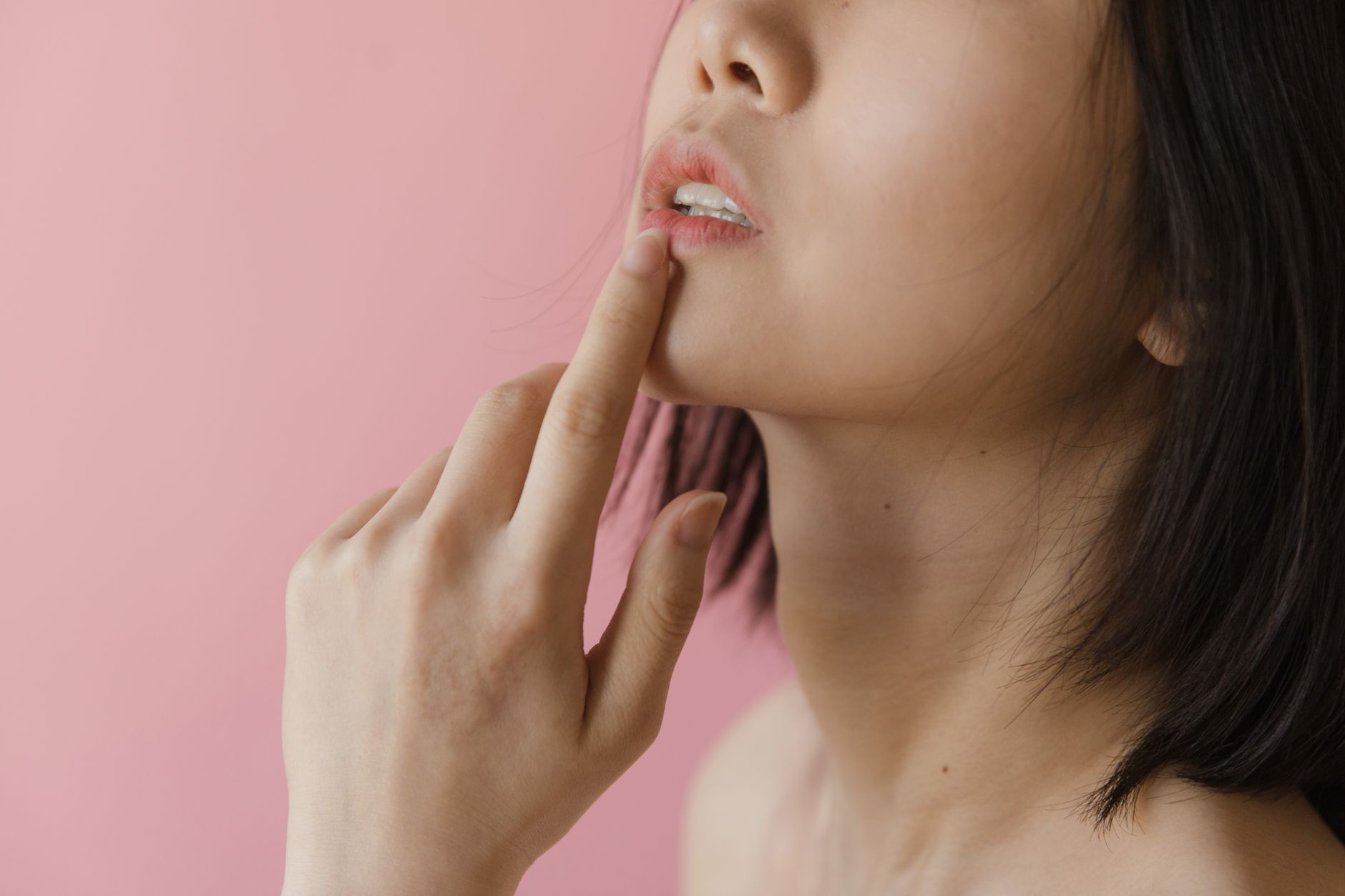
Jawline acne in women is driven mainly by androgen-sensitive oil glands reacting to hormonal shifts — menstrual cycles, pregnancy, perimenopause, menopause, and starting or stopping birth control. In men, the same androgen sensitivity is a constant baseline rather than a fluctuating one, so breakouts spread across the face and trunk instead of clustering along the jaw, and a sudden jawline-heavy flare usually points to an external androgen source such as testosterone therapy or anabolic steroids. The jawline, chin and lower cheeks are described in dermatology as the mandibular area, and they carry a dense supply of oil glands whose receptors respond to androgens — the hormone group that includes testosterone. Where the two sexes differ is not the mechanism but the trigger, the timing and the pattern, and that distinction changes which treatment makes sense.
Medical information disclaimer: This article is for general educational purposes only and does not provide medical advice, diagnosis, or treatment. Always consult a physician or other qualified health professional about symptoms, medications, tests, or treatment decisions.
Table of Contents
- Why the jawline specifically?
- What drives it in women
- What drives it in men
- Testosterone therapy and the first-year window
- When jawline acne warrants a workup
- What to do differently based on the pattern
- Frequently Asked Questions
Why the jawline specifically?
Androgens tell sebaceous glands to produce more oil, and more oil plus trapped dead skin cells plus *Cutibacterium acnes* bacteria produces inflamed, deep, often tender lesions. The mandibular skin has a high concentration of these glands, which is why rising or swinging androgen levels tend to show there first. That said, the popular picture of hormonal acne as a neat jawline-only pattern is not what most adult women actually have. In a prospective international study of 374 women aged 25 and older seen for acne, published in *JEADV*, only 11.2% had lesions confined to the mandibular area while 89.8% had acne across multiple facial zones — the authors concluded the jawline-only stereotype did not describe the majority.
You can read the Dréno et al. study abstract for the full breakdown. The practical takeaway: acne on your cheeks and forehead as well as your jaw does not rule out a hormonal driver. Distribution alone is a weak diagnostic signal.
What drives it in women
The American Academy of Dermatology attributes adult female acne largely to fluctuating hormones — around menstruation, during pregnancy, through perimenopause and menopause, and after starting or stopping birth control pills — and notes in its adult acne guidance that adult acne is most common in women going through menopause. These are shifts, not necessarily abnormal levels, which is why blood tests often come back normal in women with clear cyclical breakouts. Adult acne is predominantly a female presentation.
Collier et al.'s survey of US adults aged 20 and over found acne more common in women than men in every age band, including 35.2% of women versus 20.1% of men at ages 30–39, as reported in the *Journal of the American Academy of Dermatology*. Within that same 374-woman cohort, the mandibular-only group was a distinct subtype: milder overall (7.1% rated moderate or worse, versus 50.1% of the multi-zone group), with less chest and back involvement (19.0% versus 51.9%), higher self-reported daily stress, and roughly twice the rate of leaving the visit with an anti-androgen prescription (16.7% versus 7.7%). So jawline-dominant acne in women is less severe but more likely to be treated hormonally.
What drives it in men
Men's androgen levels are high and relatively steady after puberty, so adult male acne rarely arrives as a discrete jawline flare tied to a cycle. The signature male pattern is wider: a large adult analysis found truncal acne — on the back and chest — in 76.1% of males versus 54.1% of females, an odds ratio of 2.70 (95% CI 2.22–3.28), described in a review of truncal acne prevalence and burden. When a man does develop a sharp new lower-face flare, exogenous androgens are the first thing to consider.
Melnik et al.'s review of anabolic–androgenic steroid abuse in *JDDG* cites a fitness-club study in which 43% of users reported acne, and the pattern often involves large, inflamed nodules on the jaw, neck, shoulders and back. Supplements sold as "test boosters" or prohormones can do the same thing with no label warning. Beard care and shaving matter too. Razor irritation, ingrown hairs and heavy occlusive beard oils produce jawline and neck bumps that look like acne and respond to different measures — and folliculitis from shaving is a common misdiagnosis in men who treat themselves for acne for months without improvement.
Testosterone therapy and the first-year window
Starting testosterone is the clearest controlled demonstration that androgen exposure raises acne risk, and the evidence is specific about timing. In a study of 988 transgender patients beginning masculinizing testosterone therapy, acne prevalence was 31.1% overall, with cumulative incidence of 19.0% at one year and 25.1% at two years, highest in the youngest patients — reported by Thoreson et al. in *JAMA Dermatology*.
A matched electronic-health-record cohort published in *JAMA Dermatology* in January 2026 put five-year cumulative acne incidence at 15.8% in transmasculine patients on testosterone, versus 3.8% in cisgender men and 10.5% in cisgender women, with risk concentrated in the first year after starting. That concentration is actionable. Anyone beginning testosterone can raise skin with their prescriber before or at the start of therapy rather than waiting for breakouts, since the highest-risk period is short and well defined, and acne treatment does not require stopping or reducing hormone therapy.
When jawline acne warrants a workup
Most cyclical jawline acne needs treatment, not investigation. But a persistent lower-face pattern alongside other androgen-excess signs is worth an endocrine evaluation.
Polycystic ovary syndrome affects roughly 5–10% of women and accounts for more than 80% of women presenting with hyperandrogenism, according to StatPearls on NCBI Bookshelf; hirsutism is its most common skin sign, with acne less frequent. Signs that justify asking for bloodwork rather than another topical: A sudden, severe flare with other rapid changes — voice deepening, clitoral enlargement, marked muscle gain — should be assessed promptly rather than at a routine appointment.
- Irregular, absent or unpredictable menstrual cycles
- Coarse hair growth on the chin, upper lip, chest or abdomen
- Hair thinning at the crown or temples
- Acne that appeared or worsened abruptly in adulthood with no clear trigger
- Deep nodules that scar, or acne that has not responded to several months of standard treatment
What to do differently based on the pattern
For cyclical, jawline-dominant acne in women, treatments that act on hormones tend to outperform surface-only routines: combined oral contraceptives and spironolactone (an anti-androgen) are the standard prescription options, and the mandibular-only subgroup in the *JEADV* cohort was in fact the group most likely to receive one. A topical retinoid remains the base layer in either case, and all of these take two to three months to show their effect. For a face-plus-trunk pattern, treatment has to reach the trunk. Back and chest acne needs body-scale options — a medicated wash, a spray or lotion formulation, or oral therapy — because a pea-sized amount of facial cream will not cover it.
Stress is a modifier, not a cause. The AAD states plainly in its guidance on stress and skin that stress does not cause acne but can worsen it, because stress hormones increase oil production — notable given that the mandibular-only group also reported more psychologically stressful jobs (71.4% versus 57.5%). Managing stress is a reasonable adjunct and a poor substitute for treatment. One concrete step before changing anything else: write down the start date of each flare for two or three months alongside your cycle, any new supplement, and any hormone dose change. A pattern that lines up with a cycle argues for hormonal treatment; one that lines up with a supplement or a dose change points at the androgen source instead.
Frequently Asked Questions
Does toothpaste, pillowcase hygiene or phone use cause jawline acne?
Friction and occlusion from a phone, chinstrap or helmet can aggravate existing lesions, but they do not explain a cyclical lower-face pattern. If breakouts track your cycle, the driver is hormonal and surface habits will not resolve them.
Will stopping birth control clear my skin or make it worse?
The AAD lists both starting and stopping birth control pills among the hormonal shifts that trigger adult female acne, so either direction can cause a flare. Discuss the timing with your prescriber and expect several months before skin settles.
I'm a man with jawline-only acne and no steroid use. What now?
Rule out shaving-related folliculitis and ingrown hairs first, since both mimic acne on the jaw and neck. If lesions are genuinely acne, standard topical retinoid and antimicrobial treatment applies — male acne has no hormonal-treatment equivalent to spironolactone.