
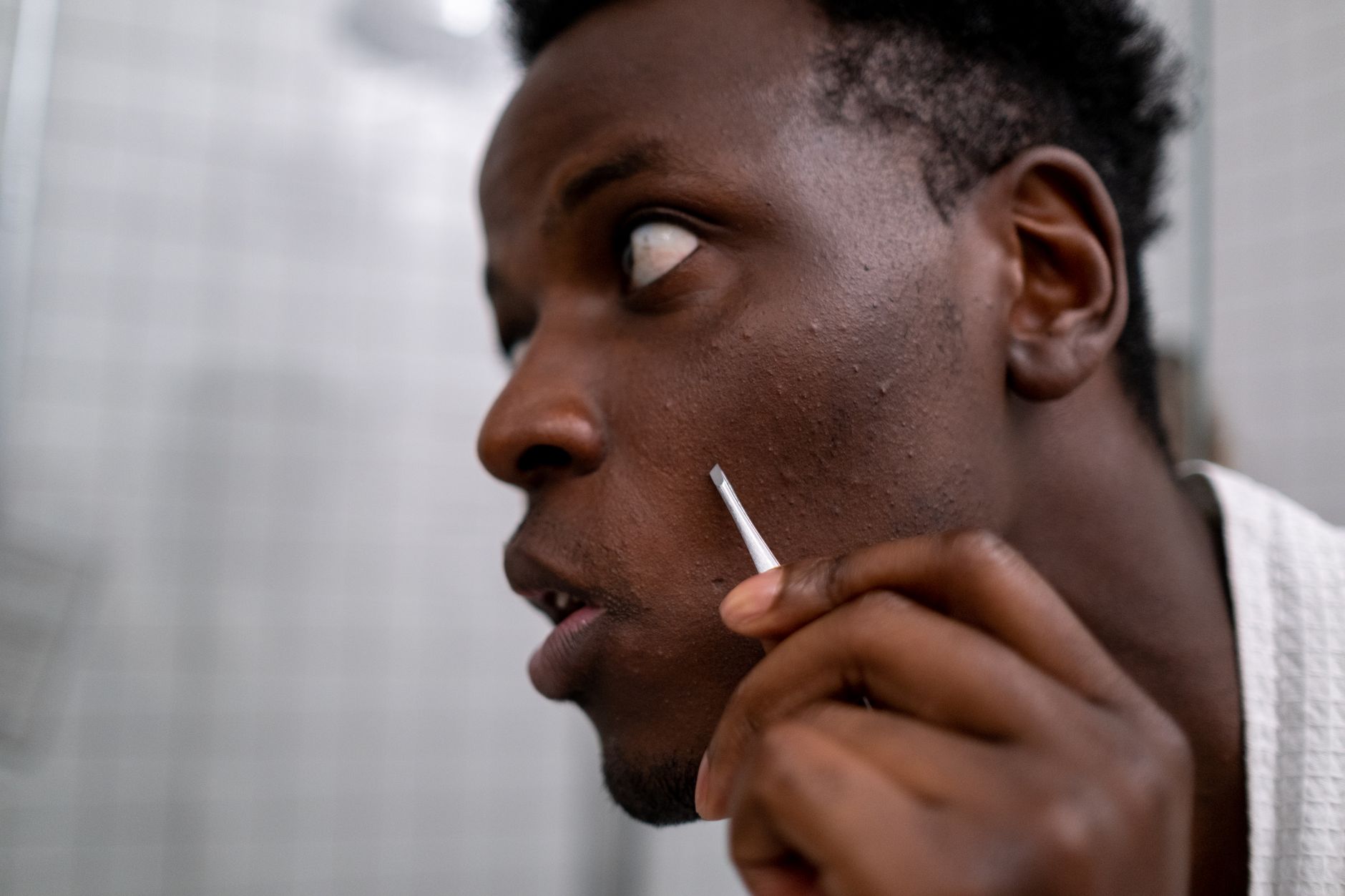
Whiteheads are closed comedones — pores plugged with oil and dead skin that stay sealed at the surface — and the treatment that has the strongest evidence behind it in 2026 is a topical retinoid, usually over-the-counter adapalene, paired with benzoyl peroxide or salicylic acid. The American Academy of Dermatology tells patients to treat them with acne medication rather than squeezing, because picking produces more lesions and scarring.
The harder part of the answer is how confident anyone can be. The trial evidence for these products is real but weaker than the marketing implies, the FDA has flagged two distinct safety issues in recent years, and the strengths you can buy without a prescription are capped by regulation. This guide sets out what is established, where the evidence thins out, and what to ask before you spend money on a routine.
Medical information disclaimer: This article is for general educational purposes only and does not provide medical advice, diagnosis, or treatment. Always consult a physician or other qualified health professional about symptoms, medications, tests, or treatment decisions.
Table of Contents
- What a whitehead is, and what actually clears it
- How strong is the evidence, really?
- The benzene recalls — what was and was not affected
- The rarer safety issue most labels do not make obvious
- Why you cannot just buy something stronger
- Questions to ask before you buy or at an appointment
- Frequently Asked Questions
What a whitehead is, and what actually clears it
A comedo forms when oil and shed skin cells block a follicle. If the plug stays covered by skin, it appears as a small white or flesh-coloured bump — a whitehead, or closed comedo. If the plug is exposed to air and oxidises, it darkens into a blackhead, or open comedo. The AAD's consumer guidance for comedonal breakouts is an over-the-counter retinoid such as adapalene to unclog the pore, plus benzoyl peroxide or salicylic acid, and it tells readers to allow six to eight weeks before judging whether the routine worked and considering a dermatologist.
That waiting period is not padding. Comedones take weeks to form, so a product that works is still clearing a pipeline of lesions that were already underway when you started. The AAD's updated acne guideline, published January 30, 2024 in the *Journal of the American Academy of Dermatology*, strongly recommends topical retinoids and endorses combining topicals that work by different mechanisms. Retinoids carry the strongest recommendation in that guideline; salicylic acid carries only a conditional one, with 0.5% salicylic acid producing roughly an 11% greater reduction in open comedones than vehicle at 12 weeks.
How strong is the evidence, really?
Weaker than the category's ubiquity suggests. The 2020 Cochrane review of topical benzoyl peroxide pooled 120 studies covering 29,592 people with mild-to-moderate acne and rated the efficacy evidence low certainty, with adverse-event evidence mainly very low certainty. The reviewers cited high or unclear risk of bias, small trials, inconsistent results, and suspected publication bias. Low certainty does not mean the product does nothing.
It means the true effect could differ substantially from the pooled estimate. The same review found benzoyl peroxide may beat placebo on self-reported improvement — three trials, 2,234 participants, over 10 to 12 weeks — but showed little to no difference against adapalene or clindamycin. That comparison is the practically useful finding. The question "should I use a topical?" has a clearer answer than "which topical?" If a product you tolerate is not working after two months, the evidence gives you no strong reason to expect a different first-line topical to be dramatically better, which is the point at which a dermatologist visit buys you more than another shelf purchase.
The benzene recalls — what was and was not affected
On March 11, 2025 the FDA reported testing 95 benzoyl peroxide acne products and found that more than 90% had undetectable or extremely low levels of benzene. Six products were voluntarily recalled at the retail level, including specific lots of La Roche-Posay Effaclar Duo, Walgreens Acne Control Cleanser, two Proactiv products, and SLMD Benzoyl Peroxide Acne Lotion. The word "retail-level" carries the practical meaning.
The recall asked retailers to pull stock; consumers were not told to discard products already at home, other than expired ones. The lot numbers and expiry dates define what was affected — not the brand name on the tube. So a bottle of Effaclar Duo in your bathroom is not automatically a recalled product. If you want to check one, match the lot number and expiry date printed on the packaging against the FDA notice rather than assuming the brand is implicated, and replace anything past its expiry date regardless.
The rarer safety issue most labels do not make obvious
Separately from benzene, the FDA warns that over-the-counter topical acne products can cause rare but potentially life-threatening hypersensitivity reactions. These are not the familiar stinging and peeling. Signs appear anywhere from minutes to a day after use: Of 131 reports the agency received through early 2013, 44% required hospital treatment and 38% were classed as anaphylaxis.
The FDA could not determine whether the reactions came from the active ingredients — benzoyl peroxide or salicylic acid — the inactive ingredients, or a combination. That limitation matters for what you do next: switching to a different brand with the same actives is not a reliable safeguard after a serious reaction. The practical step is to test a new product on a small area for a few days before applying it widely, and to treat any breathing or swelling symptom as an emergency rather than an irritation to push through.
- Throat tightness or trouble breathing
- Feeling faint or collapsing
- Swelling of the eyes, face, lips or tongue
- Hives or itching over areas well beyond where the product was applied
Why you cannot just buy something stronger
Over-the-counter strengths are set by the FDA's topical acne monograph M006, which caps benzoyl peroxide at 2.5% to 10% and salicylic acid at 0.5% to 2% and mandates specific Drug Facts warnings. A higher-strength version of these actives is not legally sold without a prescription, so a premium price on a shelf product is not buying you more drug.
Within that range, higher is not automatically better either. Benzoyl peroxide at 2.5% is commonly used precisely because it irritates less, and irritation is the most common reason people abandon a routine before the six to eight weeks the AAD asks for.
Questions to ask before you buy or at an appointment
If a product is well tolerated and the skin is still producing whiteheads after two months, that is the signal the AAD describes for seeing a dermatologist — prescription retinoids, combination prescriptions and oral options sit outside the monograph caps and are decided in a consultation, not on a shelf.
- Does this product contain a retinoid, or only an exfoliant? Adapalene is the ingredient the 2024 AAD guideline recommends most strongly for comedones.
- What are the lot number and expiry date, and does either appear in the FDA's March 2025 recall notice?
- Have I actually given the current routine six to eight weeks of consistent use, or have I switched products three times in that window?
- If two topicals are combined, do they work by different mechanisms? The 2024 guideline endorses multimodal therapy, not two products doing the same job.
- Has anything I applied ever caused swelling or breathing trouble? If so, tell the clinician, and do not assume another brand with the same actives is safe.
Frequently Asked Questions
Is it ever safe to extract a whitehead at home?
The AAD's guidance is to treat comedones with acne medication instead of squeezing them, because picking causes more lesions and scarring. Extraction is a procedure a clinician can perform, not a home routine.
Should I stop using benzoyl peroxide because of benzene?
FDA testing of 95 products found over 90% had undetectable or extremely low benzene, and the six recalls were retail-level and lot-specific. Check your lot number and expiry date against the FDA notice rather than abandoning the ingredient.
Salicylic acid or benzoyl peroxide for whiteheads?
The 2024 AAD guideline gives salicylic acid only a conditional recommendation, with 0.5% delivering about an 11% greater reduction in open comedones than vehicle at 12 weeks. Neither is the strongest-recommended option — a topical retinoid is.