

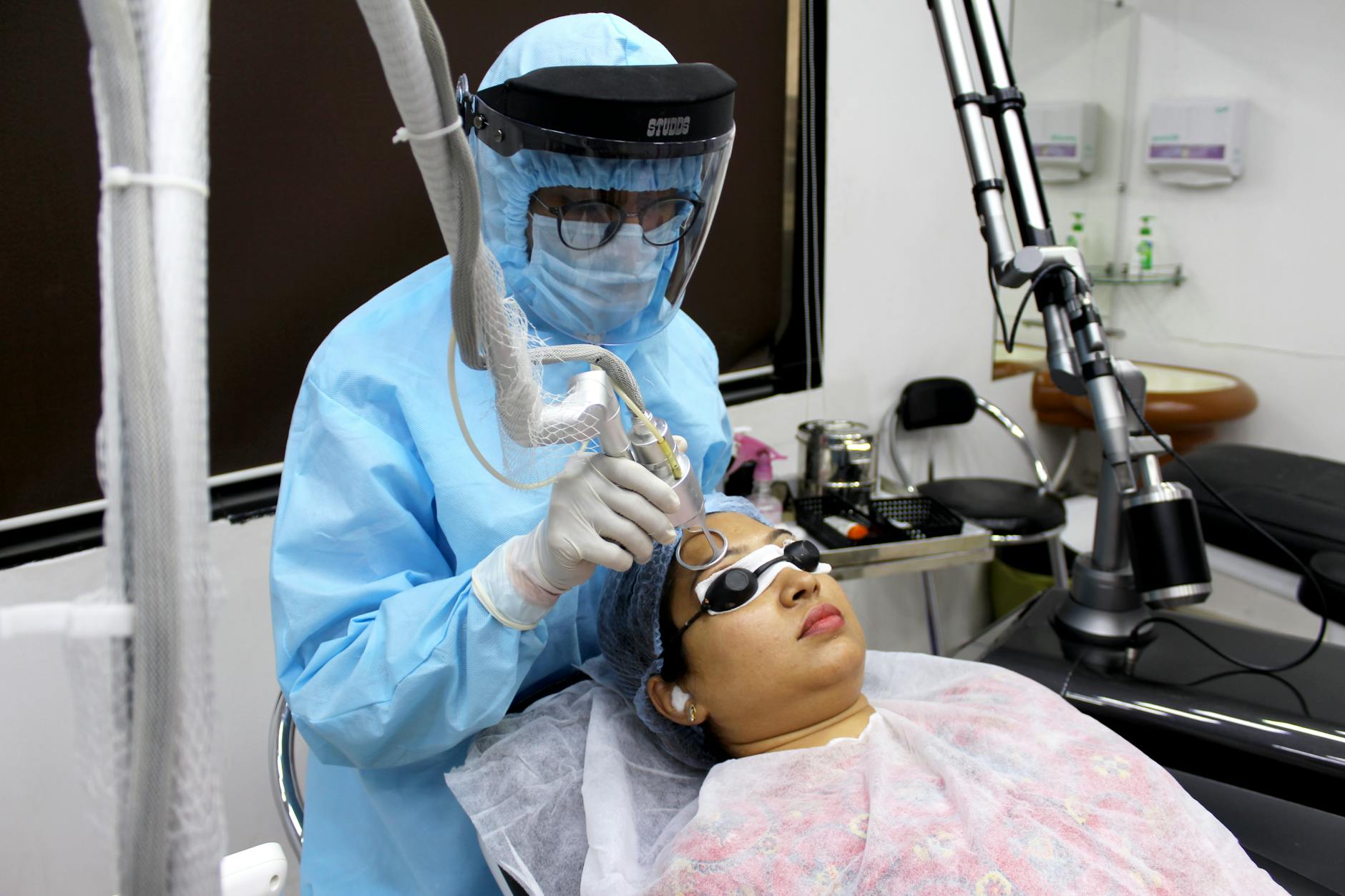
The grid pattern you see on your skin after fractional laser treatment isn’t a mistake—it’s the signature of the treatment design itself. Fractional laser technology works by delivering laser energy in a precise grid of microscopic, focused beams. Each beam creates what dermatologists call a Microscopic Treatment Zone (MTZ), a column of controlled thermal injury surrounded by untreated healthy skin. This intentional spacing is what allows fractional lasers to achieve dramatic skin rejuvenation while keeping recovery time relatively short.
Rather than treating your entire face at once (which would require weeks of downtime), fractional lasers typically treat only 15-25% of your skin surface in that grid pattern, letting the surrounding healthy tissue accelerate healing and regeneration. The visible grid marks are a temporary part of the healing process, not a permanent side effect. After fractional CO2 laser treatment for acne scars, sun damage, or wrinkles, you’ll see crusting and redness in that grid pattern for the first few days to a week. Understanding why this pattern appears—and how quickly it resolves—can help you feel more confident during the healing phase and set realistic expectations for results. This article covers how the grid is created, why dermatologists chose this approach, what to expect during healing, and how to manage complications.
Table of Contents
- How Does Fractional Laser Create the Grid Pattern on Skin?
- Why Is Fractional Spacing More Effective Than Full-Surface Laser Treatment?
- What Does the Visible Grid Pattern Look Like During Healing?
- How Should You Care for Your Skin During the Grid Pattern Phase?
- What Complications Can Occur and Who Is at Higher Risk?
- Does Skin Tone Affect the Grid Pattern Appearance and Healing?
- What Can You Expect Beyond the First Week?
- Conclusion
How Does Fractional Laser Create the Grid Pattern on Skin?
The grid pattern exists because of how fractional laser technology is engineered. Instead of one continuous beam sweeping across your face, fractional lasers emit dozens or hundreds of tiny beams in a predetermined grid formation. Each microscopic beam is intensely focused, delivering concentrated energy to create a Microscopic Treatment Zone—a narrow column of thermal damage that penetrates into the dermis (the skin layer beneath the surface) without damaging the surrounding tissue. For example, if you were to look at a cross-section of treated skin under magnification, you’d see columns of injured tissue spaced apart in a regular grid, with healthy skin cells in between.
This grid spacing isn’t random; it’s calculated based on the device settings and the treatment goal. A fractional laser treating 20% of the skin surface means that 80% remains untouched, which is why the grid pattern is visible. The pattern you see on the surface reflects the arrangement of these microscopic treatment zones underneath. Different devices and settings create different grid densities—some produce a finer, tighter grid while others create a more visible, wider-spaced pattern. The density affects both the aggressiveness of the treatment and the appearance of the grid marks during healing.
Why Is Fractional Spacing More Effective Than Full-Surface Laser Treatment?
The fractional grid approach exists for one fundamental reason: speed of healing. When dermatologists treat 100% of the skin surface with a continuous laser (called ablative laser resurfacing), the entire epidermis and upper dermis are removed or vaporized. Healing takes 2-3 weeks or longer, with significant downtime, crusting, and temporary disfigurement. With fractional treatment, untreated skin between the grid zones acts as a biological bridge for healing. Healthy cells from the untouched areas migrate into the treated zones, bringing growth factors and regenerative compounds that accelerate recovery.
Most patients experience crusting and redness for 3-7 days with fractional treatment, compared to 2-3 weeks for full-surface approaches—a dramatic difference that makes fractional lasers practical for people who can’t afford extended downtime. However, if your goal is the most aggressive resurfacing possible—such as treating severe scarring or advanced sun damage—you may need multiple fractional sessions rather than a single full-surface treatment. The trade-off is gradual improvement with minimal downtime versus faster, more dramatic results with longer recovery. Additionally, the healing speed advantage applies mainly to ablative fractional lasers (like CO2 and erbium). Non-ablative fractional lasers have even faster healing—sometimes just redness for a few hours—but also milder results. Your dermatologist will choose the type and settings based on your skin concern and how much downtime you can tolerate.
What Does the Visible Grid Pattern Look Like During Healing?
The grid pattern manifests primarily as erythema—redness—in the days immediately after treatment. The thermal injury from the laser beams triggers vasodilation, meaning blood vessels in and around the treated zones dilate and bring oxygen and immune cells to facilitate repair and regeneration. This hyperemia (increased blood flow) is why treated skin appears as a fine, grid-like pattern of red lines or patches immediately after the procedure. If you look closely in the mirror on day one after fractional CO2 laser, you’ll see the grid of redness mapped exactly onto your skin, following the treatment pattern.
As healing progresses over the next 3-7 days, this redness is accompanied by crusting and sometimes oozing at the treated sites. The crust is composed of denatured collagen and dead skin cells being sloughed off as part of normal wound healing. The grid pattern may become more pronounced as the crusts form along the columns of treated tissue, creating a visible lattice across your face or treatment area. By day 5-7, the erythema (which normally resolves within 3 days) fades significantly, and the crusts slough off as your skin naturally sheds dead tissue. By day 10, most people have minimal visible grid marks, though some residual pinkness may linger for 2-3 weeks depending on skin tone and treatment intensity.
How Should You Care for Your Skin During the Grid Pattern Phase?
The first 3-7 days after fractional laser treatment are critical for protecting healing tissue and preventing infection or complications. Your dermatologist will recommend a strict aftercare protocol: gentle cleansing with lukewarm water and a mild cleanser, frequent application of healing ointment or prescribed topical treatment, and religious sunscreen use (SPF 30+, reapplied every 2 hours). Do not pick at crusts or attempt to remove them manually—let them slough off naturally. Pulling off crusts prematurely can disturb the healing process, increase infection risk, and potentially cause scarring or post-inflammatory hyperpigmentation (dark marks where the grid pattern was). Avoid makeup, exfoliants, active ingredients like retinoids or vitamin C, and strenuous exercise during the healing phase.
These can irritate healing tissue, increase inflammation, or delay the natural crust shedding process. If you experience any signs of infection—pus, increasing warmth, or pain beyond mild tenderness—contact your dermatologist immediately. For patients with darker skin types, be especially vigilant about post-inflammatory hyperpigmentation, which occurs in some cases and manifests as darkening of the treated grid areas. Your dermatologist may prescribe hydroquinone or other lightening treatments if this occurs. The grid pattern itself is not a sign of complications; it’s simply the visible trace of the healing process unfolding as intended.
What Complications Can Occur and Who Is at Higher Risk?
While fractional laser is considered a relatively safe procedure with a low complication rate, temporary side effects do occur. A comprehensive study of 961 fractional laser treatments found that acneiform eruptions (small pimple-like bumps) occurred in 1.87% of treatments, and herpes simplex virus (cold sore) reactivation occurred in 1.77% of treatments. These are temporary complications that resolve with appropriate treatment—acne-like bumps typically fade within 1-2 weeks, and herpes outbreaks respond to antiviral medication. More commonly, some patients experience temporary post-inflammatory hyperpigmentation (darkening of the treated areas), which is more frequent in patients with darker or more reactive skin types.
If you have a history of herpes simplex virus, discuss prophylactic antiviral medication with your dermatologist before treatment; preventive therapy significantly reduces reactivation risk. Patients with very sensitive skin or history of keloid scarring should also discuss fractional laser safety with their provider beforehand. Importantly, fractional laser treatment is associated with minimal permanent sequelae—most side effects are temporary and resolve completely without long-term scarring or significant permanent marks. The grid pattern itself is not a complication; it’s an expected part of healing. True complications are rare, and when they do occur, they’re typically manageable with appropriate aftercare and medical attention.

Does Skin Tone Affect the Grid Pattern Appearance and Healing?
Skin tone significantly influences how visible the grid pattern appears during and after healing, and it affects which complications are most common. In lighter skin types, the erythema (redness) is more visible as a bright red grid, and fades relatively quickly. In darker skin types, the redness is less visible against the skin tone, but post-inflammatory hyperpigmentation becomes a greater concern. The thermal injury from fractional laser can trigger melanin production in people with darker skin, causing the grid areas to darken temporarily as they heal.
This hyperpigmentation typically appears 1-2 weeks after treatment and gradually fades over weeks to months, but can be more noticeable and longer-lasting than in lighter skin types. Dermatologists experienced in treating diverse skin types often adjust laser settings for darker skin to reduce the risk of hyperpigmentation while still achieving the desired therapeutic effect. Some may use lower energy settings or longer intervals between treatments. If hyperpigmentation does develop, topical treatments like hydroquinone, kojic acid, or vitamin C serums can help fade it more quickly. It’s essential to discuss your specific skin type and pigmentation concerns with your dermatologist before treatment so they can customize the approach and provide tailored aftercare recommendations.
What Can You Expect Beyond the First Week?
The visible grid pattern fades dramatically after the first week, but the actual skin rejuvenation process continues for weeks and months. By week 2-3, any remaining erythema has usually resolved, and you can typically resume light makeup and normal skincare. However, new collagen formation—the mechanism that creates the skin-smoothing and scar-reduction benefits—peaks around 12 weeks after treatment and continues for up to 6 months. This means your skin will continue to improve in texture, firmness, and appearance well beyond the time the grid marks disappear.
Many patients find that fractional laser results look best 3-6 months after treatment, once all the remodeling is complete. Looking forward, recent 2025 expert consensus in dermatology confirms that fractional CO2 laser treatment, when performed with appropriate pre- and post-care protocols, offers minimal downtime and side effects with excellent safety and efficacy profiles. This has solidified fractional lasers as a cornerstone treatment for acne scarring, photoaging, and other skin concerns. Most patients require 1-3 sessions spaced 4-6 weeks apart for optimal results, depending on the severity of their condition. The grid pattern you see in the first week is simply a temporary marker of the powerful regenerative process happening beneath the surface.
Conclusion
The grid pattern visible on your skin after fractional laser treatment is not a complication—it’s the intended signature of how the treatment works. The laser’s grid-like beam pattern creates microscopic treatment zones surrounded by healthy tissue, allowing rapid healing and regeneration while still achieving significant skin rejuvenation. The visible redness, crusting, and grid marks typically fade within 3-7 days as the treated skin naturally heals, with any residual erythema resolving within 3 days in most cases.
Post-treatment complications like acneiform eruptions or herpes reactivation are rare (occurring in fewer than 2% of treatments) and temporary, while the actual skin improvement continues for months. If you’re considering fractional laser treatment for acne scars, wrinkles, sun damage, or other skin concerns, the temporary grid pattern phase is a small price for results that continue improving for 6 months. Work closely with your dermatologist on pre-treatment and post-treatment care, be especially vigilant if you have darker skin tones (to minimize hyperpigmentation risk), and resist the urge to pick at crusts as your skin heals. The grid will fade, your skin will rejuvenate, and the temporary marks will become a forgotten part of the journey to clearer, smoother skin.