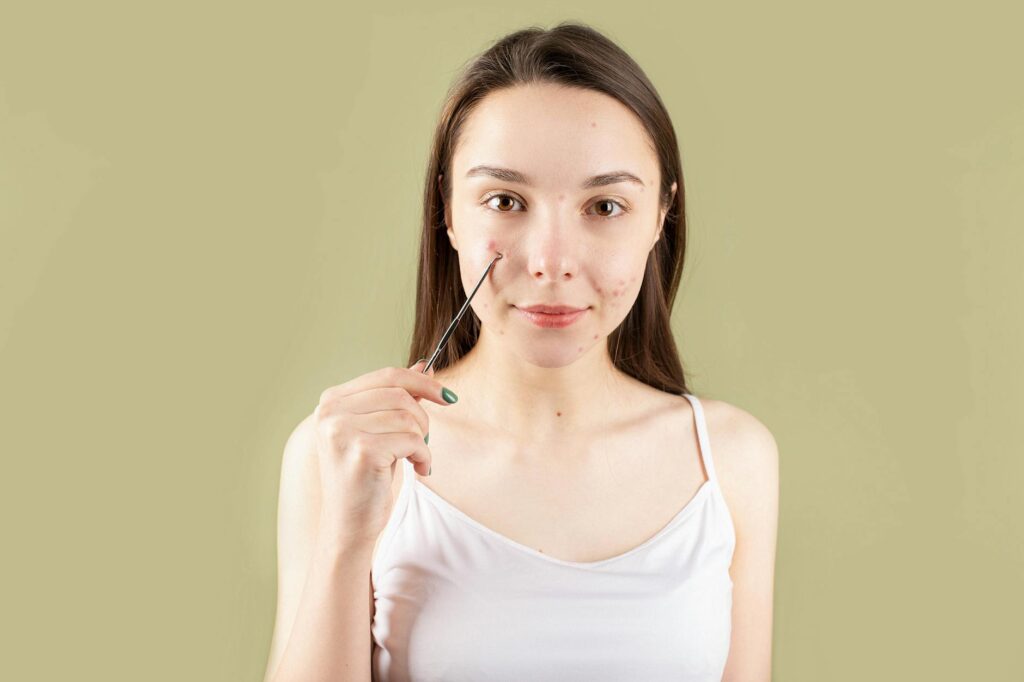
Treating acne caused by steroid use requires a different approach than managing typical hormonal or bacterial acne. The most effective treatment begins with discontinuing or tapering the steroid under medical supervision, followed by topical retinoids to normalize skin cell turnover and benzoyl peroxide to control the bacterial overgrowth that steroids encourage. In more severe cases, oral antibiotics like doxycycline or minocycline may be necessary for four to eight weeks. For instance, a bodybuilder who developed widespread truncal acne after a twelve-week anabolic steroid cycle might see improvement within six to eight weeks by combining tretinoin cream with oral doxycycline, but only after stopping the steroids entirely. Unlike regular acne that develops gradually during adolescence, steroid-induced acne typically appears suddenly and uniformly across the chest, back, and shoulders.
The lesions tend to look remarkably similar to each other, presenting as small, red papules or pustules that erupt in clusters. This article covers why steroids trigger acne in the first place, which treatments work best for different severity levels, when prescription medications become necessary, how to prevent scarring, and what to expect during the recovery timeline. Understanding the mechanism behind steroid acne helps explain why certain treatments work better than others. Steroids, whether prescribed corticosteroids or anabolic-androgenic steroids, increase sebum production and alter the immune response within hair follicles. This creates an environment where normal skin bacteria multiply rapidly, leading to inflammatory lesions that require targeted intervention rather than generic acne treatments.
Table of Contents
- What Causes Steroid-Induced Acne and How Does It Differ from Regular Acne?
- First-Line Treatments for Mild to Moderate Steroid Acne
- When to Consider Oral Antibiotics and Prescription Medications
- Managing Steroid Acne While Continuing Necessary Medical Treatment
- Preventing Scarring and Managing Post-Inflammatory Changes
- The Role of Skincare Routine in Recovery
- Timeline for Recovery and Realistic Expectations
- Conclusion
What Causes Steroid-Induced Acne and How Does It Differ from Regular Acne?
Steroid acne develops through a specific pathway that distinguishes it from common acne vulgaris. When steroids enter the body, they bind to androgen receptors in sebaceous glands, dramatically increasing oil production. Simultaneously, steroids suppress the local immune system within hair follicles, allowing Cutibacterium acnes bacteria to proliferate unchecked. This dual mechanism explains why steroid acne often appears more inflammatory and widespread than typical breakouts. A person taking prednisone for an autoimmune condition might notice acne appearing within two weeks of starting treatment, whereas someone beginning testosterone replacement therapy could see changes within the first month. The visual presentation offers important diagnostic clues. Regular acne typically shows a mix of blackheads, whiteheads, and inflamed lesions at various stages of development.
Steroid acne, by contrast, presents with lesions that appear nearly identical in size and stage, a phenomenon dermatologists call monomorphic appearance. The lesions cluster in sebum-rich areas, particularly the upper back, chest, and deltoid regions, often sparing the face initially. Comparing side by side, a teenage patient with hormonal acne might have scattered lesions of different sizes across the T-zone, while an athlete using anabolic steroids presents with uniform red bumps covering the entire upper torso. The type of steroid matters significantly. Anabolic steroids used for muscle building tend to cause more severe and persistent acne than corticosteroids prescribed for medical conditions. Testosterone and its derivatives have stronger androgenic effects, meaning they stimulate sebaceous glands more aggressively. Corticosteroid-induced acne, while often dramatic in appearance, typically resolves more quickly once the medication is reduced or discontinued.

First-Line Treatments for Mild to Moderate Steroid Acne
Topical treatments form the foundation of steroid acne management when lesions remain relatively mild. Benzoyl peroxide at concentrations of 2.5 to 5 percent effectively kills C. acnes bacteria without contributing to antibiotic resistance, making it suitable for extended use. Applying it once daily, preferably at night, to affected areas often produces visible improvement within three to four weeks. Tretinoin or adapalene, both retinoids, accelerate skin cell turnover and prevent the clogged pores that steroids promote. These can be used in combination, with benzoyl peroxide in the morning and retinoid at night, though starting slowly prevents excessive irritation. However, if the acne developed from long-term corticosteroid use for a chronic illness, topical treatments alone may prove insufficient.
Patients cannot simply stop taking prescribed steroids, which means the underlying trigger continues while treatment attempts to manage symptoms. In these situations, working with both a dermatologist and the prescribing physician becomes essential. The goal shifts from eliminating the cause to controlling symptoms while minimizing steroid dosage where medically possible. A patient with lupus requiring ongoing prednisone, for example, might achieve reasonable acne control through aggressive topical therapy even if complete clearance remains unrealistic. Azelaic acid offers an alternative for those who cannot tolerate retinoids or benzoyl peroxide. Available in both prescription and over-the-counter strengths, azelaic acid reduces inflammation and has mild antibacterial properties. It works particularly well for post-inflammatory hyperpigmentation, making it valuable for darker skin tones where steroid acne often leaves prominent marks.
When to Consider Oral Antibiotics and Prescription Medications
Oral antibiotics become necessary when topical treatments fail to control moderate to severe steroid acne or when lesions cover large body surface areas that make topical application impractical. Doxycycline and minocycline, both tetracycline-class antibiotics, remain the standard choices. They work through anti-inflammatory mechanisms rather than purely antibacterial effects, which explains their effectiveness against the immune dysregulation steroids cause. A typical course runs six to twelve weeks at doses between 50 and 100 milligrams twice daily, depending on severity and patient tolerance. Minocycline tends to cause less photosensitivity than doxycycline, making it preferable for patients who spend significant time outdoors. Conversely, doxycycline is less likely to cause the dizziness and vertigo sometimes associated with minocycline.
Neither antibiotic should be taken with dairy products or antacids, which interfere with absorption. Patients must also understand that antibiotics address active inflammation but do not prevent new lesions from forming once discontinued, which is why continued topical therapy remains important throughout and after the antibiotic course. Isotretinoin, commonly known by the former brand name Accutane, represents the most aggressive treatment option for steroid acne that fails all other interventions. This powerful oral retinoid essentially shuts down sebaceous gland activity and can produce lasting remission. However, isotretinoin carries significant risks including severe birth defects, liver toxicity, and controversial associations with mood changes. For someone using anabolic steroids recreationally, the decision to pursue isotretinoin requires honest evaluation, as continuing steroid use while taking isotretinoin creates elevated liver stress and likely recurrence once isotretinoin ends.
Managing Steroid Acne While Continuing Necessary Medical Treatment
Some patients have no choice but to continue steroid therapy despite developing acne. Transplant recipients taking immunosuppressants, severe asthma patients requiring regular prednisone bursts, and those with inflammatory bowel disease on long-term corticosteroids face this predicament regularly. For these individuals, the strategy focuses on minimizing acne rather than eliminating it while maintaining disease control. Close coordination between the dermatologist and the primary treating physician allows for adjustments that might reduce acne without compromising the underlying condition. Switching steroid formulations sometimes helps.
A patient taking oral prednisone for rheumatoid arthritis might experience less acne if transitioned to a steroid-sparing biologic medication. Someone using topical steroids for eczema could switch to tacrolimus ointment for maintenance, reserving steroids for flares only. Even within corticosteroid classes, some formulations cause less acne than others. Methylprednisolone tends to produce fewer skin side effects than prednisone at equivalent doses, though individual responses vary considerably. Taking the entire daily steroid dose in the morning rather than splitting it throughout the day may slightly reduce acne severity by aligning with the body’s natural cortisol rhythm. This approach does not work for everyone and should only be attempted with medical approval, as some conditions require more frequent dosing for adequate control.
Preventing Scarring and Managing Post-Inflammatory Changes
Steroid acne carries substantial scarring risk due to its inflammatory nature and typical location on the trunk, where skin heals more slowly than the face. Preventing scarring requires aggressive early treatment before lesions progress to cysts or nodules. Patients should never pick, squeeze, or extract steroid acne lesions, as this dramatically increases scar formation. The uniform appearance of steroid acne sometimes tempts people to attempt extraction, assuming the lesions are superficial, but the inflammation extends deeper than it appears. For lesions that have already healed with scarring, treatment depends on scar type. Atrophic scars, which appear as depressions in the skin, respond to procedures like microneedling, fractional laser resurfacing, and subcision.
These treatments should only begin after all active acne has resolved, typically three to six months after clearing. Attempting scar treatment while acne remains active risks worsening outcomes and introducing new scars. Hypertrophic or keloid scars, more common on the chest and shoulders, may require intralesional corticosteroid injections, a somewhat ironic treatment given the original cause. Post-inflammatory hyperpigmentation, the dark marks left after acne heals, affects nearly everyone with steroid acne to some degree. These marks are not true scars and will fade over six to twelve months without treatment. Topical agents like hydroquinone, vitamin C, and azelaic acid can accelerate fading, while sun protection prevents marks from darkening further.
The Role of Skincare Routine in Recovery
Establishing proper skincare habits supports medical treatment and prevents recurrence. For body acne, this means using a gentle cleanser containing salicylic acid in the shower, allowing it to sit on affected areas for one to two minutes before rinsing. Oil-free, non-comedogenic moisturizers prevent the dryness that retinoids and benzoyl peroxide cause without clogging pores. A patient recovering from chest and back acne might use a salicylic acid body wash daily, apply benzoyl peroxide gel to active areas after drying, and follow with a lightweight moisturizer containing niacinamide to reduce inflammation.
Clothing choices matter more than most people realize. Tight-fitting synthetic fabrics trap sweat and friction against skin, worsening acne mechanically while creating a warm, moist environment bacteria love. Cotton or moisture-wicking athletic fabrics reduce these problems. Showering immediately after exercise rather than sitting in sweaty clothes for hours prevents the combination of sweat, bacteria, and friction from triggering new lesions.
Timeline for Recovery and Realistic Expectations
Patients often underestimate how long steroid acne takes to resolve completely. Even after stopping steroids, the skin takes time to normalize its sebum production and immune function. Most patients see initial improvement within four to six weeks of starting treatment, but complete clearance typically requires three to six months. Athletes who used anabolic steroids during a bulking cycle should expect recovery to take roughly as long as the cycle lasted, sometimes longer.
The psychological impact of steroid acne deserves acknowledgment. Severe truncal acne affects confidence, intimacy, and willingness to engage in activities requiring exposed skin. Patients who developed acne from prescribed steroids often feel frustrated that one medical treatment created a new problem. Those who used anabolic steroids recreationally may experience shame or reluctance to seek dermatological help. Dermatologists treat steroid acne regularly and without judgment; being honest about the cause allows for more effective treatment planning and realistic outcome discussions.
Conclusion
Steroid-induced acne responds well to treatment but requires patience and a targeted approach different from conventional acne management. The combination of stopping or minimizing steroid exposure, using topical retinoids and benzoyl peroxide consistently, and adding oral antibiotics when necessary produces clearance in most cases within three to six months. Preventing scarring through early intervention and avoiding manipulation of lesions protects long-term skin appearance.
For anyone currently dealing with steroid acne, the priority should be consulting a dermatologist who can assess severity and create a personalized treatment plan. Those taking prescribed steroids should coordinate care between their dermatologist and the prescribing physician rather than stopping medications independently. With appropriate treatment and realistic expectations about the timeline, steroid acne is a manageable condition that resolves completely for the vast majority of patients.