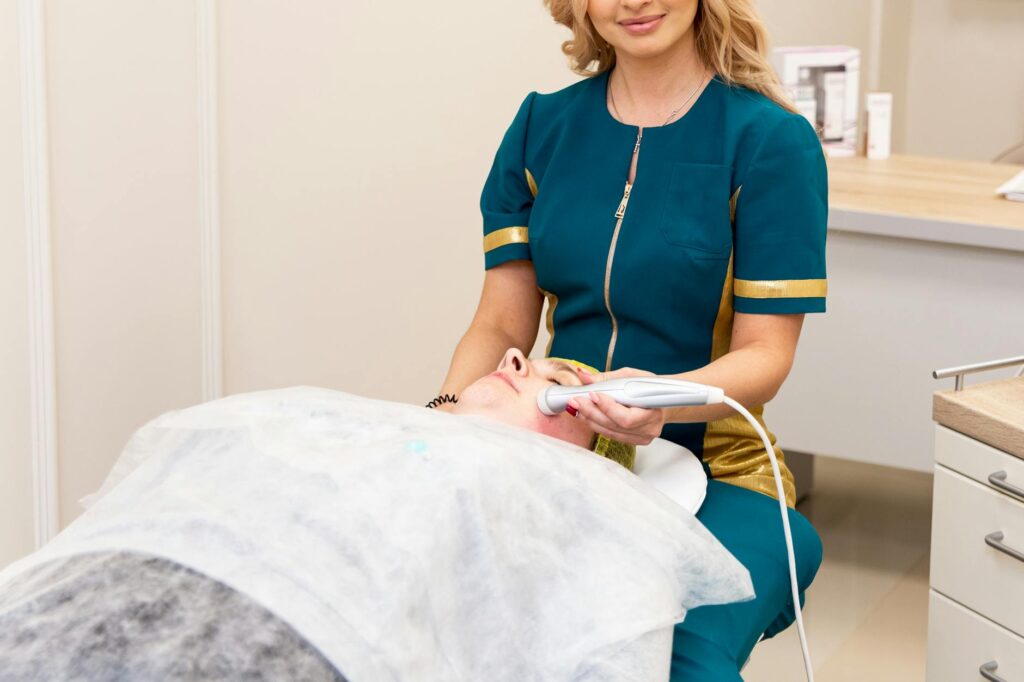
Professional treatments accelerate acne scar fading by actively remodeling damaged skin tissue through controlled trauma and collagen stimulation, rather than waiting for natural skin renewal. While at-home products can only address surface-level concerns, laser therapy achieves up to 90% efficacy for indented scars (ice pick and boxcar types), dermal fillers restore volume with 68-75% improvement in rolling scars, and combination approaches work even faster. The key difference between professional treatments and over-the-counter options lies in depth and intensity: professional-grade procedures reach the dermal layer where scarring occurs, while most home treatments remain confined to the epidermis. This article covers the major professional treatment options, realistic timelines, why combination therapy works best, and how to choose the right approach for your specific scar type.
Table of Contents
- Why Professional Treatments Work Faster Than Skincare Alone
- Understanding the Professional Treatment Timeline and What to Expect
- Laser Therapy—The Gold Standard for Atrophic Scars
- Dermal Fillers and the Combination Advantage
- Managing Expectations—Why There Are No Overnight Solutions
- Choosing Between Treatment Types Based on Your Scar Pattern
- Long-Term Results and Maintenance Outlook
- Conclusion
Why Professional Treatments Work Faster Than Skincare Alone
The fundamental reason professional treatments fade acne marks faster is that they trigger controlled collagen remodeling and skin regeneration at depths that topical products cannot reach. When acne heals improperly, it leaves either depressed scars (atrophic, appearing as indentations) or raised scars (hypertrophic or keloid). Over-the-counter retinoids and vitamin C serums can improve surface texture and tone over months, but they don’t address the underlying structural damage in the dermis where scar tissue has formed. Professional treatments, by contrast, intentionally wound and stimulate the skin in controlled ways that force the body to rebuild the scarred tissue with new, healthy collagen. This is why dermatologists and aesthetic specialists see measurable improvement within weeks rather than years. For example, a person with ice pick scars (narrow, deep indentations) could spend six months using daily retinol with minimal visible change, or undergo a series of professional laser treatments and see significant softening in as little as 3-5 days after the first session, with continued improvement over weeks.
The speed advantage comes down to intensity and precision. A dermatologist-grade CO2 laser doesn’t just stimulate the skin—it actually removes damaged tissue column by column, prompting aggressive collagen remodeling. This is fundamentally different from what any serum can do, no matter the concentration of active ingredients. The skin recognizes the laser as an injury and responds with a coordinated healing cascade that produces new, organized collagen rather than the disorganized scar tissue that formed originally. This is why professional treatments have published efficacy rates (90% efficacy for certain laser types) while topical treatments have more modest, slower results. The trade-off is that professional treatments require multiple sessions and involve downtime, whereas skincare is convenient and low-risk.
Understanding the Professional Treatment Timeline and What to Expect
Visible improvements from professional treatments typically appear within 2-3 months, though some results show much faster. For laser resurfacing specifically, patients notice changes within 3-5 days as initial swelling subsides and the skin begins its regeneration phase. However, this isn’t the full story—the timeline varies significantly depending on the treatment type and scar severity. A single laser session will show some improvement, but most professionals recommend multiple sessions spaced 4-6 weeks apart to build cumulative results. This means that while you might see encouraging changes after the first treatment, the most dramatic fading typically emerges after completing a full treatment series, usually spanning 2-4 months from start to finish.
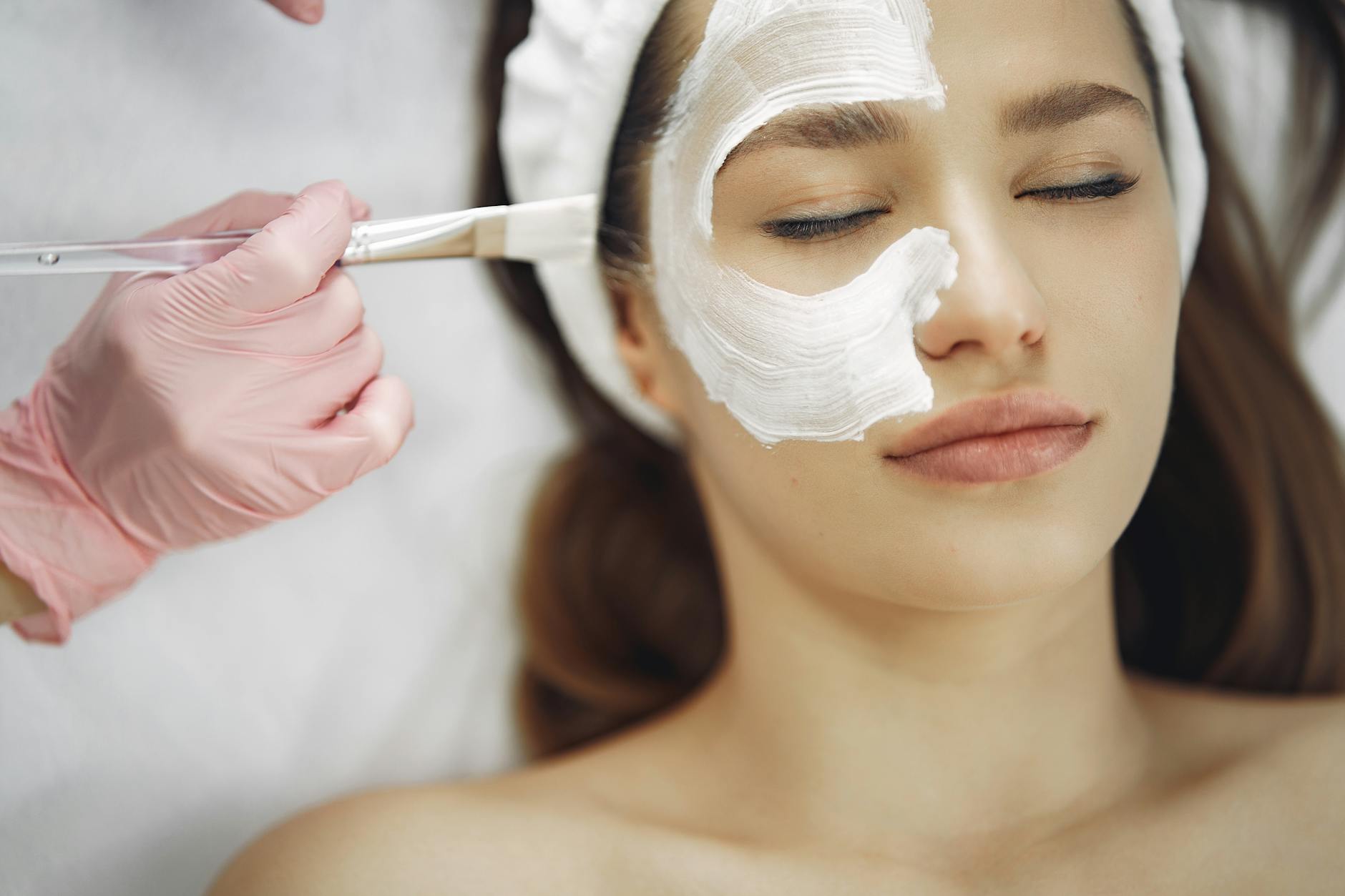
Chemical peels follow a more predictable timeline. After a TCA CROSS (Trichloroacetic Acid Chemical Reconstitution of Skin Scars) treatment for pitted scars, epidermal regeneration initiates within 24 hours and the entire healing process completes within 7-10 days. This makes chemical peels attractive for people who want faster surface-level recovery compared to laser treatments, though for deeper scars, TCA CROSS actually penetrates more effectively than some laser options. The caveat here is that while healing happens quickly, the full collagen remodeling and scar softening continue for weeks to months after the surface has healed. So you might look presentable to others within two weeks, but optimal results continue improving for three months. Someone planning a major event (wedding, reunion) should start treatment at least 3-4 months in advance to account for this delayed maturation phase.
Laser Therapy—The Gold Standard for Atrophic Scars
Laser treatments, particularly CO2 (10,600-nm wavelength) and Er:YAG (2,940-nm wavelength) lasers, represent the most thoroughly researched professional option for atrophic acne scars, with published efficacy rates reaching up to 90% for indented scars like ice pick and boxcar types. The CO2 laser works by vaporizing damaged tissue and creating controlled thermal injury that stimulates aggressive collagen regeneration. The Er:YAG laser operates at a different wavelength, giving it slightly different penetration characteristics and typically produces less thermal injury and faster healing. Both work, but they represent different points on a spectrum of intensity versus downtime—CO2 is more aggressive and effective but requires more recovery time, while Er:YAG is gentler with faster healing but may require more sessions to achieve similar results.
Fractional laser technology has made these treatments more practical by treating only a fraction of the skin at a time, leaving islands of untreated skin to facilitate faster healing. This fractional approach is what makes the 3-5 day visible improvement possible, though the deeper collagen remodeling continues for months. The limitation of laser monotherapy is that it works best on certain scar types: indented scars respond beautifully, but very severe ice pick scars or mixed scar patterns may benefit from combination approaches. A person with predominantly rolling scars (gentle waves across the skin) might see better results combining laser with dermal fillers, rather than laser alone. This is why a skilled practitioner evaluates your specific scar morphology and may recommend a customized approach rather than a one-size-fits-all laser protocol.

Dermal Fillers and the Combination Advantage
Dermal fillers address acne scars through a completely different mechanism than laser or chemical treatments: they physically elevate depressed scars by injecting volume beneath the scar tissue. Poly-D,L-lactic acid (PDLLA) fillers have shown measurable improvement in rolling scars, with 68-75% improvement after just two sessions, and the effects last 18-24 months before gradual resorption. This makes fillers particularly valuable for rolling scars, which are difficult for laser alone to address completely because they’re broad depressions rather than narrow pitted holes. The appeal is immediate visible improvement—after a filler session, the scars look better that same day. The downside is that fillers are temporary and require maintenance treatments, whereas laser treatments create more permanent collagen remodeling. The most effective approach emerging from clinical research combines multiple modalities.
Research found that Er:YAG laser combined with PRP (Platelet-Rich Plasma) achieved the highest efficacy rating (SUCRA 0.873), significantly outperforming laser monotherapy alone (SUCRA 0.773). Following closely were fractional CO2 laser monotherapy and fractional CO2 laser combined with 30% salicylic acid (SUCRA 0.772). What this data reveals is that combining treatments targets scars from multiple angles simultaneously: laser remodels collagen, PRP enhances healing and stimulates hyaluronic acid production, and chemical exfoliation addresses texture. For someone with mixed scar types—some ice picks, some rolling scars, some generalized texture irregularity—a practitioner might recommend a staggered approach: laser sessions combined with PRP injections and periodic chemical peels. The combination takes longer and costs more than any single treatment, but produces superior results compared to pursuing just one modality. However, if budget is limited, laser monotherapy still produces meaningful improvement for most patients.
Managing Expectations—Why There Are No Overnight Solutions
A critical reality that separates professional treatments from the unrealistic claims of many skincare brands is this: no single product or in-clinic procedure can erase acne scars overnight. Even the most advanced laser or filler treatment requires multiple sessions and months of patient healing to achieve optimal results. The clinical literature is consistent on this point—efficacy rates of 90% don’t mean scars completely disappear; they mean significant visible improvement and softening. A severe ice pick scar might look 80-90% less noticeable after a complete treatment series, but trace texture may remain. This is important to understand before committing to treatment, because unrealistic expectations often lead to disappointment even when the treatment is objectively successful. The timeline also extends beyond the immediately visible healing.
While the surface heals within 7-10 days for peels or 2-3 weeks for laser, the maturation of new collagen continues for 3-6 months. Scars typically look their best 3-4 months after the final treatment session, not immediately after. Additionally, the number of sessions needed varies by scar depth and extent—a person with a few scattered scars might need 3 sessions, while someone with extensive scarring might need 6-8. Cost and time commitment are real factors. Professional treatments also carry risks that home products don’t: post-inflammatory hyperpigmentation (darker marks) or hypopigmentation (lighter marks) can occur, particularly in darker skin tones. Infection is rare but possible. This is why working with a qualified dermatologist matters—they can adjust protocols based on your individual skin and scar characteristics.
Choosing Between Treatment Types Based on Your Scar Pattern
Different scar types respond differently to different treatments, which is why proper diagnosis before starting is critical. Ice pick scars—narrow, deep, puncture-like indentations—respond exceptionally well to laser therapy, especially CO2 or Er:YAG, because the laser can precisely target and remodel these confined, deep areas. Boxcar scars—wider, angular depressions with defined edges—also respond well to laser but often benefit from combination laser plus filler because the edges need collagen remodeling and the base might need volume restoration. Rolling scars—broad, wave-like depressions—are often the trickiest for laser alone because the scar is wide and shallow; these frequently respond better to fillers combined with microneedling or laser, or to TCA CROSS if they’re concentrated in specific areas. Hypertrophic or keloid scars (raised rather than depressed) require a completely different approach than the atrophic scars discussed above.
These respond better to treatments that inhibit collagen overproduction, such as steroid injections or specialized laser settings designed to flatten raised tissue. If you’ve never had a dermatology consultation, this is the first step—a dermatologist examines your scars, determines the type and depth, assesses your skin tone and healing tendencies, and recommends the optimal treatment protocol. Attempting to self-treat with the “most popular” or “most aggressive” option without this assessment is a common mistake. A person with predominantly rolling scars getting aggressive fractional CO2 laser might spend thousands on multiple sessions with disappointing results, when a combination of filler and milder laser would have worked better. Taking time upfront for a professional assessment prevents wasted treatment and money.
Long-Term Results and Maintenance Outlook
Once you’ve completed a professional treatment series, the results are relatively durable, but the long-term trajectory depends on the treatment type. Laser-induced collagen remodeling is largely permanent—the new collagen that forms stays, which is why many dermatologists consider laser treatments the most durable option for acne scars. Patients often see continued subtle improvement for up to a year after their final laser session as collagen continues to reorganize. However, laser doesn’t reverse aging or prevent new scarring, so while the acne scars remain improved, the treated area will age similarly to surrounding skin. This means that 10 years after laser treatment, that area doesn’t look dramatically different from the rest of your face regarding fine lines or texture changes—the relative improvement from acne scarring persists, but it’s part of an aging process.
Filler results fade gradually over 18-24 months as the body metabolizes the injected material, requiring maintenance treatments to sustain the improvement. For someone with rolling scars, this might mean a filler touch-up every 18 months to maintain the visual smoothness. Some practitioners now advocate for periodic combination approaches—a laser refresher every few years combined with strategic filler to maintain results. The future landscape of acne scar treatment is also shifting toward combination protocols and adjuvant therapies like PRP becoming more standard, rather than relying on any single treatment. As technology advances, practitioners are better able to customize treatments to individual scar morphology, potentially reducing the number of sessions needed. For now, the most effective strategy remains combining evidence-based treatments tailored to your specific scar type.
Conclusion
Professional treatments fade acne marks significantly faster than any topical skincare product because they actively trigger collagen remodeling at the dermal level where scarring occurs. Laser therapy achieves up to 90% efficacy for certain scar types, dermal fillers provide immediate volume restoration for rolling scars, and combination approaches produce the best results by addressing scars from multiple angles. The realistic timeline is 2-3 months to visible improvement with full maturation continuing over several months, not overnight results.
The most important first step is a consultation with a dermatologist who can assess your specific scar type and recommend the optimal treatment protocol for your skin and goals. If you’re considering professional scar treatment, start with a dermatology consultation to determine whether your scars are atrophic (depressed), hypertrophic (raised), or a combination, and to understand realistic expectations for your specific situation. Don’t assume the most aggressive or most expensive option is right for you—customized combination therapy often outperforms single treatments, and a qualified professional will design an approach suited to your scar morphology, skin tone, and lifestyle. The investment in professional treatment typically proves worthwhile compared to years of minimal results from topical products.