

At least 22% of people who use over-the-counter acne products report that they regularly pick at their acne, often despite knowing it causes harm. This widespread behavior carries serious consequences: when you pick at acne, you push bacteria deeper into the skin, breach the protective barrier layer, and create conditions that lead to permanent scarring, hyperpigmentation, and prolonged inflammation.
A person using a benzoyl peroxide wash, for example, might clear surface blemishes within weeks, only to undo that progress by picking at healing lesions and introducing new bacteria that creates deeper, more stubborn acne. The act of picking seems harmless—almost reflexive—especially when acne products dry out the skin and make lesions feel ready to “pop.” But beneath the surface, picking disrupts the skin’s natural healing process, forces bacteria into deeper dermis layers where they multiply and cause cyst-like formations, and triggers the body’s inflammatory response in ways that leave permanent indentations or raised scar tissue. Understanding why picking is so damaging, and how to stop the cycle, is essential for anyone using OTC acne treatments.
Table of Contents
- Why Does Picking at Acne Push Bacteria Deeper and Cause Infection?
- How Permanent Scarring Develops From Repeated Acne Picking
- The Role of OTC Acne Products in Triggering Picking Behavior
- How to Stop Picking: Breaking the Cycle and Protecting Your Skin
- Why Professional Treatment is More Effective Than OTC Products for Severe Acne
- How to Treat Active Acne Scars and Reduce Their Appearance
- Building a Sustainable Acne Management Plan That Prevents Picking
- Conclusion
Why Does Picking at Acne Push Bacteria Deeper and Cause Infection?
When you pick at a pimple, you’re not simply removing the bacteria on the surface—you’re creating a wound that extends into multiple skin layers. The epidermis (outer layer) tears, and your fingernails or tools introduce new bacteria into the lesion, while simultaneously pushing existing bacteria deeper into the dermis. This is where the infection worsens: the dermis lacks the same antibacterial defenses as the surface, and bacteria trapped in these deeper pockets replicate rapidly and trigger a stronger inflammatory response. The bacterial load matters significantly. A single fingernail can carry thousands of bacteria, even if you’ve washed your hands.
When you pick at acne, you’re essentially inoculating the wound with these pathogens, which then colonize the deeper tissue. Compare this to leaving a pimple untouched: the body’s immune system can fight bacteria on the surface and within the follicle itself, while the skin naturally sheds dead cells and pushes out sebum. Picking disrupts this process entirely, turning a surface inflammation into a deeper, more serious infection that may require stronger treatment or professional extraction. Many people don’t realize that the moment you pick, you’ve created a pathway for bacteria to go deeper. Acne bacteria (primarily Cutibacterium acnes, formerly known as Propionibacterium acnes) spreads aggressively in the anaerobic environment of a puncture wound, and this is why picked acne often becomes redder, larger, and more painful within hours or days. The body responds by sending more white blood cells to fight the infection, which causes additional swelling and inflammation—the very thing that makes the acne look worse.
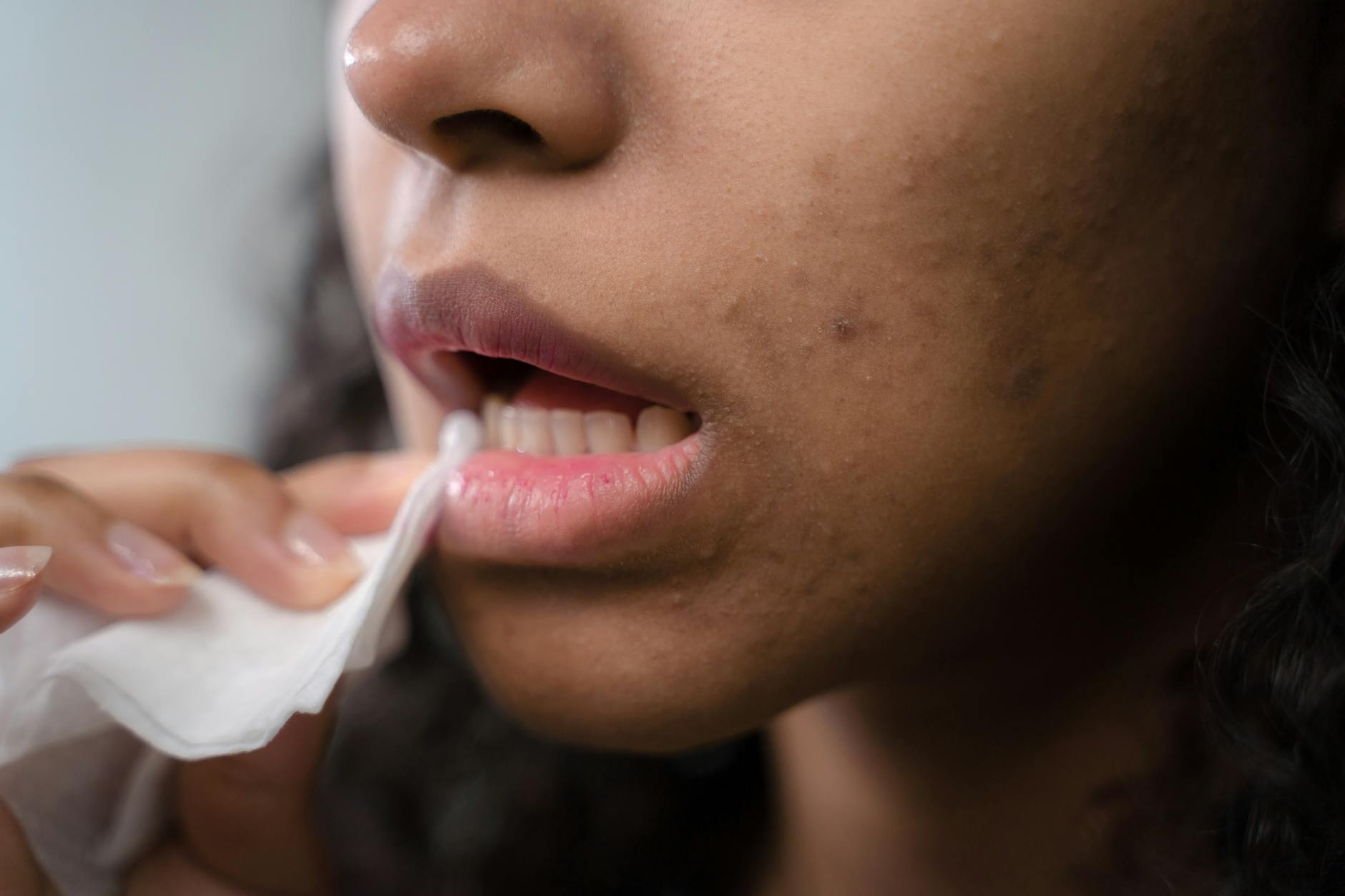
How Permanent Scarring Develops From Repeated Acne Picking
Scarring occurs because picking damages not just the epidermis, but the collagen and elastic fibers of the dermis beneath. When a lesion heals naturally, the body lays down new collagen in an organized, structured way. But when you create a deeper wound through picking, the body’s repair process becomes chaotic: collagen fibers fill in the wound unevenly, sometimes too much (hypertrophic or keloid scarring) or too little (atrophic or “ice pick” scars). The risk of scarring increases dramatically if you pick at the same spot repeatedly, as each injury compounds the previous damage and leaves the skin with less ability to repair itself smoothly. Atrophic scars—the most common type from acne picking—develop when collagen loss creates indentations in the skin. These are especially visible on the cheeks, chin, and temples, where skin is tighter and less forgiving. Unlike acne marks, which can fade with time or targeted treatments, true scars are permanent structural damage to the skin.
A person who picks at inflammatory acne for even a few months can develop visible scarring that takes years and expensive professional treatments (laser resurfacing, subcision, fillers) to minimize. The limitation here is important: once scarring occurs, you cannot fully reverse it. You can only improve its appearance. The scarring risk is highest when you pick at cystic acne or deep nodular acne—the most inflammatory types. OTC acne products are often less effective at treating cystic acne anyway, which means many people pick out of frustration when their benzoyl peroxide or salicylic acid cleansers don’t work. This is a dangerous cycle: ineffective OTC treatment leads to picking, which leads to deeper infection, worsening acne, and more picking. Professional help (dermatologist-prescribed retinoids, oral antibiotics, or hormonal treatments) would actually break this cycle, but people sometimes resort to picking instead.
The Role of OTC Acne Products in Triggering Picking Behavior
Over-the-counter acne treatments like benzoyl peroxide and salicylic acid work partly by drying out the skin and accelerating cell turnover. While this can improve mild acne, it also creates flaky, irritated, or sensitive skin that feels uncomfortable and looks like it needs to be “cleared off”—which is when many people start picking. The products themselves aren’t causing the picking behavior directly, but they’re setting conditions that make picking more tempting and feel more justified. For example, someone using a 10% benzoyl peroxide wash twice daily might develop visibly peeling, tight skin by day three or four. The dead skin cells accumulate, pimples surface quickly due to accelerated cell turnover, and the overall appearance looks “messy.” This triggers the urge to pick—to clean it up, to speed along the healing, to get rid of the flaking. The irony is that the dryness itself is temporary and part of the product’s mechanism, but it creates psychological pressure to interfere.
A dermatologist would recommend patience and moisturizer; many people instead pick, setting off the infection-scarring cycle. The most common trap involves using multiple OTC products at once. Someone might use benzoyl peroxide wash in the morning, salicylic acid toner at night, and a retinol product as well—all in pursuit of faster acne clearance. This over-treatment damages the skin barrier, triggers excessive peeling, and makes picking almost inevitable. The skin becomes so inflamed and uncomfortable that restraint feels impossible. The comparison here is telling: a single, gentle OTC product with consistent use and a good moisturizer often works better than an aggressive multiple-product regimen that leads to picking and barrier damage.

How to Stop Picking: Breaking the Cycle and Protecting Your Skin
Stopping acne picking is difficult because the behavior is partly habit, partly psychological (anxiety, stress, boredom), and partly triggered by the physical sensation of raised or flaky skin. The most effective approach is a combination: reduce the urge by simplifying your skincare routine and fixing the barrier, address the psychological trigger by keeping hands busy or using physical barriers, and use professional treatment if OTC products aren’t working. If you’re picking because your OTC treatments aren’t clearing acne effectively, that’s the strongest signal to stop using them and see a dermatologist instead. Practically, this means: wash your face once or twice daily with a gentle cleanser (not an acne-specific one if you’re currently picking), apply a good moisturizer while skin is still damp, and avoid any additional actives until the picking stops. Use products that repair the barrier (ceramides, centella asiatica, niacinamide) rather than strip it further.
For acne, benzoyl peroxide 2.5% is actually as effective as 5% or 10%, so if you must use an OTC product, use the lowest strength and apply it only to acne-prone areas, not the entire face. The tradeoff is clear: a gentler routine with better compliance and no picking will give you better results than an aggressive routine that you undermine by picking. Physical barriers like bandages on pimples, cotton gloves at night, or keeping nails short reduce the mechanical ability to pick. Some people find that fidget toys, stress balls, or even just keeping their hands in their pockets helps with the compulsive urge. If picking is tied to anxiety or stress, addressing the underlying mental health—through exercise, therapy, meditation, or medication—is often more effective than skincare changes alone. The warning here is that picking can become compulsive enough to warrant professional mental health support, not just dermatology care.
Why Professional Treatment is More Effective Than OTC Products for Severe Acne
If you’re picking at your acne, that’s evidence that OTC products aren’t effectively treating your acne—otherwise, you wouldn’t feel the need to pick. Prescription treatments like tretinoin (a retinoid), adapalene, or oral antibiotics work faster and more effectively at reducing the inflammatory response that makes picking tempting. Tretinoin, for example, rebuilds the skin barrier while simultaneously clearing acne, which removes the psychological trigger of flaky, irritated skin. This alone often stops picking because the acne improves so rapidly and noticeably that the urge diminishes. For moderate to severe acne, a dermatologist might recommend oral antibiotics combined with topical retinoids, or in the case of hormonal acne, birth control or spironolactone. These approaches address acne at the source—bacterial overgrowth, sebum production, inflammation, or hormonal triggers—rather than just treating the surface inflammation.
Isotretinoin (Accutane) is reserved for severe acne that’s resistant to other treatments and that’s causing scarring, and it’s remarkably effective at preventing the kind of acne that makes people pick repeatedly. The limitation of OTC products is that they simply don’t work for everyone. Benzoyl peroxide is antibacterial but doesn’t reduce sebum production. Salicylic acid exfoliates but doesn’t treat the bacteria. Neither addresses hormonal acne or deeply rooted cystic lesions. If you’ve been using OTC products for more than 8-12 weeks without significant improvement, professional evaluation is necessary—not because you’re failing, but because your acne type requires prescription-strength treatment. Continuing with ineffective OTC products while picking is the worst possible outcome: you get no acne improvement and permanent scarring.

How to Treat Active Acne Scars and Reduce Their Appearance
If picking has already caused scarring, several professional treatments can improve appearance. Laser resurfacing (especially ablative lasers) removes the top layer of skin and stimulates collagen remodeling, which can flatten atrophic scars by 40-60%. Subcision involves a needle placed under the scar to break up fibrous tissue and allow new collagen to fill in the depression. Dermal fillers provide temporary improvement by raising indented scars, though they require repeat treatments.
Chemical peels can help with mild scarring and post-inflammatory hyperpigmentation. The most important thing to know is that these treatments don’t work instantly or completely. Most scars improve gradually over months, and multiple sessions are often needed. A person with moderate atrophic scarring from picking might need four to six laser treatments spaced several weeks apart, costing several thousand dollars total. This underscores why preventing scarring through stopping the picking behavior is infinitely better than treating scars afterward.
Building a Sustainable Acne Management Plan That Prevents Picking
The long-term solution isn’t finding the “best” acne product—it’s building a routine that’s simple enough to stick with, effective enough that it improves acne visibly, and gentle enough that it doesn’t trigger picking urges. For most people, this means a cleanser, moisturizer, and one acne treatment (either an OTC product for mild acne or a prescription treatment for moderate-to-severe acne). Adding more products doesn’t improve results; it usually worsens them by triggering barrier damage and picking.
Looking forward, the dermatology field is moving toward more targeted treatments—treatments based on your specific acne type, skin barrier status, and even genetics. Personalized skincare is becoming more accessible, with dermatologists offering compounded treatments tailored to individual needs rather than a one-size-fits-all OTC approach. For people with a history of picking, personalized professional treatment is often the best path forward, as it provides results that OTC products simply cannot match, which removes the frustration that triggers picking in the first place.
Conclusion
At least 22% of people using OTC acne products engage in picking behavior, driven partly by frustration when products don’t work and partly by the uncomfortable skin sensation that even effective products create. Picking damages the skin at multiple levels: it pushes bacteria deeper, triggers infections, and causes permanent scarring through disrupted collagen remodeling. The scarring that results—ice pick scars, rolling scars, or hyperpigmentation—is far more difficult and expensive to treat than the original acne.
The way forward is to break the picking cycle by either simplifying your skincare routine with barrier-repair products and lower concentrations of active ingredients, or transitioning to professional treatment if OTC products aren’t working after 8-12 weeks. Stopping the picking is more important than any specific product choice, and it often requires addressing the psychological triggers alongside the skincare changes. If scarring has already occurred, professional treatments like laser therapy can improve appearance, but prevention remains the most effective approach.
You Might Also Like
- At Least 52% of People Who Use OTC Acne Products Have Never Been Told That Accutane Can Permanently Clear Acne in 85% of Patients After One Course
- At Least 72% of People Who Use OTC Acne Products Are Unaware That Combining Multiple Active Ingredients Can Destroy the Skin Barrier
- At Least 17% of Skincare Consumers Have Tried Physical Scrubs on Inflamed Acne Spread Bacteria and Cause Scarring