
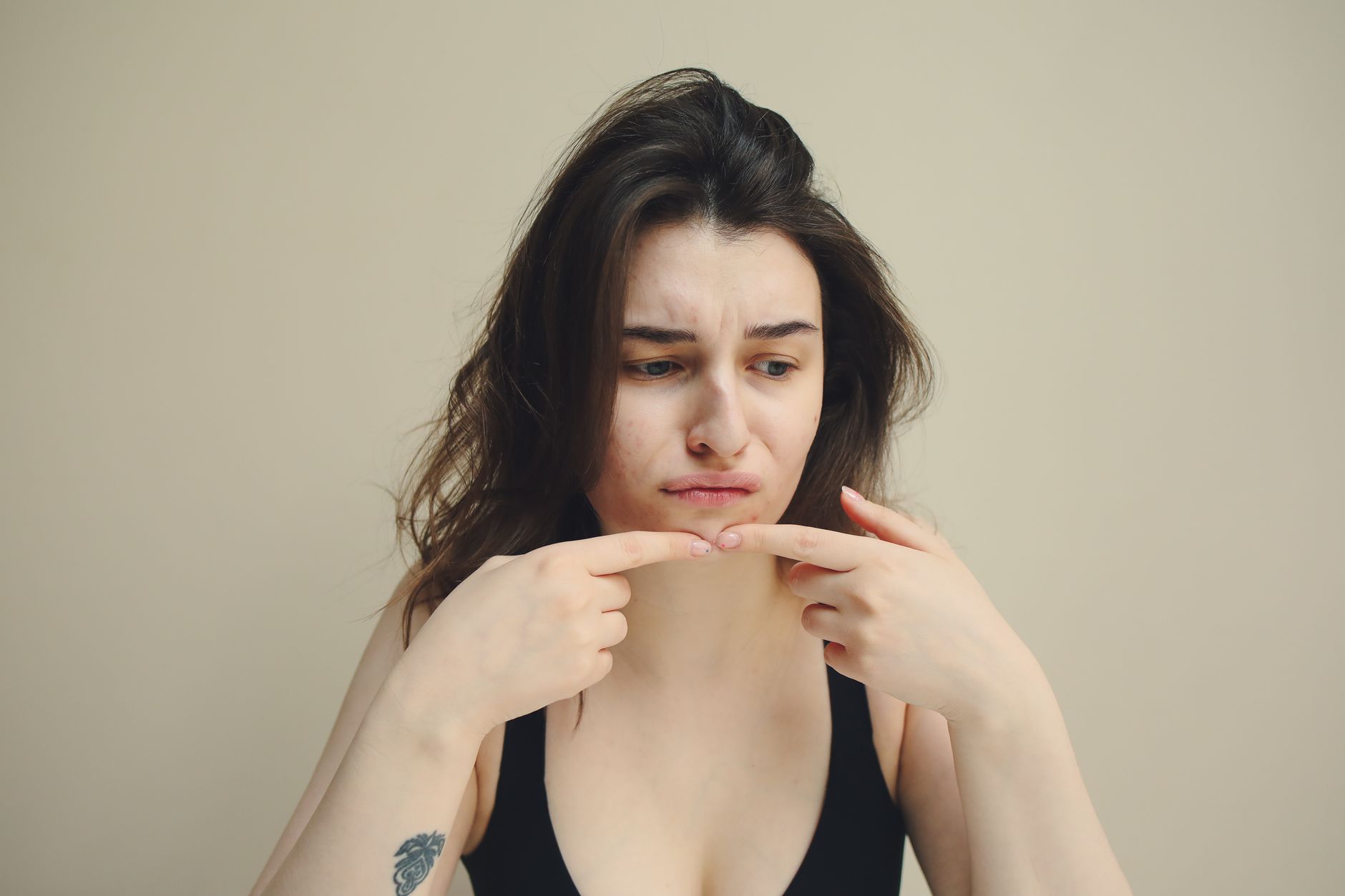
The headline gets one thing right and one thing wrong. The mechanism is real: high-glycemic foods do raise blood insulin, and that insulin spike stimulates androgen activity and oil (sebum) production in the skin, which is one of the established drivers of acne. The “at least 19% of people who pick at their skin report this” figure, however, is not supported by any verifiable scientific source. There is no study showing that 19% of skin-pickers believe or report a diet-insulin-oil connection. That number appears to be invented, stitched onto a legitimate dermatology fact. So the honest answer is that the diet-to-oil pathway deserves your attention while the statistic does not.
For example, a person with excoriation disorder (the clinical name for compulsive skin-picking) who also eats a high-glycemic diet of white bread, soda, and candy may genuinely have more active sebaceous glands and more breakouts to pick at. That is a plausible chain of events grounded in research. But framing it as a precise survey result like “19%” gives a false sense of measured certainty. Throughout this article, the verified facts are kept separate from the fabricated framing so you can act on what is actually known. Skin-picking disorder itself is well-documented, affecting somewhere between roughly 1.4% and 5.4% of the general population. The diet-acne link is also well-documented. The error in the headline is connecting the two with a fake percentage, and that distinction matters if you are trying to make real decisions about your skin.
Table of Contents
- Is the “At Least 19% of People Who Pick at Their Skin Report High-Glycemic Foods Spike Insulin” Claim Real?
- How High-Glycemic Foods Spike Insulin and Increase Oil Production
- What the Research Actually Shows About Diet and Acne
- Practical Steps to Lower Insulin-Driven Oil Production
- Where Skin-Picking and Acne Treatment Collide
- Why Fabricated Health Statistics Spread So Easily
- The Verified Numbers Worth Remembering
- Frequently Asked Questions
Is the “At Least 19% of People Who Pick at Their Skin Report High-Glycemic Foods Spike Insulin” Claim Real?
No. The specific claim that at least 19% of people who pick at their skin report a belief about high-glycemic foods, insulin, and oil production cannot be traced to any peer-reviewed study, survey, or clinical dataset. What can be verified is that two separate, legitimate topics have been fused together: the prevalence of excoriation (skin-picking) disorder, and the dietary mechanism behind acne. Each is real on its own. The bridge between them, expressed as “19%,” is not. For comparison, consider how real prevalence figures are reported in the literature. A systematic review and meta-analysis puts excoriation disorder prevalence near 3.45%, with point-prevalence estimates clustering around 2.1% and lifetime prevalence around 3.1% to 5%.
Notice that these are ranges drawn from multiple studies with cited methodologies. The “19%” in the headline has none of that backing. When a statistic appears without a study, a sample size, or a source, it should be treated as decorative rather than factual. This kind of conflation is common in health content because it sounds authoritative. A reader sees a precise number attached to a real biological process and assumes the whole sentence has been measured. The warning here is simple: a true mechanism does not validate a false statistic. You can accept that insulin influences sebum without accepting that anyone counted how many skin-pickers know it.
How High-Glycemic Foods Spike Insulin and Increase Oil Production
The part of the headline that holds up is the biology. High-glycemic foods, such as refined sugar, white rice, sugary drinks, and processed snacks, cause blood glucose to rise quickly, which triggers a sharp release of insulin. That insulin does more than manage blood sugar. It stimulates androgen production and promotes the proliferation of sebocytes, the cells that produce sebum. More active sebocytes mean more oil, and excess oil is a core contributor to clogged pores and acne lesions. The pathway goes deeper than insulin alone.
Elevated insulin also raises insulin-like growth factor 1 (IGF-1) and lowers insulin-like growth factor binding protein 3 (IGFBP-3). Research on adult acne has found that patients tend to show higher IGF-1 and lower IGFBP-3 levels, and this signaling activates a cellular pathway known as mTORC1, which further upregulates sebum production. In practical terms, a diet that keeps insulin chronically elevated keeps the skin’s oil factories running harder than they otherwise would. The limitation worth stating plainly is that diet is one factor among many, not a master switch. Hormones, genetics, the skin’s bacterial environment, and stress all shape whether someone breaks out. A person can eat a low-glycemic diet and still have acne driven by genetics or polycystic ovary syndrome. So while cutting high-glycemic foods can reduce oil production, it is not a guaranteed cure, and anyone promising that is overselling the evidence.
What the Research Actually Shows About Diet and Acne
The strongest evidence comes from randomized controlled trials of low-glycemic-load diets. These trials have shown modest but meaningful reductions in acne lesion counts when participants shifted away from high-glycemic eating. The effect is real and measurable, which is why dermatology literature increasingly treats diet as a legitimate adjunct to medical treatment rather than a folk remedy. The keyword is adjunct: diet supports treatment, it does not replace topical retinoids, benzoyl peroxide, or prescribed medication. A concrete example helps illustrate the scale of the effect.
In low-glycemic-load diet studies, participants typically replaced refined carbohydrates with whole grains, legumes, vegetables, and lean proteins over a period of weeks, and researchers counted both inflammatory and non-inflammatory lesions before and after. The reductions were noticeable but not dramatic, the kind of improvement that complements a treatment plan rather than carrying it alone. Someone expecting their cystic acne to vanish from giving up soda will likely be disappointed. This is also where the skin-picking angle becomes relevant in a real way, separate from the fake statistic. If a low-glycemic diet reduces lesion counts, it reduces the number of bumps and blemishes a person with excoriation disorder feels compelled to pick at. Fewer perceived imperfections can mean fewer picking triggers, though the disorder itself is a behavioral and psychological condition that diet cannot treat.
Practical Steps to Lower Insulin-Driven Oil Production
The actionable core is straightforward: reduce the glycemic load of your diet rather than chasing individual “bad” foods. That means favoring whole grains over white flour, choosing whole fruit over juice, pairing carbohydrates with protein and fat to blunt the glucose spike, and treating sugary drinks as the highest-impact item to cut. These changes lower the insulin response that feeds sebum production, and they tend to improve general metabolic health as a side benefit. The tradeoff is one of speed versus sustainability. A drastic elimination diet might produce faster visible results, but it is hard to maintain and can create an unhealthy relationship with food, especially for someone already managing a compulsive condition like skin-picking.
A gradual reduction in high-glycemic foods is slower to show on the skin but far more likely to stick for years. For most people, the slower path wins because acne management is a long game, not a two-week sprint. It is also worth comparing dietary change against topical and medical treatment in terms of effort and payoff. Diet is low-cost and broadly healthy but slow and modest in effect. A prescribed retinoid is more targeted and more powerful for many people but comes with its own irritation and adjustment period. The most effective approach usually combines them, using diet to reduce the underlying oil load while medication addresses the lesions directly.
Where Skin-Picking and Acne Treatment Collide
Excoriation disorder is not the same as occasionally squeezing a pimple. It is a recognized mental health condition, and it tends to travel with other conditions: studies report generalized anxiety disorder in around 63.4% of cases, depression in around 53.1%, and panic disorder in around 27.7%. It also affects women roughly three times more often than men. These figures matter because they reframe skin-picking as a behavioral health issue, not merely a skincare problem that better products will solve. The warning for anyone in this situation is that focusing only on diet or topicals can miss the real driver.
If the picking is compulsive, clearing the acne may reduce triggers but will not address the underlying urge, which often persists even when skin is clear. People can and do pick at healthy skin. This is why dermatologists frequently refer patients with excoriation disorder to mental health support, including cognitive behavioral therapy and habit-reversal training, alongside any skin treatment. There is also a physical risk that compounds the problem. Picking at acne lesions, whether or not diet caused them, damages the skin barrier, introduces bacteria, and can cause scarring and post-inflammatory hyperpigmentation that lasts far longer than the original blemish. So even if a low-glycemic diet reduces oil and lesion counts, the act of picking can leave marks that outlast the acne itself, which is its own reason to address the behavior directly.
Why Fabricated Health Statistics Spread So Easily
Numbers like the “19%” in the headline spread because they feel verifiable. A specific percentage attached to a real mechanism reads as research even when no research exists. The pattern is recognizable once you know to look for it: a precise figure, no named study, and a claim that conveniently links two topics people already worry about.
In this case, skin-picking and diet are both real concerns, so the fabricated bridge between them feels intuitive. For example, a reader scrolling quickly might remember “19% of skin-pickers blame high-glycemic foods” as a fact and repeat it, even though no one measured it. The defense is to ask three questions of any health statistic: who collected this number, how many people were studied, and is the source named? The verified facts in this article all carry citations and ranges. The 19% figure carries none, which is exactly why it should be discarded while the underlying biology is kept.
The Verified Numbers Worth Remembering
If you want to hold onto accurate figures from this topic, anchor to the ones with sources behind them. Excoriation (skin-picking) disorder affects roughly 1.4% to 5.4% of the general population, with a meta-analysis estimate near 3.45%, a point prevalence around 2.1%, and lifetime prevalence around 3.1% to 5%. Women are affected about three times as often as men.
Among diagnosed individuals, generalized anxiety disorder appears in roughly 63.4%, depression in 53.1%, and panic disorder in 27.7%. On the diet side, the verified facts are mechanistic and trial-based: high-glycemic foods raise insulin, which elevates IGF-1, lowers IGFBP-3, activates mTORC1, and increases sebum production, and randomized trials of low-glycemic-load diets show modest but real reductions in acne lesion counts. Every one of these numbers traces back to published research, which is the single feature the headline’s “19%” lacks.
Frequently Asked Questions
Is it true that 19% of people who pick their skin report high-glycemic foods spike insulin?
No. There is no scientific source supporting that figure. It appears to be fabricated, attached to a genuine mechanism to make it sound measured.
Do high-glycemic foods really increase oil production?
Yes. They raise insulin, which stimulates androgens and sebocytes, increasing sebum (oil). This is supported by dermatology research and randomized diet trials.
How common is skin-picking disorder?
Excoriation disorder affects roughly 1.4% to 5.4% of people, with a meta-analysis estimate near 3.45%. Women are affected about three times more often than men.
Will a low-glycemic diet cure my acne?
No. Trials show modest but meaningful reductions in lesions, making diet a useful adjunct to medical treatment, not a standalone cure.
If diet clears my acne, will I stop picking?
Not necessarily. Skin-picking is a behavioral condition often tied to anxiety and depression, and people can pick at clear skin. It usually needs its own treatment.
What foods raise insulin the most?
Refined sugar, sugary drinks, white bread, white rice, and processed snacks cause the sharpest glucose and insulin spikes.
You Might Also Like
- At Least 46% of People Who Pick at Their Skin Believe That Their Face Mask Material Matters for Preventing Maskne
- At Least 40% of People Who Pick at Their Skin Say That Dairy Consumption Has Been Linked to 44% Higher Acne Risk
- At Least 39% of People Who Pick at Their Skin Say That Their Moisturizer Contains Comedogenic Ingredients