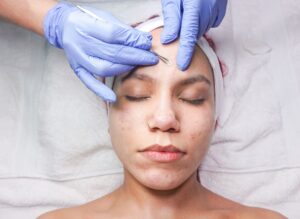
Yes, PCOS affects roughly 1 in 10 women globally, and hormonal acne is indeed one of the most visible—and often first noticed—symptoms. About 49% of women with PCOS develop acne vulgaris, making it significantly more common in PCOS patients than in the general female population; women with PCOS have 1.6 times higher acne prevalence overall. For many women, acne on the lower face, jawline, and neck becomes the catalyst that sends them to a dermatologist or gynecologist, only to discover they have PCOS during the workup. This article explains why PCOS drives hormonal acne, who is most affected, how it differs from other acne types, and what treatment options actually work for PCOS-related breakouts.
The connection between PCOS and acne is hormonal. Women with PCOS produce elevated levels of androgen hormones—primarily testosterone and DHEA—that overstimulate sebaceous glands to produce excess oil and slow down skin cell turnover. The result is a perfect storm for acne: more sebum, more bacterial colonization, and less efficient skin barrier repair. Unlike typical teenage acne or stress-related breakouts, PCOS acne tends to persist into adulthood and cluster on the lower third of the face, making it immediately recognizable to those who understand the pattern. Because up to 70% of women with PCOS remain undiagnosed, many suffer years of acne before realizing it’s a symptom of an underlying metabolic disorder—not just bad skin genetics.
Table of Contents
- Why Does PCOS Cause Hormonal Acne in So Many Women?
- The Mechanism: How Elevated Androgens Transform Skin Chemistry
- Where Does PCOS Acne Appear, and Why Does Location Matter?
- How Androgen Levels Drive Both PCOS and Acne Severity
- The Challenge of Late Diagnosis and Persistent Acne
- Acne as the Entry Point to PCOS Diagnosis
- The Future of PCOS and Hormonal Acne Management
- Conclusion
Why Does PCOS Cause Hormonal Acne in So Many Women?
The mechanism is straightforward: PCOS disrupts insulin and hormone balance, triggering the ovaries to overproduce androgens. These androgen hormones—testosterone and DHEA-S—stimulate the sebaceous glands in the skin to produce more oil (sebum). Simultaneously, the increased androgen activity prevents normal skin cell shedding, trapping bacteria and dead cells in pores. The result is inflammation-prone, oil-rich skin that erupts in cystic and inflammatory acne. Research shows 49% to as high as 76% of women with PCOS experience acne vulgaris (the exact rate depends on whether you use Rotterdam or NIH diagnostic criteria for PCOS—a detail that matters for epidemiologists but less for someone dealing with a breakout). The prevalence is staggering.
Globally, PCOS affects 10 to 13% of women—approximately 65.8 million cases as of 2021. In the United States, the prevalence is even higher at 5.2%, roughly double what was estimated in prior decades. Among women with PCOS, between 50% and 60% develop adult acne. This is not teenage acne that clears in the twenties. This is adult-onset or persistent acne that often worsens with hormonal cycles and may continue for years or decades without proper management. For comparison, in women without PCOS, acne prevalence in adulthood drops significantly, making the 1.6-fold higher risk among PCOS patients a meaningful clinical distinction.

The Mechanism: How Elevated Androgens Transform Skin Chemistry
When androgen levels rise in PCOS, the sebaceous glands don’t just increase oil production—they change the composition of that oil, making it more prone to bacterial growth and comedone formation. The androgen-driven changes also slow epidermal turnover (the natural shedding of dead skin cells), which means pores clog more easily. Additionally, androgens can increase the colonization of Cutibacterium acnes, the bacterium central to acne pathogenesis. This creates a self-perpetuating cycle: excess oil + poor skin turnover + bacterial overgrowth = persistent, inflammatory acne. However, not all women with PCOS develop acne to the same degree.
Some have mild breakouts confined to a few spots on the jaw, while others develop severe cystic acne across the lower face, neck, and upper back. This variation reflects differences in individual androgen sensitivity at the skin level, genetic predisposition to acne, and the severity of hormonal imbalance within each person’s PCOS presentation. A woman with mildly elevated testosterone might see only occasional breakouts, while another with significantly higher androgen levels could develop severe, treatment-resistant acne. Additionally, if a woman with PCOS is also exposed to other acne triggers—poor skincare habits, dairy consumption, high-glycemic foods, or sleep deprivation—the acne burden compounds. Understanding this variability is critical: treating PCOS acne requires addressing the hormonal root cause, not just topical skin management.
Where Does PCOS Acne Appear, and Why Does Location Matter?
PCOS-related acne has a distinctive distribution. It typically clusters on the lower face—the jawline, chin, and lower cheeks—and often extends to the neck and upper chest. This location pattern is a telltale sign of hormonal acne, different from typical teenage acne that scatters across the T-zone (forehead, nose, chin). The lower facial distribution occurs because androgen receptors are densest in the lower face and neck, making those areas most responsive to hormonal signals.
This location pattern has practical implications. Lower-face acne is harder to conceal with makeup and more visible during conversations and profile photos, often triggering emotional and social distress that teenage acne might not. Additionally, the jawline and neck areas are prone to friction from clothing, phone contact, and moisture buildup, which can worsen existing breakouts or trigger new ones. Many women with PCOS acne report that the acne appears cyclically—worse around ovulation or during the luteal phase—further confirming its hormonal root. If acne is appearing predominantly on the lower face and jawline in an adult woman, PCOS screening becomes a reasonable next step, especially if she has other PCOS symptoms like irregular periods, weight gain, or excess facial hair.

How Androgen Levels Drive Both PCOS and Acne Severity
The androgen elevation in PCOS is not binary—it exists on a spectrum. Some women with PCOS have mildly elevated testosterone, while others have significantly elevated levels. This spectrum of androgen excess directly correlates with acne severity. Studies show that women with higher circulating androgen levels tend to have more pronounced acne, though the relationship is not perfectly linear; other factors like skin barrier integrity, immune response, and bacterial load also influence outcome.
One critical limitation: acne severity does not always mirror PCOS severity or androgen levels. A woman might have markedly elevated testosterone but mild acne due to fortunate genetic skin resilience, while another with moderate androgen elevation develops severe cystic acne because her skin is more androgen-sensitive. This is why topical acne treatments alone often fail in PCOS acne—addressing the skin-level inflammation is necessary but insufficient without also managing the underlying hormonal imbalance. Conversely, some women find that treating their PCOS with spironolactone (an androgen blocker) or hormonal contraceptives significantly clears their acne, while others require additional topical or systemic antibiotics. The variability underscores why a holistic, dermatology-endocrinology partnership is often needed for optimal outcomes.
The Challenge of Late Diagnosis and Persistent Acne
Acne is often one of the main reasons women with PCOS initially seek medical care, yet the PCOS diagnosis itself is frequently delayed. Up to 70% of women with PCOS remain undiagnosed, meaning many are treating acne symptomatically—with topical retinoids, benzoyl peroxide, and antibiotics—without ever addressing the hormonal disorder driving it. This leads to years of frustration: the acne may improve slightly with skincare interventions but never fully clear, leaving women to believe they have uniquely difficult skin rather than an underlying endocrine condition. Furthermore, if acne is the primary presenting symptom, it may be mistaken for typical adult acne rather than a PCOS red flag.
A dermatologist seeing a 25-year-old woman with jawline acne might prescribe isotretinoin (Accutane) or long-term antibiotics without conducting hormonal screening. While isotretinoin is effective, it does not address PCOS, meaning acne could recur once the medication is stopped if androgens remain elevated. Additionally, some PCOS-related acne is resistant to standard topical treatments because the hormonal stimulus is so powerful—women may cycle through multiple antibiotics, retinoids, and combinations without meaningful improvement until the androgen excess itself is treated. This is a critical limitation of symptom-focused care.

Acne as the Entry Point to PCOS Diagnosis
For many women, acne is not just a symptom—it is the diagnostic gateway to PCOS. A woman might visit a dermatologist with persistent lower-face acne, and the dermatologist, recognizing the pattern, asks about menstrual regularity, hirsutism, weight gain, or family history of PCOS. This conversation often reveals other symptoms the woman hadn’t connected to a single underlying condition. She might then be referred to a gynecologist or endocrinologist for hormonal testing, ultrasound screening, and a formal PCOS diagnosis. Once the diagnosis is made, treatment can shift from purely dermatological to endocrinological—adding anti-androgen medication, improving insulin sensitivity through diet and exercise, or starting hormonal birth control designed to suppress androgens.
Example: A 28-year-old woman has had acne on her jawline and neck for five years despite using multiple topical treatments. She has irregular periods every 6 to 8 weeks and has gained 15 pounds over the past two years despite no major diet change. Her dermatologist asks about these symptoms, suspects PCOS, and refers her to an endocrinologist. Testing confirms elevated testosterone and DHEA-S, and an ultrasound shows polycystic ovaries. She starts spironolactone and a PCOS-friendly diet; within three months, her acne significantly improves, her periods regularize, and her energy increases. The acne was the visible clue to a systemic hormonal disorder affecting multiple body systems.
The Future of PCOS and Hormonal Acne Management
The burden of PCOS is projected to increase. Global disability-adjusted life years (DALYs) due to PCOS are projected to reach 423,753.97 by 2026, reflecting growing recognition of the condition’s systemic impact on quality of life, fertility, and metabolic health. As awareness improves and diagnostic criteria become standardized (a move toward Rotterdam criteria in many clinical settings), more women will receive earlier diagnoses, and acne as a presenting symptom will increasingly trigger PCOS screening. Treatment options continue to evolve.
While older approaches relied on antibiotics and retinoids, modern PCOS management integrates anti-androgen medications, inositol supplementation (which improves insulin sensitivity), GLP-1 agonists in select cases, and lifestyle interventions. For acne specifically, combining hormonal treatment with targeted skincare and, in severe cases, low-dose isotretinoin (with concurrent PCOS management) offers the best outcomes. As research deepens understanding of PCOS heterogeneity, personalized medicine approaches—tailoring treatment based on individual androgen sensitivity, insulin resistance severity, and inflammatory status—will likely become standard. The key insight for anyone with PCOS acne is this: acne is not a dermatological problem alone; it is an endocrinological one wearing a skin-level mask.
Conclusion
PCOS affects approximately 1 in 10 women globally, and hormonal acne is one of the condition’s most visible early symptoms, occurring in about half of women with PCOS. The acne arises from elevated androgen hormones that overstimulate sebaceous glands, increase oil production, and slow skin cell turnover—creating an ideal environment for bacterial growth and inflammation. Because acne often clusters on the lower face and jawline, persists into adulthood, and resists standard topical treatments, it frequently serves as the diagnostic entry point to PCOS, leading women to uncover a condition that affects multiple body systems, from reproductive health to metabolic function.
If you have persistent lower-face acne that doesn’t fully respond to standard skincare or topical treatments, especially if accompanied by irregular periods, weight gain, or excess facial hair, ask your dermatologist about PCOS screening. Early diagnosis enables early treatment—addressing the hormonal root cause rather than just applying topical creams indefinitely. Managing PCOS through medication, lifestyle changes, and targeted skincare offers the best chance of clearing acne and preventing the long-term metabolic complications of the condition.