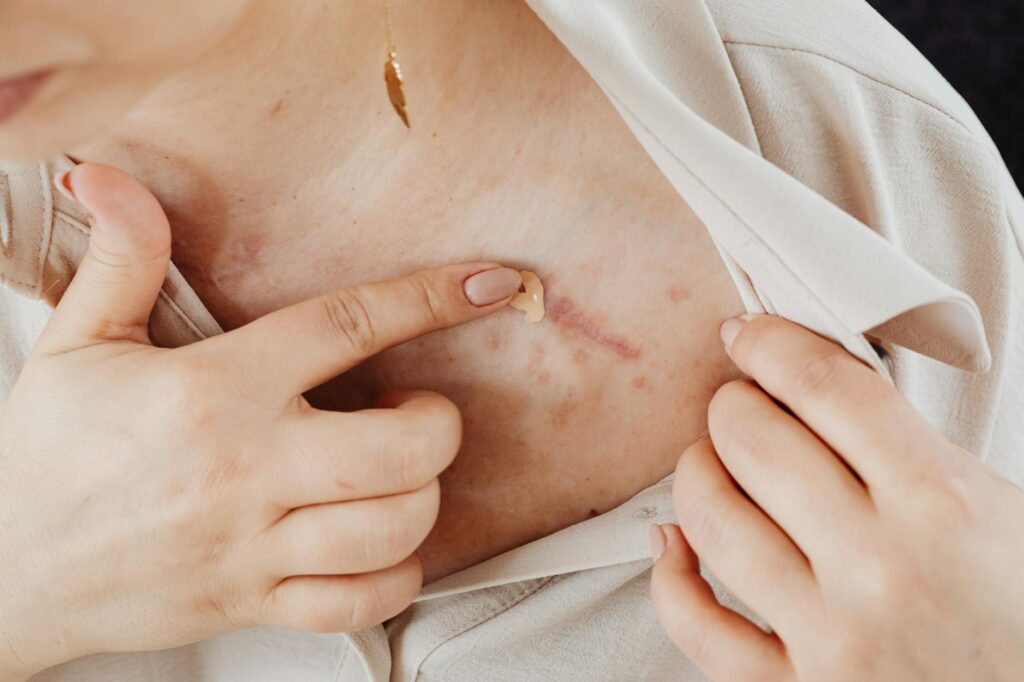
Losartan prevents scar formation by blocking the angiotensin II type 1 (AT1) receptor, which normally triggers the transforming growth factor-beta (TGF-β) signaling cascade that drives excessive collagen production and fibroblast activation. When you block this receptor, you cut off the molecular switch that tells your skin cells to create scar tissue in the first place. This mechanism has been documented in research showing that losartan-treated skin produces significantly less collagen and fewer markers of fibrosis compared to untreated skin. For example, in animal models of cutaneous scarring, AT1 receptor blockade resulted in measurably decreased scar formation.
This article explores how losartan works at the cellular level, what makes it different from other scar-prevention approaches, and what the latest clinical evidence tells us about its potential for both post-acne scars and other types of dermal fibrosis. The mechanism is fundamentally different from topical treatments that simply moisturize or exfoliate the skin surface. Instead of working on the scar after it forms, losartan addresses the underlying biological process that creates the scar in the first place—the activation and overproduction of collagen by fibroblasts during wound healing. Understanding this distinction is important because it explains why losartan has shown promise not just for preventing new scars, but also for treating existing fibrosis that has persisted for years.
Table of Contents
- How Does Losartan Block AT1 Receptors to Reduce Scar Formation?
- The TGF-β/Smad Signaling Pathway and Why Blocking It Prevents Scarring
- Fibroblast Activity—How Losartan Reduces Contractility and Migration
- Topical Losartan Application—Practical Considerations for Skincare Use
- Limitations and Potential Side Effects of Losartan Therapy
- Recent Clinical Evidence—Corneal Scarring and Broader Applications
- Future Directions in Scar Prevention and Losartan Combination Therapies
- Conclusion
How Does Losartan Block AT1 Receptors to Reduce Scar Formation?
Losartan is an angiotensin II receptor blocker (ARB) originally developed to treat high blood pressure by relaxing blood vessel walls. The AT1 receptor sits on the surface of many cell types in the skin, including fibroblasts, and when angiotensin II binds to it, a cascade of signaling begins that ultimately leads to fibroblast activation and excessive collagen synthesis. By occupying this receptor, losartan prevents angiotensin II from triggering that cascade. Think of it like changing the lock on a door—if the key (angiotensin II) can’t insert into the lock (AT1 receptor), the signal never gets delivered inside the cell.
Research has shown that this blockade specifically decreases the expression of genes and proteins involved in fibrosis. When losartan-treated human dermal fibroblasts were compared to untreated controls, the treated cells showed significantly reduced expression of TGF-β1, collagen type I, and monocyte chemoattractant protein-1 (MCP-1)—all molecules that either directly produce scar tissue or recruit inflammatory cells that perpetuate the scarring process. In animal models of cutaneous scarring, AT1 receptor blockade led to measurably decreased scar formation compared to control wounds, indicating that this mechanism translates from the cell culture dish to actual skin wound healing. One important limitation: losartan works best when applied or taken before or very early during the wound-healing process, during the phase when fibroblasts are actively proliferating and laying down collagen. If fibrosis has already fully developed into mature scar tissue with cross-linked collagen fibers, the mechanism becomes less effective because the signaling cascade that created the scar is no longer active.
The TGF-β/Smad Signaling Pathway and Why Blocking It Prevents Scarring
The TGF-β/Smad pathway is the primary molecular highway driving scar formation in wounds. After tissue injury, TGF-β1 is released by inflammatory cells and activated fibroblasts. This growth factor then binds to receptors on fibroblast surfaces, triggering a cascade in which Smad proteins shuttle into the nucleus and turn on genes for collagen synthesis. The more TGF-β signaling occurs, the more scar tissue forms. Losartan disrupts this by reducing TGF-β1 expression in the first place—when AT1 receptors are blocked, fibroblasts produce less TGF-β1, weakening the entire pathway before it gets started.
A 2022 study published in Scientific Reports demonstrated that losartan cream directly inhibits scar formation via the TGF-β/Smad pathway, confirming that this mechanism works in a topical formulation, not just systemically. The research showed measurable reductions in collagen expression and fibroblast activation markers in treated tissue compared to controls. This is particularly relevant for acne scars and post-surgical scars, where excessive TGF-β signaling drives the fibroblast overgrowth that creates the depressed or hypertrophic appearance. However, the TGF-β pathway is complex and serves multiple purposes in wound healing—some level of TGF-β signaling is actually necessary for normal wound closure and tissue repair. This means that while blocking this pathway prevents excessive scarring, completely suppressing it might impair normal healing. The goal isn’t to eliminate TGF-β signaling entirely, but to modulate it enough to prevent the pathological scar formation that occurs when the response becomes excessive.
Fibroblast Activity—How Losartan Reduces Contractility and Migration
Fibroblasts are the cells responsible for producing collagen and contracting wounds during healing. They’re essential for normal repair, but when overactivated, they create scars. Losartan decreases both fibroblast contractility and fibroblast migration—two fundamental mechanisms driving scar formation. Without the ability to contract and migrate effectively, fibroblasts cannot lay down the excessive collagen matrix that characterizes scar tissue. This dual effect on fibroblast behavior represents one of losartan’s most important advantages over other anti-fibrotic approaches.
In treated human dermal fibroblasts, the reduction in contractility is accompanied by decreased expression of proteins like alpha-smooth muscle actin (α-SMA), which is the marker that fibroblasts express when they become activated and scar-forming. The suppression of MCP-1 production is also significant because this chemokine normally recruits monocytes and macrophages to the wound site, cells that further amplify the pro-fibrotic environment. By reducing MCP-1, losartan indirectly suppresses the inflammatory cascade that perpetuates scar formation. One practical consideration: fibroblast behavior varies depending on the type of wound and the tissue location. Fibroblasts in highly mobile areas of the face (like around the lips or eyes) may respond differently to losartan than fibroblasts in less mobile areas (like the forehead or chest). Similarly, fibroblasts in people with genetic predisposition to hypertrophic or keloid scarring may require higher concentrations or longer treatment durations to suppress their activity adequately.
Topical Losartan Application—Practical Considerations for Skincare Use
While losartan was originally developed as an oral medication for blood pressure, recent research has explored topical formulations for direct application to scarred or wound-prone skin. The advantage of topical delivery is that it concentrates the drug at the site of injury while minimizing systemic absorption and side effects. Losartan cream applied directly to wound sites has been shown to inhibit scar formation without the cardiovascular or metabolic effects associated with oral administration. Topical losartan appears most effective when applied during the early inflammatory and proliferative phases of wound healing—roughly the first 1-2 weeks after injury.
Some clinical evidence suggests that starting losartan treatment within days of acne extraction or other skin procedures may yield better results than starting weeks or months after the injury occurred. The 2025 update on topical losartan in corneal scarring documented successful treatment of scarring that had persisted for 3 years, representing the longest-standing scar successfully treated, though the mechanism may work better as a preventive than as a treatment for very mature scars. One tradeoff: topical delivery requires more frequent application (typically multiple times daily) compared to oral medication, and the penetration of losartan through the outer skin barrier may be limited. For deeper dermal scarring, systemic administration or intradermal injection might be more effective, though those approaches come with greater risks of systemic side effects and require medical supervision.
Limitations and Potential Side Effects of Losartan Therapy
Not all scars respond equally well to losartan treatment. Hypertrophic scars and keloids, which are characterized by excessive collagen production and fibroblast proliferation, appear to be more responsive than atrophic or depressed scars like typical acne pitting. This is because hypertrophic scars are actively being formed and remodeled, keeping the fibroblasts in an activated state where AT1 receptor blockade can intervene. Atrophic scars, by contrast, represent a loss of collagen rather than an excess, and losartan’s mechanism doesn’t address that type of damage. Topical losartan formulations may cause skin irritation, dryness, or sensitivity in some individuals, particularly if the formulation contains penetration enhancers or other irritating ingredients.
The 2025 clinical update noted potential epithelial toxicity concerns with certain dosages, suggesting that the optimal concentration and application frequency remain subjects of ongoing research. Additionally, losartan is not selective—it affects AT1 signaling throughout the body, so individuals taking losartan systemically (for blood pressure) may experience effects on other tissues beyond the skin. Another important limitation: losartan is not a substitute for proper wound care during the healing phase. Keeping wounds clean, protecting them from infection, minimizing tension on wound edges, and avoiding sun exposure are all critical for preventing scars. Losartan enhances these basic measures but cannot overcome poor wound management practices.

Recent Clinical Evidence—Corneal Scarring and Broader Applications
Recent clinical applications of topical losartan have extended beyond dermatology into ophthalmology, with a 2025 publication documenting successful treatment of corneal scarring fibrosis in a patient with scarring that had persisted for 3 years following varicella zoster virus keratitis infection. This represents the longest-standing prior scarring documented before successful losartan treatment. The clinical success in corneal tissue, which is metabolically and histologically different from skin, suggests that losartan’s anti-fibrotic mechanism may be broadly applicable across multiple tissue types.
Beyond skin and cornea, research has documented that losartan suppresses TGF-β1 production and inhibits fibrosis in liver and other tissues through the same AT1 receptor blockade mechanism. This multi-tissue efficacy supports the idea that angiotensin II signaling is a fundamental driver of pathological fibrosis, not just in skin but across many organ systems. For acne and other dermatological scars, this broader clinical evidence provides confidence that the mechanism is robust and not limited to artificial laboratory conditions.
Future Directions in Scar Prevention and Losartan Combination Therapies
As research into losartan’s anti-fibrotic properties continues, future applications may include combination therapies that target fibrosis through multiple mechanisms simultaneously. For example, losartan could potentially be combined with other anti-fibrotic agents, topical retinoids, or laser treatments to produce greater scar reduction than any single approach alone. The fact that losartan works specifically through TGF-β pathway inhibition means it may complement treatments that work through entirely different mechanisms, such as devices that remodel collagen through thermal or mechanical means.
The development of topical formulations optimized for skin penetration and tolerability remains an active area of research. As dermatologists and formulators better understand how to deliver losartan effectively to the dermis (the layer where fibroblasts reside), the clinical utility for post-acne scars and other traumatic scars will likely improve. The expanding body of clinical evidence, including the 2025 corneal scarring data, suggests that losartan is moving from experimental status to a legitimate consideration in scar management protocols.
Conclusion
Losartan prevents scar formation by blocking the AT1 receptor, which normally activates the TGF-β/Smad signaling pathway—the primary molecular mechanism driving excessive collagen production and fibroblast activation during wound healing. By reducing TGF-β1 expression and decreasing fibroblast contractility and migration, losartan interrupts the biological process that creates scars rather than attempting to reverse scars after they form.
Recent clinical evidence, including successful treatment of scarring that persisted for years, demonstrates that this mechanism translates from laboratory research to real-world efficacy. If you have recent scars from acne extractions, wounds, or procedures, discussing topical or systemic losartan with a dermatologist may be worthwhile, particularly if you have a family history of hypertrophic or keloid scarring. For existing mature scars, losartan appears less effective, but for scar prevention and early-stage scar modulation, it represents a genuinely novel approach grounded in cutting-edge molecular understanding of fibrosis.