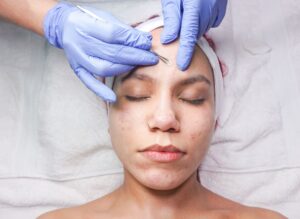
Steroid creams work by suppressing the inflammatory response that triggers postinflammatory hyperpigmentation (PIH) after acne laser treatment. When your skin undergoes ablative fractional laser resurfacing for acne scars or active lesions, the treatment creates controlled injury that stimulates collagen remodeling—but this inflammation can overstimulate melanin production in susceptible skin, leading to dark spots that persist for months. A topical corticosteroid applied immediately after the procedure can dramatically reduce this risk: studies show that ultra-potent clobetasol propionate 0.05% reduced PIH incidence to just 39% in dark-skinned patients, compared to 75% when using basic petrolatum alone—a 36 percentage point difference in outcomes.
This article covers how steroid creams prevent PIH, which strengths work best, proper application timing, combination therapy strategies, duration limits, and why certain populations benefit most from this preventive approach. Beyond prevention, understanding steroid cream’s role in post-laser recovery helps you make informed decisions with your dermatologist and manage realistic expectations. Steroid creams won’t reverse existing PIH (that requires different treatments), but they’re your most powerful tool for preventing it from developing in the first place.
Table of Contents
- How Do Steroid Creams Prevent PIH After Laser Treatment?
- Ultra-Potent Versus Mid-Strength Steroids—Which Actually Works?
- The Critical Timing Window—When to Start Steroid Application
- Combination Therapy—Why Steroid Cream Alone Isn’t the Complete Solution
- The 8-Week Duration Limit—Why You Can’t Use Steroid Cream Indefinitely
- Special Consideration—PIH Prevention in Darker Skin Tones
- Looking Forward—Integration of Steroid Prevention Into Modern Laser Protocols
- Conclusion
How Do Steroid Creams Prevent PIH After Laser Treatment?
postinflammatory hyperpigmentation develops when the skin’s inflammatory response to laser injury triggers excessive melanin production. The laser creates thousands of microscopic thermal injuries to stimulate new collagen and remove damaged tissue—a beneficial process for treating acne scars. However, this controlled trauma activates immune cells and inflammatory mediators that can signal melanocytes (pigment-producing cells) to increase melanin synthesis. In people with darker skin tones, this inflammatory cascade is particularly likely to result in unwanted pigmentation because melanocyte reactivity is already higher. Steroid creams interrupt this process by suppressing the inflammatory response before it escalates to visible PIH. Topical corticosteroids work by binding to glucocorticoid receptors in skin cells, reducing the production of inflammatory cytokines and chemokines that stimulate melanocytes.
When applied in the immediate post-procedure window—ideally within hours of laser treatment—they essentially dampen the inflammatory signal before melanin overproduction becomes established. This is why timing matters so much: applying steroids days or weeks after the procedure is far less effective than immediate application. The distinction between prevention and treatment is critical. Steroid creams are preventive tools; they work best when applied to unaffected skin immediately after injury. Once hyperpigmentation has already developed and melanin has been deposited in the dermis, steroid creams alone cannot eliminate it. At that point, you’d need depigmenting agents (hydroquinone), retinoids to speed cell turnover, or repeat laser treatments. This is why dermatologists emphasize proactive steroid use rather than waiting to see if PIH develops.
Ultra-Potent Versus Mid-Strength Steroids—Which Actually Works?
Not all steroid creams are equally effective for PIH prevention. The potency classification matters significantly: ultra-potent steroids like clobetasol propionate 0.05% outperform mid-strength options such as triamcinolone acetonide 0.02% for post-laser protection. Research directly comparing these strengths demonstrates that clobetasol’s superior anti-inflammatory power translates to better clinical outcomes—the 39% PIH incidence with clobetasol versus 75% with petrolatum represents the most convincing evidence in the literature. Why the difference? Ultra-potent steroids have greater receptor binding affinity and penetrate the dermis more effectively, where much of the inflammatory cascade driving PIH occurs.
Mid-strength steroids may suppress surface inflammation without adequately addressing the deeper inflammatory signals that activate melanocytes. However, this potency advantage comes with a tradeoff: stronger steroids carry higher risk of steroid-induced skin atrophy, telangiectasia (visible blood vessels), and systemic absorption if used on large areas or for extended periods. This creates a practical clinical decision: dermatologists typically prescribe ultra-potent steroids for the first 1-2 weeks post-laser when PIH risk is highest, then transition to mid-strength formulations for the remaining 6-8 week window. This approach captures the preventive benefit of maximum strength during the critical inflammation phase while minimizing long-term potency-related side effects. If your dermatologist prescribes a mid-strength steroid expecting equivalent protection, it’s worth discussing whether an ultra-potent option might be more appropriate for your specific risk factors.
The Critical Timing Window—When to Start Steroid Application
The timing of steroid cream application is perhaps the single most important variable determining whether it actually prevents PIH. Research consistently shows that topical corticosteroids applied immediately after ablative fractional laser resurfacing significantly decrease PIH risk, particularly in darker skin types. “Immediately” means within hours of the procedure—ideally before you leave the dermatology office or within the first 24 hours at maximum. Here’s why this matters: the inflammatory cascade triggering melanocyte activation begins within minutes of laser injury. Immune cells migrate to the injury site, inflammatory mediators are released, and signal molecules start accumulating that tell melanocytes to produce more pigment.
If you wait days or weeks to start steroids, you’re trying to suppress an inflammatory process that’s already well-established and escalating. Your dermatologist will typically apply the first steroid cream dose immediately after the procedure ends, while your skin is still healing. A practical example: after fractional CO2 laser treatment for acne scars on your cheeks, you experience controlled thermal injury across the treated area. Starting clobetasol propionate 0.05% within hours reduces the inflammatory signal reaching your melanocytes. In contrast, delaying steroid initiation until 5 days post-laser—perhaps because the prescription wasn’t filled promptly—means your melanocytes have already received days of activation signals. Even if you then use steroids religiously for 8 weeks, the preventive benefit is substantially diminished because the inflammatory momentum has already shifted toward melanin overproduction.

Combination Therapy—Why Steroid Cream Alone Isn’t the Complete Solution
While steroid creams are powerful anti-inflammatory agents, they’re most effective as part of a multi-modal approach. Medical literature and clinical practice guidelines consistently show that combining steroids with retinoids and hydroquinone produces superior PIH prevention compared to steroid monotherapy. The most evidence-backed combination is a triple-combination cream containing hydroquinone 4%, fluocinolone acetonide 0.1%, and tretinoin 0.05%—formulations sometimes compounded specifically for post-laser patients. How these three components work together: the corticosteroid (fluocinolone) suppresses the inflammatory drive to melanin production. Hydroquinone, a tyrosinase inhibitor, directly reduces melanin synthesis within melanocytes.
Tretinoin accelerates epidermal cell turnover, helping shed any melanin that has already been produced before it deposits deeper into the dermis. Applied together in the post-laser window, they address PIH through three complementary mechanisms—reducing the inflammatory signal, reducing pigment production, and accelerating pigment clearance. Not all dermatologists prescribe triple combinations routinely; some use steroids with retinoids but not hydroquinone, or vice versa. If your dermatologist recommends steroid monotherapy post-laser, especially if you have darker skin or previous hyperpigmentation history, it’s reasonable to ask whether adding a retinoid or hydroquinone would be appropriate. This conversation is especially important if you’re at higher risk for PIH. The research supports combination therapy as the most evidence-based approach.
The 8-Week Duration Limit—Why You Can’t Use Steroid Cream Indefinitely
Topical corticosteroids should be used for no more than 8 weeks post-treatment to minimize steroid-induced skin changes. This isn’t arbitrary—it’s based on accumulated evidence about steroid safety on facial skin. Beyond 8 weeks, even ultra-potent topical steroids can cause adverse effects including skin atrophy (thinning), telangiectasia (persistent redness and visible blood vessels), perioral dermatitis, and steroid-induced roscea-like changes. The challenge is that PIH development doesn’t follow a neat 8-week timeline. Many patients continue to experience darkening past week 4, and the inflammatory phase driving new pigment production can persist beyond 8 weeks in some cases.
However, extending steroid use beyond this window to prevent additional PIH carries real risks. After 8 weeks, your dermatologist will typically recommend transitioning to non-steroid approaches: continuing retinoid therapy, using hydroquinone if not already incorporated, adding niacinamide or vitamin C serums, and potentially sun protection to prevent worsening of existing hyperpigmentation. This timing creates an important clinical reality: if you’re still developing new pigmentation after week 8, steroid continuation isn’t the answer. Instead, you’d shift to depigmenting agents and potentially discuss repeat laser treatment once the inflammation has fully resolved (typically 3-6 months post-initial procedure). Planning for this transition with your dermatologist before you start steroid therapy helps set realistic expectations about what these creams can and can’t accomplish.

Special Consideration—PIH Prevention in Darker Skin Tones
Postinflammatory hyperpigmentation disproportionately affects people with darker skin types (Fitzpatrick IV-VI), not because their skin is more prone to injury, but because their melanocytes are inherently more reactive to inflammatory signals. Studies specifically examining PIH after ablative fractional laser in dark-skinned populations found that 75% developed noticeable hyperpigmentation without preventive steroids—more than double the rate in lighter skin types. The research showing clobetasol propionate reducing PIH to 39% was conducted in this higher-risk population, making it directly relevant to determining if you’d benefit most from steroid prevention.
If you have darker skin and are considering laser treatment for acne scars or active acne, discussing steroid-based PIH prevention with your dermatologist should be a priority conversation, not an afterthought. Your provider may recommend starting clobetasol propionate immediately after the procedure and potentially continuing combination therapy longer (though still within the 8-week steroid limit). The evidence strongly supports being proactive rather than reactive—preventing PIH is far easier than treating established hyperpigmentation in darker skin.
Looking Forward—Integration of Steroid Prevention Into Modern Laser Protocols
As laser treatment for acne becomes more standardized, steroid-based PIH prevention is increasingly incorporated as part of the procedural protocol rather than left as an optional post-care step. Dermatologists who perform high volumes of fractional CO2 and similar ablative lasers now routinely prescribe preventive steroids as standard care, especially for patients at elevated risk.
This shift reflects the evidence base demonstrating clear benefit and acceptable safety profiles when used appropriately. Emerging discussions in dermatology now center on optimizing the combination and timing of preventive agents—whether ultra-potent steroids for week 1-2 followed by transition to combination creams works better than simultaneous initiation of triple therapy, or whether different racial and ethnic groups with distinct melanocyte reactivity patterns might benefit from individualized protocols. These refinements will likely improve PIH prevention further, but the fundamental principle remains: steroid-based anti-inflammatory therapy in the immediate post-laser window is your most evidence-supported defense against this common complication.
Conclusion
Steroid creams prevent postinflammatory hyperpigmentation after acne laser treatment by suppressing the inflammatory cascade that activates melanocytes to overproduce pigment. Ultra-potent formulations like clobetasol propionate 0.05% reduce PIH incidence from 75% to 39% in vulnerable populations when applied immediately after laser procedures, making them the gold-standard preventive agent. The critical factors determining whether steroid therapy actually works are: ultra-potent strength (not mid-strength), immediate application within hours of treatment, combination with retinoids and hydroquinone for synergistic benefit, and strict adherence to the 8-week duration limit to avoid steroid-induced side effects.
If you’re planning laser treatment for acne scars or active acne, especially if you have darker skin or prior hyperpigmentation history, ensure your dermatologist has a documented PIH prevention protocol in place before your procedure date. This conversation should happen during consultation, not as an afterthought post-treatment. Having steroids and supporting depigmenting agents prescribed and ready to start immediately after your procedure—rather than delayed by pharmacy fills or office visits—can meaningfully reduce your risk of developing persistent dark spots that would otherwise require months or additional treatments to resolve.