

Punch excision scars typically appear as small, well-defined depressions or indentations in the skin that gradually fade in color from red or purple to a more skin-matched tone over 12 to 18 months. The final appearance depends on how deep the excision went, your skin type, and how your body heals—some scars become barely noticeable while others remain slightly visible as shallow indentations that catch light at certain angles. For example, a punch excision scar on the cheek might start as a 2-3mm red crater immediately after removal of a severe acne cyst, but after a year of healing, could appear as a light skin-colored divot that’s only noticeable in direct overhead lighting. This article covers what to expect at each stage of scar maturation, how different factors influence final appearance, realistic timelines for healing, and treatment options if the scar doesn’t fade enough on its own.
Table of Contents
- How Deep Punch Excision Determines Scar Visibility After Healing
- Color Changes and Pigmentation During Healing
- Texture and Indentation in the Healed Scar
- How Skin Type Influences Scar Appearance
- What Happens If the Scar Doesn’t Improve Enough
- Scar Revision Options for Persistent Indentation
- Long-Term Evolution and Prevention of Future Acne Scars
- Conclusion
How Deep Punch Excision Determines Scar Visibility After Healing
The depth of the original punch excision directly dictates how prominent your scar will look during and after healing. When a dermatologist removes a severe acne lesion, they typically excise down through the dermis—the thick collagen layer beneath the epidermis—to prevent the cyst from reforming. A shallow punch (barely through the epidermis) might leave a mark that’s barely perceptible after six months, appearing only as a slight texture change if you run your finger across the skin.
Deeper excisions that extend into the deeper dermis or subcutaneous tissue create more noticeable bowl-shaped depressions, because the body has to rebuild collagen from the bottom up to fill that void—and it often can’t produce enough new collagen to completely restore the original skin level. However, if the punch goes extremely deep, paradoxically the final scar can sometimes look better than a medium-depth punch, because dermatologists know they need to use special closure techniques or let the body fill it in gradually. A punch so deep that it might scar badly will instead be treated with punch elevation or grafting, which tends to produce better results than leaving a deep crater to fill with disorganized scar tissue.

Color Changes and Pigmentation During Healing
Immediately after punch excision, the wound site is red or purple due to inflammation and blood vessel dilation—this is completely normal and doesn’t indicate the scar will be permanently colored. Over the first two weeks, the wound forms a crust that eventually sloughs off, revealing pink or darker red tissue underneath. By weeks three to six, the color typically remains red or slightly purple as new collagen is being laid down and the site is still actively inflamed. The critical point is that this red-to-purple color can persist for months even though the wound itself is technically closed.
The timeline for pigment normalization varies dramatically by skin type. On lighter skin tones, punch excision scars usually transition from red to pink around month three, then gradually fade toward skin tone by month nine to twelve. On darker skin tones (particularly deeper brown and Black skin), the scar can remain noticeably darker or more pigmented than surrounding skin for much longer—sometimes 18 to 24 months—because of post-inflammatory hyperpigmentation, where melanin production increases in response to healing. If your scar still looks red or darker at month four, this doesn’t mean the collagen remodeling is failing; it usually just means the pigmentation is taking longer to normalize than the scar texture itself.
Texture and Indentation in the Healed Scar
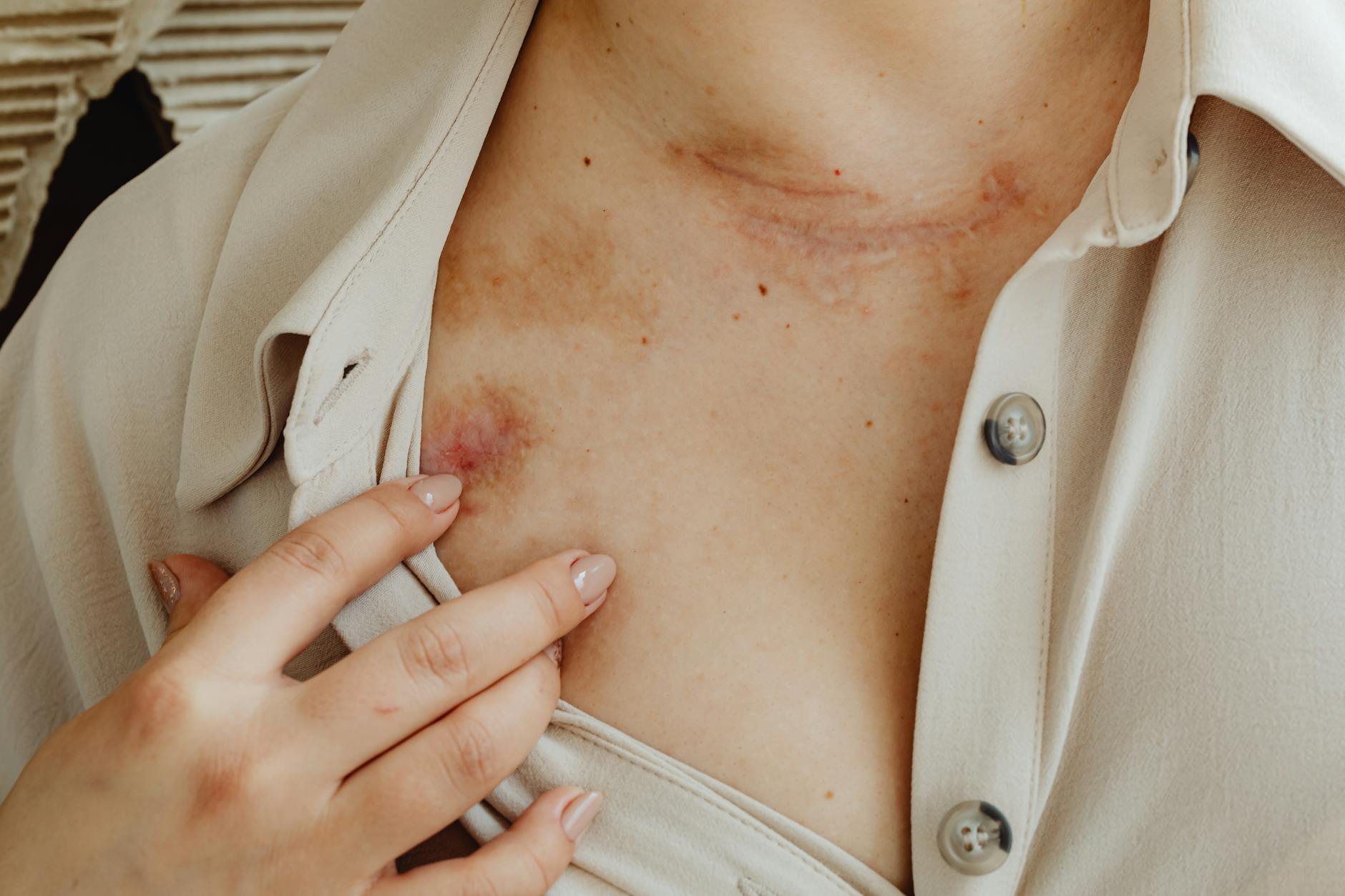
The most defining characteristic of a healed punch excision scar is its texture—whether it appears as a subtle indentation, a smooth depression, or nearly invisible, depending on how well collagen has rebuilt. In the best-case scenario (most common on younger patients with good healing capacity), the scar becomes a very shallow depression that’s barely palpable when you run your fingernail across it; it might only be visible if you stretch the skin or catch it in certain lighting. This happens because the skin naturally attempts to flatten the crater over time as collagen remodeling continues—even after apparent healing, subtle remodeling can continue for up to two years.
A more typical outcome, especially for scars on textured areas like the cheeks or chin, is a slightly deeper indentation that’s noticeable in direct light but not obvious in normal conversation distance. For example, a punch excision scar that initially looked like a 2-3mm deep crater often settles into appearing as a depression that’s roughly 0.5-1mm deep after one year—still visible if you know to look for it, but substantially improved. Some scars, particularly those on very textured skin or deeper lesions, can remain as visible indentations indefinitely, though they typically improve somewhat even after the first year of dramatic change.
How Skin Type Influences Scar Appearance
Your skin type plays one of the largest roles in how visible a punch excision scar will be long-term, and this factor is sometimes underestimated when people compare their results to celebrity or social media examples. Fair, thin-skinned individuals often see faster color normalization but may have scars that remain slightly more obviously indented because thin skin has less collagen to draw from for rebuilding. In contrast, thicker-skinned individuals (very common in deeper skin tones) can sometimes heal with less visible indentation but may experience prolonged redness or hyperpigmentation that makes the scar more noticeable during the critical months two through eight.
Combination and oily skin types also matter—skin with naturally more sebaceous glands tends to have slightly thicker dermis and may fill punch excision sites somewhat better, though the inflammation and healing response might be more pronounced. Additionally, very dry or sensitive skin can become inflamed for longer during healing, which can prolong the red/purple phase. If you have acne-prone skin with existing hyperpigmentation or melasma, a punch excision scar may be more noticeable against an already uneven skin tone, so you might benefit from earlier treatment of remaining indentation rather than waiting for passive healing.
What Happens If the Scar Doesn’t Improve Enough
Even after 12 to 18 months of natural healing, some punch excision scars remain noticeable—either as indentations, persistent pigment changes, or both. This outcome is more likely if the original lesion was very deep, if you’re prone to keloid or hypertrophic scarring, or if your skin type tends toward prolonged inflammation. However, if a scar remains stable and isn’t actually worsening after month 12, this doesn’t mean you’re stuck with it forever; multiple treatment options exist to improve remaining indentation.
A critical warning: some dermatologists recommend waiting the full 18 months before pursuing scar revision, because treating too early can disrupt the natural collagen remodeling process and potentially worsen the scar. If you’re considering treatments like microneedling, chemical peels, or laser resurfacing to improve a punch excision scar, discuss timing with your dermatologist—treating a 3-month-old scar is very different from treating a 12-month-old scar, and the differences in outcomes are significant. You can safely apply silicone scar creams or use makeup to camouflage the scar during the waiting period without interfering with healing.
Scar Revision Options for Persistent Indentation
If a punch excision scar remains visibly indented after 18 months, several evidence-based treatments can improve it further. Punch elevation, where the dermatologist uses a special instrument to lift the scarred tissue up to the level of surrounding skin (essentially removing the depression itself), works well for some scars but requires careful placement to avoid creating a new problem. Dermal fillers—either temporary hyaluronic acid or semi-permanent options—can be injected directly under a punch scar to lift it level with surrounding skin; this is immediate and non-invasive but requires maintenance injections every 6-18 months depending on the filler type.
Microneedling or fractional laser treatments stimulate collagen production in and around the scarred area, gradually filling in shallow indentations. These treatments work better on already-healing scars (month 12 and beyond) than on fresh scars, because the tissue is more stable. For very deep or stubborn punch scars, subcision (using a special needle to break up scar tissue attachments beneath the skin) followed by filler or microneedling often produces better results than either treatment alone. The reality is that no treatment will make every scar completely invisible, but most scars can be noticeably improved to the point where they’re not the first thing people notice when looking at your face.
Long-Term Evolution and Prevention of Future Acne Scars
One important reality about punch excision scars is that they continue to evolve subtly even after the first year. Many patients report that their scars look better at month 18 or 24 than they did at month 12—not dramatically, but noticeably. This ongoing improvement is due to continued collagen remodeling in the dermal layer, where the body gradually optimizes the collagen architecture even when surface-level changes have stopped. However, this also means that some scars do reach a “final form” where further improvement plateaus; knowing whether your scar falls into the “continuing to improve” or “stable” category typically becomes clear by month 15.
Moving forward, the most important step is preventing future severe acne that would require punch excision. Punch excision is typically reserved for cysts, nodules, or very deep lesions that won’t respond to standard acne treatment—so addressing acne with the right combination of topical medications (retinoids, benzoyl peroxide, salicylic acid) and possibly oral treatments like antibiotics or isotretinoin can prevent the need for future excisions. The punch excision scar you have now is a reminder that even though that cyst is gone, the underlying acne tendency is still present unless treated comprehensively. Many patients find that consistent acne maintenance prevents them from developing additional scars that would compound the problem.
Conclusion
Punch excision scars typically appear as shallow indentations with associated redness or pigmentation changes immediately after removal, then gradually improve over 12 to 18 months as collagen remodels and color normalizes. The final appearance depends heavily on excision depth, skin type, and individual healing capacity—some scars fade to barely visible marks while others remain as subtle indentations. The most important expectation to set is that improvement is gradual and often continues beyond one year, so patience during months 3-12 is warranted before considering revision treatments.
If you’re currently managing a punch excision scar, the best immediate steps are protecting the healing site from sun exposure (UV can darken scars), avoiding aggressive skincare that irritates the area, and using silicone products to help normalize collagen deposition. If the scar remains bothersome after 18 months, multiple treatment options exist to further improve it—consult with your dermatologist about whether your specific scar is best served by time alone, supportive treatments like topical care, or active revision procedures. Most importantly, use this experience to guide your acne management going forward, because preventing future severe lesions is far easier than treating their scars.