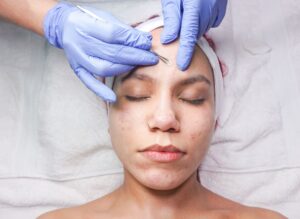
Yes, personalized acne products are becoming the norm rather than the exception. Major skincare brands now offer genetic testing, microbiome analysis, and AI-driven formulation tools that match active ingredients specifically to your skin’s chemistry rather than treating acne as a one-size-fits-all condition. This shift reflects a growing understanding that acne develops differently in each person—one person’s skin barrier needs niacinamide and zinc, while another benefits more from salicylic acid combined with prebiotics—and that generic treatments often fail because they ignore these individual differences.
The move toward personalization is driven by two converging forces: advanced diagnostics that can now measure your skin’s pH, bacterial composition, lipid profile, and genetic predisposition to acne; and data science that can match these findings to specific ingredient combinations that have shown results in people with similar profiles. Unlike the acne treatments available ten years ago, which relied on broad categories like “oily skin” or “sensitive skin,” today’s personalized products are built on molecular matching. This article explores how personalization works in acne treatment, the science behind customized formulations, the real benefits and limitations you should know, how to evaluate personalized products critically, and whether the added cost is justified for your situation.
Table of Contents
- Why Are Acne Experts Pushing Personalized Formulations Over Generic Treatments?
- How Do Companies Personalize Acne Products—And What Are the Real Limitations?
- What Specific Ingredients Are Being Personalized, and How Does This Differ From Standard Acne Products?
- How Do You Know If a Personalized Acne Product Is Actually Right for You, and When Are Generics Still the Better Choice?
- What Are the Hidden Pitfalls and Oversold Claims in Personalized Acne Products?
- The Role of Microbiome Testing in Personalized Acne Products
- The Future of Personalized Acne Products and When This Approach Becomes Mainstream
- Conclusion
- Frequently Asked Questions
Why Are Acne Experts Pushing Personalized Formulations Over Generic Treatments?
The reason dermatologists and skincare scientists increasingly recommend personalized products is straightforward: acne is not caused by one thing. A person with Cutibacterium acnes overgrowth and a compromised skin barrier needs different treatment than someone whose acne is driven by hormonal fluctuations and excess sebum production without barrier damage. Generic treatments—like a standard benzoyl peroxide wash or a one-strength tretinoin—often fail or cause side effects because they don’t account for these underlying differences. Personalized formulations solve this by starting with diagnostics.
Some brands use at-home testing kits that measure skin bacteria levels, pH balance, and sebum production; others use genetic testing to identify whether you carry variants associated with acne-prone skin; still others use AI questionnaires combined with photo analysis to estimate your skin’s needs. A personalized product might contain, for example, 2.5% benzoyl peroxide paired with a prebiotic to rebuild your microbiome and hyaluronic acid to protect your barrier—whereas a standard benzoyl peroxide product would just have the active ingredient plus basic moisturizing fillers. The difference is that the personalized version addresses the specific way acne develops on your skin. Example: A customer with oily, acne-prone skin that also has a weakened barrier (common after over-treating with strong actives) might get a formula with salicylic acid to exfoliate, but also ceramides and centella asiatica to repair the barrier. A standard acne cleanser would likely contain only the salicylic acid, potentially worsening the barrier damage and leading to irritation or rebound oiliness.

How Do Companies Personalize Acne Products—And What Are the Real Limitations?
Personalization happens through several methods, each with different levels of accuracy. The most rigorous approach uses microbial testing: the company sends you a collection kit, you swab your skin, and their lab analyzes the bacterial composition of your microbiome. This tells them what percentage of your skin bacteria is C. acnes versus beneficial species, and informs whether you need antibacterial ingredients, prebiotics, or both. Some brands combine this with a genetic test that identifies whether you carry genes linked to sebum overproduction, skin barrier dysfunction, or inflammatory acne. The limitation here is important: personalization based on one-time testing can miss dynamic factors. Your acne-causing bacteria levels, pH, and sebum production change with stress, diet, hormones, season, and products you’re using. A test taken in February might not reflect your skin in June, especially if you’re cycling hormonal birth control.
Additionally, genetic predisposition doesn’t always predict current severity—you might carry genes for acne but have mild or no acne right now. Some personalized product companies acknowledge this and recommend retesting every few months; others don’t, meaning their formula might become less accurate over time. If you have hormonal acne that fluctuates with your cycle, a personalized product formulated during your luteal phase might not serve you equally well during your follicular phase. Another common personalization method uses AI-driven questionnaires and photo analysis without lab testing. These are less accurate than microbial analysis but faster and cheaper. The algorithm asks about your skin history, current symptoms, lifestyle, and diet, then analyzes photos of your skin to estimate your skin type, inflammation level, and likely acne triggers. The risk is that AI trained on limited datasets can misclassify skin—for example, mistaking rosacea or contact dermatitis for acne, or missing early signs of fungal acne. Before committing to a personalized product based on AI analysis alone, compare its assessment to a dermatologist’s diagnosis if possible.
What Specific Ingredients Are Being Personalized, and How Does This Differ From Standard Acne Products?
Personalized acne formulas adjust several ingredient categories based on your profile: the type and concentration of active exfoliants (salicylic acid, glycolic acid, azelaic acid), the inclusion or exclusion of antibacterial agents (benzoyl peroxide, niacinamide), barrier-repair ingredients (ceramides, cholesterol, essential fatty acids), and microbiome-balancing ingredients (prebiotics, plant extracts known to support beneficial bacteria). A standard acne product line might offer three or four variants—like a cleanser for oily skin, a cleanser for sensitive skin, and a treatment serum. In contrast, a personalized system might generate a cleanser with 2% salicylic acid plus prebiotics for one customer, and a cleanser with 0.5% salicylic acid plus ceramides for another, based on their individual testing.
Some brands take this further by adjusting the pH, the humectant blend, and the emulsifier system to match your skin’s specific needs. Example: Curology, a telemedicine acne service, creates custom formulations based on a photo and questionnaire assessment by a dermatology provider. A prescription might be 4% azelaic acid, 1% clindamycin, and 4% niacinamide for someone with rosacea-like acne; another person might get 5% benzoyl peroxide, 1% tretinoin, and 1% clindamycin. Neither formula would work for both people—the first person would likely experience irritation from benzoyl peroxide and tretinoin, while the second person might not get strong enough acne clearance from azelaic acid alone.

How Do You Know If a Personalized Acne Product Is Actually Right for You, and When Are Generics Still the Better Choice?
Evaluate personalized products by checking three things: the credibility of their testing method, the transparency of their ingredient sourcing and concentrations, and whether they’re recommending retesting or formula adjustments over time. If a company sends you a genetic test, verify that the genes they’re testing are actually linked to acne (not every genetic acne test is rigorous). If they’re using AI, ask whether their training data is published and whether they’re comparing results to dermatologist assessments. Reputable personalized brands publish their validation studies or at least explain their methodology clearly. That said, generic acne products are still the right choice if you already know your acne triggers and what works for you.
If you’ve used salicylic acid for five years with clear results, a personalized formula might offer marginal improvement at much higher cost—often $100 to $300 per month for prescription personalization, versus $8 to $20 for a drugstore benzoyl peroxide wash. Similarly, if your acne is mild and responds well to basic cleansing and sunscreen, the complexity and cost of personalization isn’t justified. Personalization makes the most sense for people with moderate-to-severe acne, treatment-resistant acne, or acne complicated by other skin conditions like rosacea or eczema. A practical comparison: A person with straightforward comedonal acne on their forehead might do equally well with a $12 salicylic acid cleanser as with a $300/month personalized prescription. A person with cystic hormonal acne, a compromised barrier from over-treating, and mild rosacea would likely benefit far more from personalization because the risk of adverse effects is higher and the underlying mechanisms are more complex.
What Are the Hidden Pitfalls and Oversold Claims in Personalized Acne Products?
The biggest pitfall is that personalization companies often claim higher efficacy than the evidence supports. A brand might say “scientifically formulated for your unique skin” based on a small study of their algorithm or a testimonial-driven marketing campaign, but the actual clinical improvement compared to a well-chosen generic product might be modest. Additionally, many personalized products are sold as subscription services, meaning you’re locked into monthly deliveries even if you want to stop or adjust your treatment. Cancellation can be difficult, and the company keeps your personal data and microbiome test results. Another hidden issue: personalized products are not regulated differently than generic acne products.
If a personalized product contains a prescription active like tretinoin or adapalene, it requires a prescription and medical oversight—which is actually a good thing for safety. But some direct-to-consumer personalized brands blur this line, offering “semi-prescription strength” formulas that skirt regulatory requirements or make claims about efficacy they haven’t rigorously tested. Always verify that any personalized prescription product is issued by a licensed provider (dermatologist or nurse practitioner) who has reviewed your skin and medical history, not just an AI assessment. Finally, personalization assumes that your acne is driven by factors the test measures. If your acne is primarily hormonal and triggered by androgens or cortisol fluctuation, a personalized topical formula—no matter how well-matched to your microbiome—might not solve the root problem. You might need systemic treatment (birth control, spironolactone) combined with a topical, but the personalized product company is only addressing the topical side of the equation.

The Role of Microbiome Testing in Personalized Acne Products
Microbiome testing has emerged as one of the more scientifically grounded approaches to personalization because acne is fundamentally a dysbiosis problem—an imbalance where C. acnes overgrows while beneficial species decline. Testing your skin microbiome reveals the ratio of acne-causing to beneficial bacteria, the diversity of your bacterial community, and sometimes the presence of fungal species that might complicate acne (like Malassezia, which can trigger fungal acne that looks similar to bacterial acne but requires different treatment). Example: If your test shows that 40% of your skin bacteria is C. acnes while a healthy microbiome typically has less than 10%, and you have low diversity, a personalized formula might include benzoyl peroxide to reduce C.
acnes load, plus prebiotics to encourage beneficial bacteria regrowth. If your test shows moderate C. acnes levels but very low diversity, the formula might skip benzoyl peroxide and instead focus on microbiome-rebuilding ingredients like lactobacillus lysates or inulin. This targeted approach is more effective than a generic benzoyl peroxide wash used by someone whose acne isn’t primarily a C. acnes overgrowth problem.
The Future of Personalized Acne Products and When This Approach Becomes Mainstream
As technology improves and costs decline, personalization will likely become the standard for moderate-to-severe acne treatment. More brands are integrating real-time monitoring—using at-home devices or smartphone apps to track your skin’s condition over time and adjust formulas accordingly. Some researchers are exploring implantable or wearable sensors that continuously monitor skin chemistry, though these are still experimental. Additionally, telemedicine dermatology platforms are increasingly combining AI-assisted diagnosis with provider oversight, making personalized prescriptions more accessible and affordable.
However, the future also depends on regulation and standardization. As personalization becomes mainstream, regulators will likely require higher evidence standards for efficacy claims, and clear labeling of what’s tested versus what’s inferred. The skincare industry will probably converge on a few dominant microbiome or genetic markers that all companies measure, allowing for better comparison between brands. The shift will also make education more critical—consumers will need to understand what their test results mean and why a particular formula was chosen, not just trust a brand’s marketing.
Conclusion
Personalized acne products are becoming more common because the science is sound: acne develops differently in different people, and matching treatment to individual skin chemistry can improve results and reduce side effects. The most credible personalization approaches use microbiome testing, genetic assessment, or dermatologist-guided formulation; less rigorous methods relying only on AI or questionnaires offer value but with lower certainty. However, personalization is not always necessary—if your acne responds well to a standard treatment, or if it’s mild, the added cost and complexity may not be justified.
Before choosing a personalized acne product, verify the credibility of the testing method, understand what factors drive your acne (hormonal, bacterial, barrier-related, or a combination), and compare the expected benefit against the cost and commitment. For treatment-resistant acne or acne complicated by other skin conditions, personalization offers real advantages. For mild or straightforward acne, a well-chosen generic product or a single visit to a dermatologist often delivers comparable results at a fraction of the cost.
Frequently Asked Questions
Do I need a microbiome test to get an accurate personalized acne product?
No. Microbiome testing is one approach, but dermatologist-guided personalization (like Curology) or AI-driven assessment can also be accurate, especially if combined with photo analysis or if prescribed by a provider who reviews your history. However, microbiome testing is the most scientifically rigorous method available now.
How often should I retake a personalized acne test to keep my formula current?
This depends on your skin’s stability and the company’s recommendations. If your skin changes seasonally, with your cycle, or after starting new treatments, retesting every 3-6 months makes sense. If your acne is stable, annual retesting is usually sufficient.
Can personalized acne products replace seeing a dermatologist?
They can complement dermatology care but shouldn’t fully replace it, especially for severe acne, acne with complications (like cysts that scar), or acne that might indicate an underlying hormonal disorder. Telemedicine dermatology services combine personalization with provider oversight, which is ideal.
Will personalized products work faster than generic ones?
Not necessarily. The active ingredients work at the same speed whether in a personalized or generic formulation. The advantage of personalization is that you’re more likely to see results because the formula matches your skin’s needs, and you’re less likely to experience irritation that disrupts your routine.
Are there side effects to microbiome testing for acne?
No. The testing kits are non-invasive swabs. There’s no risk, though there is a small risk of privacy concerns if you’re sharing genetic or microbiome data with a third-party company. Review the company’s privacy policy before testing.
How much does personalized acne treatment cost compared to generic products?
Generic products typically cost $5-$30 per product. AI-guided personalized systems range from $30-$100 monthly. Prescription-based personalized treatments (like Curology) range from $30-$100 monthly depending on ingredients. Microbiome testing adds an upfront cost of $50-$150, which some companies fold into subscription fees.