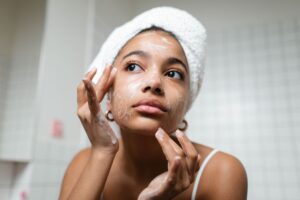
Acne doesn’t appear randomly across your face—it follows a pattern determined by skin biology, hormones, and environment. The reason some people get breakouts only on their forehead while others struggle with chin acne comes down to three main factors: the concentration of oil-producing sebaceous glands in different facial zones, hormonal triggers that affect specific areas, and environmental or contact-based bacteria that colonize particular regions. For example, a teenager might develop acne exclusively in their T-zone (forehead, nose, and chin) due to sebum overproduction, while an adult woman might notice breakouts appearing only along her jawline during specific phases of her menstrual cycle. Understanding why your acne appears where it does is the first step toward treating it effectively at its source rather than applying generic acne treatments across your entire face.
Table of Contents
- How Sebaceous Gland Distribution Creates the T-Zone Acne Pattern
- Hormonal Acne and Why Your Jawline Breaks Out
- Bacterial Acne Concentrates in Oil-Rich Facial Zones
- Contact and Environmental Factors Behind Cheek Acne
- Why Individual Variation Means Your Acne Pattern Is Unique
- Debunking the Traditional Face Mapping Theory
- Identifying Your Personal Acne Pattern for Targeted Treatment
- Conclusion
How Sebaceous Gland Distribution Creates the T-Zone Acne Pattern
your face isn’t uniform when it comes to oil production, and this unevenness directly explains localized acne patterns. Sebaceous glands—the tiny structures that produce sebum to protect your skin—are largest and most densely concentrated on your face and scalp, which is why acne predominantly forms in these areas rather than on your neck, chest, or arms.
Within the face itself, the T-zone (forehead, nose, and chin) contains a particularly high density of sebaceous glands and produces significantly more sebum than other facial areas like your cheeks or temples. This higher oil production in the T-zone creates an ideal environment for acne-causing bacteria to thrive in clogged pores. Many people notice they can have completely clear cheeks while their forehead is covered in breakouts—this disparity exists because their cheeks simply don’t produce oil at the same rate as their T-zone, making bacterial colonization and pore congestion less likely in those regions.

Hormonal Acne and Why Your Jawline Breaks Out
While the T-zone is driven primarily by oil gland activity, acne on your chin and jawline typically stems from a different biological mechanism: hormonal fluctuations. Androgens (male hormones present in all bodies) regulate sebum production, and when hormone levels shift, they can trigger increased oil production specifically in the lower face and jawline area. This is why hormonal acne follows predictable patterns rather than random distribution.
For adult women, this connection is particularly pronounced—approximately 65% notice acne flares directly linked to their menstrual cycle, with the most severe breakouts occurring during the pre-menstrual period when progesterone and estrogen levels drop. Similarly, adolescent boys often develop prominent acne along the jawline during growth spurts when androgens surge. It’s important to note that not everyone’s jawline acne is hormonal; if you’re experiencing breakouts in this area, it could still be bacterial or environmental in origin. However, if your chin and jawline acne worsens at predictable times (around your period, for instance), hormonal fluctuation is likely the primary driver.
Bacterial Acne Concentrates in Oil-Rich Facial Zones
The bacterium *Cutibacterium acnes* (formerly called *Propionibacterium acnes*) is the primary bacterial culprit behind inflammatory acne, and it thrives specifically in areas with abundant sebaceous glands and sebum production. This is why bacterial acne concentrates in the T-zone rather than spreading across the entire face—the bacteria colonizes oil-filled pores where conditions are optimal for growth.
The forehead, in particular, has larger pores and a greater density of sebaceous glands compared to other facial areas, making it a hot spot for bacterial acne despite being visible and often frustrating for sufferers. This explains why someone with bacterial acne might develop a prominent cluster of inflamed spots across their forehead and upper cheeks while maintaining completely clear skin on their jawline and temples. Once you understand that your forehead acne is driven by bacterial proliferation in oil-rich pores rather than hormonal triggers, you can target treatment more effectively—for example, antibacterial or bacteria-reducing treatments become more relevant than hormonal interventions.

Contact and Environmental Factors Behind Cheek Acne
Not all localized acne stems from internal biology; sometimes where you develop breakouts reflects external contact and environmental exposure. Cheek acne frequently results from bacteria transferred to your skin through regular contact with contaminated surfaces—your cell phone is a notorious offender, constantly pressed against your cheek and harboring bacteria that accumulate on its surface.
Dirty makeup brushes, pillowcases that aren’t washed regularly, hair products that migrate to your cheeks, or even repeated touching of your face can all introduce bacteria to cheek skin and trigger localized breakouts. Additionally, acne on the cheeks is often influenced by genetics or environmental factors rather than hormones or oil production, which is why you might inherit a tendency toward cheek breakouts from a parent while escaping the jawline acne that affects your sibling. The practical implication here is that cheek acne may respond poorly to systemic acne treatments and might improve dramatically simply by cleaning your phone regularly, washing makeup brushes weekly, or changing your pillowcase daily—changes that have nothing to do with treating the acne-causing bacteria internally.
Why Individual Variation Means Your Acne Pattern Is Unique
Even among people with similar skin types and hormonal profiles, acne distribution varies significantly, and understanding this variation is crucial for realistic treatment expectations. Genetics play a substantial role in determining not just whether you’ll have acne, but specifically where on your face it will appear and how severe it will be in those zones. One person’s genetic predisposition might be toward forehead acne that responds well to topical treatments, while their genetically identical twin (hypothetically) might struggle with cystic jawline acne that requires systemic intervention.
This means that comparing your acne pattern to someone else’s and using their treatment regimen is unlikely to work—your cheek acne might have a completely different origin than your friend’s cheek acne. Additionally, your personal acne pattern can change over time as hormones shift, environmental exposures change (moving to a humid climate, starting a new job, changing makeup brands), and your skin’s barrier function evolves. Someone who had exclusively T-zone acne as a teenager might develop hormonal jawline acne as an adult, requiring a shift in treatment strategy.

Debunking the Traditional Face Mapping Theory
You’ve likely encountered “face mapping” claims suggesting that acne in certain facial zones reflects health issues with specific organs—for example, forehead acne indicating digestive problems or cheek acne suggesting liver dysfunction. While these ideas have roots in traditional Chinese medicine and appear frequently in wellness content, they lack scientific support in dermatological literature. Modern research has not established reliable connections between the location of acne breakouts and the health status of specific internal organs.
Instead, as discussed throughout this article, acne location is determined by sebaceous gland distribution, hormonal patterns, bacterial colonization, and environmental factors—mechanisms that have nothing to do with organ function. This doesn’t mean your diet or digestive health are irrelevant to your acne; poor nutrition and certain dietary factors may exacerbate acne systemically regardless of where it appears on your face. However, the specific location of your breakouts won’t tell you whether your liver, kidneys, or stomach need attention. Relying on face mapping to guide treatment decisions may delay you from addressing the actual biological cause of your acne.
Identifying Your Personal Acne Pattern for Targeted Treatment
Now that you understand the biological mechanisms behind localized acne, you can use your personal breakout pattern to guide treatment more effectively. Start by documenting where your acne clusters appear most consistently—is it concentrated in the T-zone, scattered across your cheeks, concentrated on your jawline, or a combination of areas? Next, track whether your acne follows a predictable pattern over time; if it worsens around your menstrual cycle or during specific seasons, environmental and hormonal factors are likely significant.
Consider whether your typical breakout areas are also the areas where you produce the most oil (often visible as shine throughout the day), which would suggest sebaceous gland density and bacterial acne as primary drivers. Finally, evaluate external factors in those breakout zones—do you frequently touch your forehead, rest your cheek on your hand, or sleep on a specific side with an unwashed pillowcase? Your personal acne distribution pattern is essentially a diagnostic tool telling you which treatment approach will be most effective, whether that’s oil-control products for bacterial T-zone acne, hormonal interventions for jawline breakouts, or lifestyle changes to reduce environmental bacterial exposure on your cheeks.
Conclusion
Acne appears in specific facial zones for scientifically identifiable reasons rooted in sebaceous gland distribution, hormonal fluctuations, bacterial proliferation, and environmental exposure.
Rather than treating acne as a whole-face problem requiring universal solutions, identifying whether your breakouts are driven by oil production, hormonal cycles, or bacterial/contact factors allows you to apply targeted treatments where they’ll actually work. This personalized approach—addressing the specific cause of your acne in its specific location—is far more effective than generic acne products applied indiscriminately across your entire face.