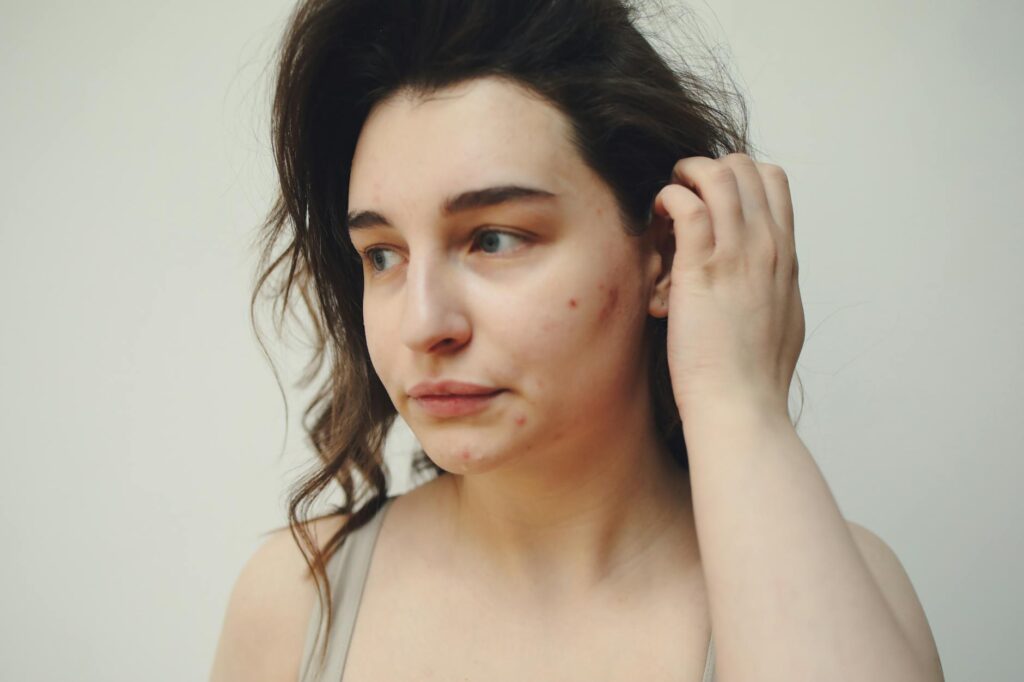
Some acne forms deep beneath your skin’s surface and causes throbbing pain that can last for weeks, while other acne sits on your skin as a simple blackhead that causes minimal discomfort. The difference comes down to where the clog actually happens. Deep acne—called cystic or nodular acne—forms in the dermis layer when oil, bacteria, and dead skin cells become trapped deep within your hair follicles, triggering intense inflammation beneath the skin’s surface.
In contrast, surface acne like blackheads, whiteheads, and minor red bumps are simply clogged pores that never go deeper than your skin’s outer layer. The location of the clog determines everything: how painful it feels, how long it lasts, whether it’ll scar, and which treatments will actually work on it. This article explains the structural and biological reasons why some acne stays shallow while other acne buries itself deep in your skin. You’ll learn why hormonal changes trigger deep acne but not surface-level comedones, how bacterial infection plays a different role in each type, why deep acne is much more likely to leave scars, and why your favorite acne serum might work great on blackheads but do almost nothing for cystic acne.
Table of Contents
- What Separates Deep Acne From Surface-Level Breakouts?
- Why Surface Acne Stays Shallow and Non-Inflammatory
- Why Deep Acne Hurts and Lasts So Long
- Hormones and Stress—Why They Trigger Deep Acne, Not Surface Acne
- Bacterial Infection and the Role of Cutibacterium acnes
- Scarring Risk—Why Deep Acne Leaves Permanent Marks
- Treatment Differences—Why What Works on Surface Acne Fails on Deep Acne
- Conclusion
What Separates Deep Acne From Surface-Level Breakouts?
The fundamental difference is location. Surface-level acne—blackheads, whiteheads, and papules—forms when a hair follicle clogs with sebum (oil) and dead skin cells. That’s it. There’s no infection, no fluid accumulation, no inflammatory cascade. A blackhead is oxidized oil sitting in an open pore; a whitehead is a clogged pore that’s closed over.
These remain on or very near the skin’s surface, which is why they’re often called “non-inflammatory” acne—there’s simply less inflammation happening because the blockage isn’t triggering a deep immune response. Deep acne, which includes cystic acne and nodular acne, involves the entire follicle filling with oil, bacteria, and dead skin, but the rupture or inflammation extends into the deeper dermis layer of your skin. Instead of a simple plug, you get a fluid-filled sac (a cyst) or a firm, deep knot (a nodule) that your body has walled off. Medical professionals grade acne on a four-point severity scale: Grade I is comedones only, Grade II includes inflammatory red papules, Grade III adds pustules, and Grade IV means nodules and cysts are present. Most people with Grade I or II acne have surface-level issues; Grade III and IV acne is predominantly deep.

Why Surface Acne Stays Shallow and Non-Inflammatory
Blackheads and whiteheads stay near your skin’s surface because they’re simply the result of a clogged pore—there’s no deeper rupture, no bacterial overgrowth in an enclosed pocket, and no immune system escalation. Your skin’s surface naturally sheds dead cells and produces oil; when that process gets congested in a single follicle and doesn’t rupture deeper, you get a cosmetic issue, not a medical emergency. Surface comedones can persist for weeks too, but they don’t cause pain because there’s no swelling or pressure building beneath your skin.
The reason surface acne doesn’t typically become infected is that it’s exposed to air and your skin’s natural defenses. A blackhead on your nose is literally open to the environment; a whitehead has a closed surface but no deep pocket trapping bacteria in an anaerobic (oxygen-free) environment. However, if you repeatedly pick or squeeze surface acne—poking holes, extracting the contents, and damaging the surrounding tissue—you can push the infection deeper and convert a simple comedone into something much worse. This is why dermatologists warn against squeezing even surface acne; you might turn a non-scarring blemish into something with long-term damage.
Why Deep Acne Hurts and Lasts So Long
The pain from cystic acne is real and significant because of what’s happening below your skin. When a follicle ruptures deep in the dermis, your body treats it like an injury or infection. White blood cells rush to the area, fluid accumulates, and swelling intensifies the pressure in that pocket beneath your skin—you literally have inflammation pushing outward from inside, with nowhere to go. That’s why cystic acne is tender to the touch and can throb.
A fluid-filled cyst can persist for weeks because the body has to slowly reabsorb that fluid and repair the tissue damage. Nodular acne is a different flavor of deep acne—instead of a fluid-filled sac, you get a firm, hard bump that feels like a knot under your skin. Nodules are often even more painful than cysts because the inflammation is intense and the lesion is deep and dense. Both types can linger far longer than surface acne: while a whitehead might last a few days, a cyst or nodule can dominate your skin for three to eight weeks or longer, especially without treatment. The deeper the inflammation, the more time your body needs to heal it.
Hormones and Stress—Why They Trigger Deep Acne, Not Surface Acne
The reason some people experience sudden breakouts of deep, painful cystic acne while others stay clear for months points to a hormonal trigger. Hormonal changes—including those during puberty, menstrual cycles, pregnancy, and menopause—ramp up sebum production in your hair follicles. More critically, these hormonal shifts affect how your skin cells shed and how your immune system reacts to bacteria in follicles. Deep cystic acne is almost always hormonal, which is why it’s so common during specific times of your cycle or during stressful periods (stress also affects hormones).
Surface acne, in contrast, usually stems from straightforward pore clogging: not rinsing off sunscreen well enough, touching your face too much, or your skin’s natural oil production on a given day. It’s not typically tied to your hormones in the same way. This distinction matters because it changes how you should approach treatment. If your acne is hormonal and deep, topical acne treatments alone usually won’t solve it—you might need to address the hormonal driver itself through birth control, prescription medications, or other systemic approaches. If your acne is surface-level, a good cleanser and a topical retinoid might be all you need.
Bacterial Infection and the Role of Cutibacterium acnes
Every person’s skin hosts the bacterium Cutibacterium acnes (formerly called Propionibacterium acnes). This bacterium isn’t the villain of acne—it’s normally present and harmless. The trouble begins when this bacterium gets trapped in a deep, oxygen-free pocket of a clogged follicle. Once trapped in that anaerobic environment, the bacteria multiply, your immune system escalates its response, and infection develops.
In cystic and nodular acne, Cutibacterium acnes becomes concentrated in pockets deep beneath your skin, fueling the inflammation that makes these lesions so painful and persistent. Surface comedones don’t typically involve significant bacterial infection because they’re exposed or near-surface, so the environment doesn’t favor bacterial overgrowth the way a sealed deep pocket does. A blackhead has bacteria on and in it, sure, but not in the concentrated, infection-level quantities that drive a cyst. This is why antibiotics—whether topical or oral—can help with deep, infected acne but are less necessary for simple blackheads. However, it’s worth noting that widespread antibiotic use for acne can lead to antibiotic-resistant bacteria, which is why dermatologists now prefer to use antibiotics in combination with other treatments rather than alone, and only for moderate to severe acne.

Scarring Risk—Why Deep Acne Leaves Permanent Marks
Cystic acne is far more likely to cause scarring than surface-level acne, and the reason is structural. When inflammation and tissue damage occur deep in the dermis—your skin’s structural support layer—your body’s repair process can leave behind permanent indentations, pitted scars, or raised scars (keloids). Surface acne, even if it leaves temporary redness, usually heals without scarring because the damage is superficial and your skin’s repair mechanisms can restore the surface smoothly.
The scarring risk escalates dramatically if you pick, squeeze, or pop deep cysts. When you manually rupture a cyst that’s deep beneath your skin, you’re introducing bacteria, forcing infected material deeper into surrounding tissue, and damaging healthy skin in the process. This self-inflicted trauma significantly increases the likelihood of permanent scarring. Even without picking, severe cystic acne can scar—which is why dermatologists consider any cystic breakout a reason to seek professional treatment early rather than waiting and hoping it resolves on its own.
Treatment Differences—Why What Works on Surface Acne Fails on Deep Acne
Your favorite acne serum, the one with salicylic acid or benzoyl peroxide that clears up your occasional blackheads, won’t penetrate deep enough to treat a cyst. Topical treatments work well on surface acne because they can reach the clogged pore on or near your skin’s surface. But a cyst sitting in the dermis layer is beyond the reach of most topical products—the medication simply can’t travel deep enough through your skin to reduce the inflammation where it’s happening.
This is why dermatologists prescribe oral antibiotics, hormonal birth control, or medications like isotretinoin (Accutane) for deep, severe acne. These systemic treatments work from the inside: hormonal birth control can reduce the androgen-driven sebum production that fuels cystic acne, while isotretinoin can permanently reduce oil production and bacterial load. If you’re dealing with recurrent deep acne and topical treatments haven’t worked after a reasonable timeframe, a conversation with a dermatologist about systemic options is the practical next step.
Conclusion
The difference between painful, deep acne and surface-level breakouts comes down to location, hormonal triggers, and bacterial involvement. Deep cystic and nodular acne forms in your skin’s lower layers, often driven by hormonal changes, and involves bacterial infection in anaerobic pockets—all of which make it more painful, longer-lasting, and more scarring-prone than surface acne. Surface acne like blackheads and whiteheads are simple clogs that your topical treatments can address, but deep acne requires a different approach.
If you’re experiencing recurrent painful breakouts, don’t assume over-the-counter acne treatments will solve it. See a dermatologist for a proper diagnosis; if it’s cystic or nodular acne, you’ll likely need systemic treatment rather than topical-only approaches. And critically: resist the urge to squeeze or pick at deep lesions, no matter how painful or frustrating they are. The temporary relief isn’t worth the scarring risk.