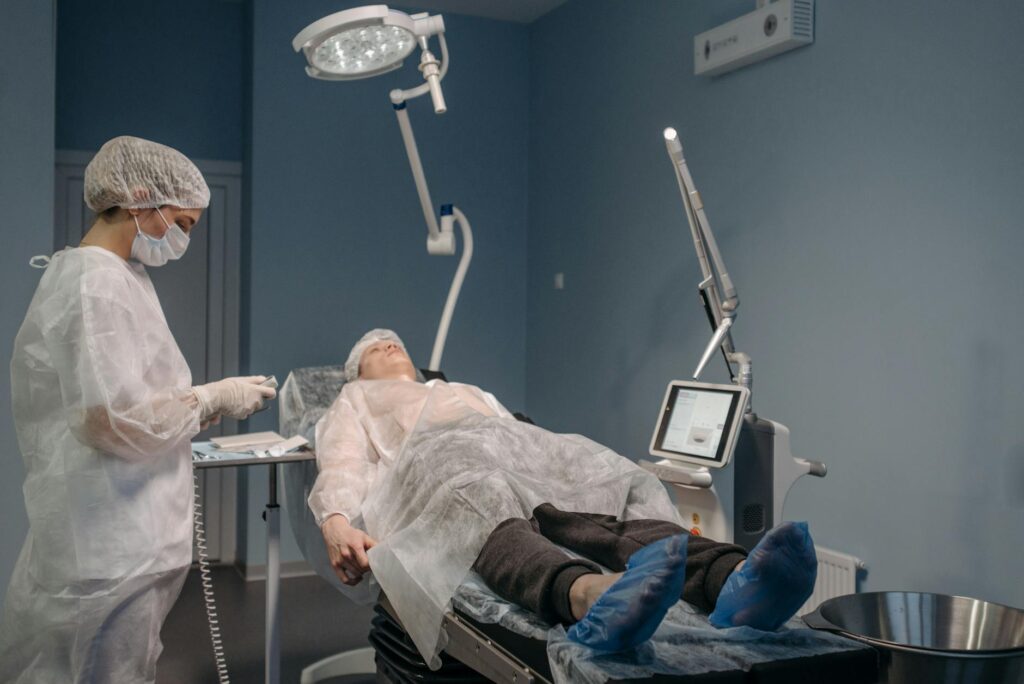
Pulsed dye laser (PDL) is considered the first-line treatment for hypertrophic acne scars because it directly targets the vascular component that drives these raised, red scars. When acne heals improperly, excess collagen accumulates and blood vessels remain dilated, creating that characteristic raised, often reddish appearance.
PDL wavelengths (typically 595 nm) preferentially absorb hemoglobin in these blood vessels, causing them to collapse and flatten the scar tissue beneath—effectively addressing the root cause rather than just smoothing the surface. For someone with raised, red acne scars on the chest or shoulders that developed over the past year, PDL can produce visible improvement in both color and height within 2-3 sessions, often making it the most practical starting point before considering more aggressive methods. This article explains why dermatologists reach for pulsed dye laser first, how the technology works on hypertrophic scars specifically, what results you can realistically expect, and when you might need to combine it with other treatments for optimal outcomes.
Table of Contents
- How Does Pulsed Dye Laser Target Hypertrophic Acne Scars?
- Comparing PDL to Other Hypertrophic Scar Treatments
- What Results Can You Realistically Expect from PDL?
- PDL Protocol and Treatment Frequency
- Common Challenges and When PDL Falls Short
- Combining PDL with Other Treatments
- The Future of Laser Treatment for Acne Scars
- Conclusion
- Frequently Asked Questions
How Does Pulsed Dye Laser Target Hypertrophic Acne Scars?
Hypertrophic acne scars are fundamentally different from atrophic (indented) scars because they involve excess tissue rather than tissue loss. This distinction matters because PDL’s mechanism—selective photothermolysis of vascular structures—directly addresses what makes hypertrophic scars visible: the hypervascularity and inflammation that perpetuate collagen overproduction. The laser energy heats blood vessels in and around the scar, triggering their collapse and prompting the body to remodel the excess collagen over weeks to months. This remodeling process gradually reduces both the height of the scar and its red or purple discoloration. Unlike ablative lasers that vaporize tissue or chemical peels that damage the skin surface, PDL leaves the outer skin intact, which is why downtime is minimal—most people experience only temporary redness or purpling that fades within days.
A patient with a raised, pink scar on the jawline might see the scar flatten and lose its color intensity after the first treatment, then continue improving as collagen remodels. The beauty of targeting vascularity is that it works with your body’s natural healing response rather than forcing immediate mechanical change. The PDL doesn’t work instantaneously like a scalpel might. Instead, it initiates a biological cascade: vessel destruction → inflammation response → collagen remodeling → scar flattening. This is why most protocols involve 3-5 sessions spaced 4-6 weeks apart. Each session builds on the previous one, progressively remodeling the scar tissue.
Comparing PDL to Other Hypertrophic Scar Treatments
When dermatologists consider treatment options for hypertrophic scars, several competitors exist, but each has trade-offs that make PDL the logical starting point. Steroid injections directly reduce collagen production and flatten scars, but they require injections into the scar tissue itself (which can be uncomfortable) and results are temporary—typically lasting 3-6 months before the scar begins to rebound. Subcision, which involves mechanically breaking up scar tissue with a needle, works well for tethered scars but doesn’t address the vascular component, and it requires more skill and carries more bruising risk. However, if a hypertrophic scar is very thick or shows minimal improvement after several PDL sessions, steroid injections or even microneedling radiofrequency might become necessary additions.
The limitation of PDL alone is that it may not sufficiently flatten extremely thick scars or those with deep fibrous tissue—these often need mechanical intervention to break up the underlying structure. A raised acne scar that’s been present for 5+ years and measures 2-3 mm above surrounding skin is more likely to need combination therapy than a newer scar. PDL excels at reducing color, initiating remodeling, and flattening thin-to-moderate hypertrophic scars, but it works more slowly than more invasive methods. Ablative lasers (like CO2 or erbium) can vaporize scar tissue entirely, but they require significant downtime (1-2 weeks of visible healing) and carry higher infection and hyperpigmentation risks, especially in darker skin tones. PDL’s minimal downtime and safety across skin types is why it remains first-line despite being less immediately dramatic.
What Results Can You Realistically Expect from PDL?
Clinical studies show that PDL produces 50-75% improvement in hypertrophic acne scars over a series of treatments, with the most dramatic improvements in scar color (red or purple scars fade significantly) and moderate improvement in scar height. A scar that’s 2 mm raised might flatten to 0.5-1 mm, which is often visually imperceptible at arm’s length. The timeline matters: most visible color changes appear after 2-3 weeks post-treatment, while height reduction develops over 8-12 weeks as collagen remodels. A real-world example: someone with raised, red post-acne scars on the upper back might have their scars fade from a bright red to skin-tone color and drop from 1.5 mm to nearly flat after 4 sessions.
However, if that same person has atrophic (depressed) scars mixed in with hypertrophic ones, PDL won’t help the indented scars—those require different treatments like subcision or fillers. This is the key limitation: PDL specifically improves hypertrophic scars but doesn’t address thickness loss or significant textural irregularity. Expectation-setting is crucial because some patients expect complete scar elimination after one session. In reality, even excellent responders see gradual, cumulative improvement over months, and most scars don’t disappear entirely—they become much less noticeable. Darker skin types generally show good results but must be treated with lower fluences to avoid post-inflammatory hyperpigmentation, which can sometimes take months to fade and may be more noticeable than the original scar during the healing window.

PDL Protocol and Treatment Frequency
The standard PDL protocol for hypertrophic acne scars involves 4-6 sessions spaced 4-6 weeks apart, using fluences of 7-10 J/cm² with a 595 nm wavelength. The spacing matters: waiting only 2-3 weeks doesn’t allow adequate collagen remodeling, while spacing beyond 8 weeks extends the overall treatment timeline unnecessarily. Each session typically treats the scarred area plus surrounding skin to prevent patchiness and promote overall skin remodeling.
The tradeoff between aggressive treatment (higher fluences, closer spacing) and conservative treatment (lower fluences, longer intervals) depends on skin type and scar severity. Lighter skin types can tolerate higher fluences and thus see faster results, while darker skin requires conservative fluences to avoid prolonged erythema or unwanted pigmentation changes. Someone with Fitzpatrick type 3-4 skin might need 6-8 sessions with lower fluences, while type 1-2 skin might achieve similar results in 4 sessions with standard fluences. Cost and time commitment become considerations: each session costs $200-600 depending on scar size and location, so total treatment ranges from $1000-3500.
Common Challenges and When PDL Falls Short
The most common reason PDL underperforms is incorrect diagnosis: patients sometimes assume they have hypertrophic scars when they actually have boxcar or icepick (atrophic) scars, which PDL won’t improve. A visual distinction is helpful—hypertrophic scars are raised and firm, while atrophic scars are depressed or indented. Another challenge is patient impatience: visible improvement in color occurs within weeks, but height reduction takes 2-3 months per session, and the cumulative effect requires all 4-6 sessions. Laser-induced hyperpigmentation is a real risk in darker skin types, where transient post-inflammatory hyperpigmentation can occur in 10-15% of treatments.
This typically resolves within 3-6 months with strict sun protection (SPF 30+), but if it persists or worsens, it becomes more concerning than the original scar. A warning for all skin types: inadequate sun protection after PDL treatment increases risk of hyperpigmentation and can paradoxically darken treated scars rather than improving them. Another limitation is that PDL may plateau in effectiveness: after 4-5 sessions, some scars show minimal additional improvement, suggesting maximum biological response has been reached. At this point, combination therapy with steroid injections or microneedling radiofrequency might be necessary, but that’s a different treatment entirely.
Combining PDL with Other Treatments
In practice, dermatologists often combine PDL with other modalities for faster or more complete results. Subcision performed 1-2 weeks after PDL can be synergistic: the PDL initiates vascular remodeling and collagen turnover, and the mechanical subcision breaks up fibrous tissue, creating better opportunities for remodeling. Intralesional steroid injections given 2-4 weeks after PDL can further flatten stubborn hypertrophic scars by directly inhibiting collagen synthesis.
A patient with moderately thick hypertrophic scars might undergo 3 PDL sessions combined with two steroid injection sessions in between, reducing total timeline while improving final outcomes. The combination approach requires coordination between treatments but can yield 80-90% improvement versus 50-60% with PDL alone. The trade-off is cost: combination therapy easily runs $2500-5000 for complete treatment versus $1500-2500 for PDL monotherapy.
The Future of Laser Treatment for Acne Scars
Emerging PDL technologies and modifications continue to improve outcomes. Longer pulse durations and dynamic cooling systems reduce pain and downtime further, making treatments more tolerable.
Fractional PDL (which treats only portions of skin rather than the entire surface) is gaining traction for treating mixed scar types in the same area, allowing targeted treatment of hypertrophic scars without unnecessary heating of surrounding atrophic scars. The direction of acne scar treatment is increasingly personalized: rather than one protocol fitting all patients, treatments are tailored to specific scar type, depth, color, and skin type. PDL remains foundational because it safely addresses the vascular component that perpetuates hypertrophic scars, but the most successful outcomes combine it with mechanical and chemical interventions based on individual scar characteristics.
Conclusion
Pulsed dye laser is first-line treatment for hypertrophic acne scars because it directly targets the vascular and inflammatory components driving these raised scars, while offering minimal downtime and broad applicability across skin types. Over 4-6 sessions, PDL typically produces 50-75% improvement in color and moderate flattening of scar height, with cumulative results developing over weeks to months as collagen remodels.
Success requires patient patience, strict sun protection, and realistic expectations—PDL excels at making scars less noticeable rather than making them disappear entirely. If you have hypertrophic acne scars, consultation with a dermatologist experienced in laser treatment will clarify whether PDL alone or combination therapy is appropriate for your specific scars. Combination approaches with steroid injections or mechanical subcision can accelerate results for stubborn scars, but PDL serves as the logical starting point due to its efficacy, safety, and ability to initiate the biological remodeling process that characterizes successful scar improvement.
Frequently Asked Questions
How long does PDL treatment take, and what’s the recovery time?
Each PDL session takes 15-30 minutes depending on scar area. Recovery is minimal—most people experience temporary redness or mild purpling that fades within 3-7 days. Return to normal activities is immediate, though sun protection is essential for 2-4 weeks post-treatment.
Will PDL work on scars that are many years old?
Older scars generally respond more slowly because the collagen is more established and fibrotic. A scar from 5-10 years ago may require 6-8 sessions to show comparable improvement to a newer scar, but age alone doesn’t preclude good results. Scar thickness and firmness matter more than age.
Can PDL be used on darker skin types safely?
Yes, but with caution. Darker skin types are treated with lower fluences (6-7 J/cm² vs. 8-10 J/cm²) to minimize risk of post-inflammatory hyperpigmentation. Results take longer (6-8 sessions vs. 4-5), but outcomes are generally good with experienced practitioners and strict sun protection.
What’s the difference between PDL and other laser types for acne scars?
PDL specifically targets blood vessels and is ideal for red or hypertrophic scars. Ablative lasers (CO2, erbium) vaporize tissue and work faster but require downtime and carry higher risks. Fractional non-ablative lasers work through collagen remodeling but are gentler and slower. PDL balances efficacy and safety.
If PDL doesn’t work well enough, what are the next options?
Combination therapy with steroid injections, subcision, or microneedling radiofrequency can address residual scarring. In severe cases, surgical excision or grafting might be considered, though these are rarely needed after comprehensive PDL treatment.
How much does PDL treatment cost?
Individual sessions typically range from $200-600 depending on scar size and geographic location. A complete course of 4-6 sessions costs $1000-3500. Many practices offer package discounts for multiple sessions.