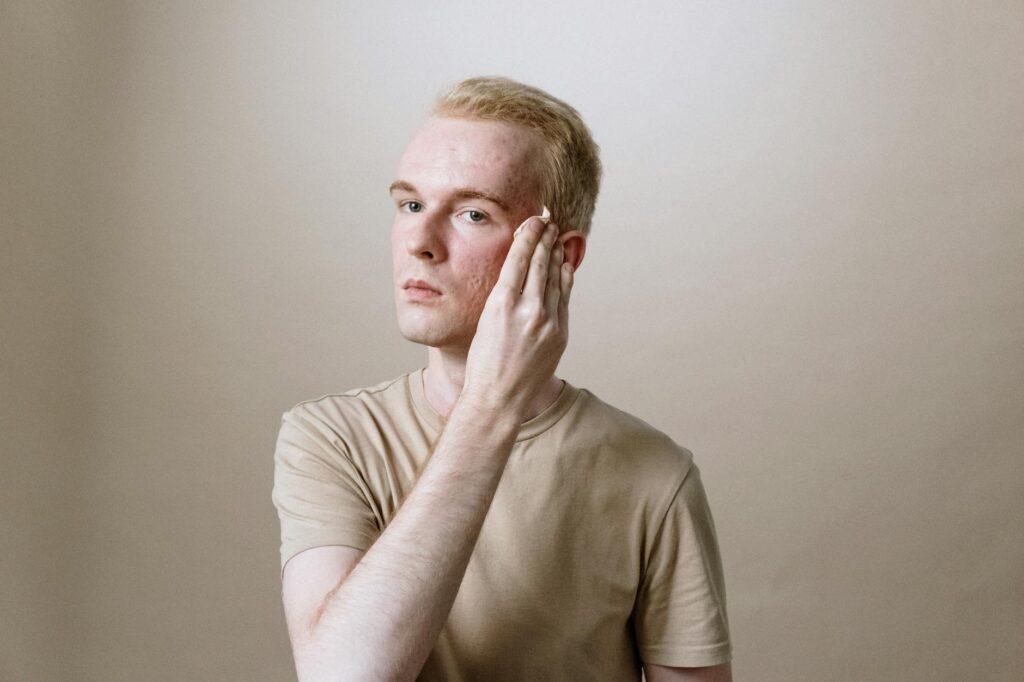
Humidity makes acne worse for certain people because moisture-heavy air triggers a cascade of skin responses that clog pores faster than they can clear themselves. When relative humidity climbs above 70 percent, your skin’s sebaceous glands often ramp up oil production in response to the sweat and surface moisture sitting on your face, while dead skin cells that would normally shed and flake away instead stick to the skin’s surface like wet paper. Someone living in Phoenix who moves to Houston in July, for example, might break out along the jawline and forehead within days, even if their skincare routine hasn’t changed at all. The combination of excess sebum, trapped dead cells, and bacterial proliferation in warm, moist conditions creates an ideal environment for inflammatory and comedonal acne alike.
Not everyone reacts to humidity the same way, though. People with naturally oilier skin types or a genetic predisposition toward overactive sebaceous glands tend to suffer most, while those with dry or balanced skin might actually find humid climates improve their complexion by reducing transepidermal water loss. The difference often comes down to how your skin barrier functions under stress and whether your pore structure is prone to blockage. This article breaks down the specific biological mechanisms behind humidity-driven breakouts, which skin types are most vulnerable, how to adjust your routine for high-moisture environments, and what dermatologists recommend when the weather itself seems to be working against your skin.
Table of Contents
- How Does Humidity Trigger Acne Breakouts in Certain Skin Types?
- Which Skin Types Are Most Vulnerable to Humidity-Related Acne?
- The Role of Sweat, Sunscreen, and Product Buildup in Humid Conditions
- How to Adjust Your Skincare Routine for High-Humidity Environments
- When Humidity-Related Acne Signals Something More Serious
- Geographic and Seasonal Patterns in Humidity-Driven Breakouts
- Emerging Research and Future Approaches to Climate-Adaptive Skincare
- Conclusion
- Frequently Asked Questions
How Does Humidity Trigger Acne Breakouts in Certain Skin Types?
The relationship between humidity and acne starts at the stratum corneum, the outermost layer of your skin. Under normal conditions, dead skin cells called corneocytes detach from this layer in a process called desquamation. In humid environments, these cells absorb water and swell, which makes them stickier and less likely to shed properly. Instead of sloughing off, they clump together at the openings of hair follicles, forming plugs that trap sebum beneath the surface. This is the same basic mechanism behind regular comedonal acne, but humidity accelerates it by keeping those dead cells perpetually hydrated and adhesive. The heat that typically accompanies humidity compounds the problem.
Elevated temperatures increase sebum production by roughly 10 percent for every degree Celsius rise in skin surface temperature, according to research published in the British Journal of Dermatology. Your sweat glands also kick into gear, and while sweat itself doesn’t directly cause acne, it changes the pH of your skin’s surface and mixes with oils to create an occlusive film. Compare someone working outdoors in a dry 95-degree climate versus a humid 85-degree one: the person in humid conditions often fares worse because the sweat can’t evaporate efficiently, so it sits on the skin and contributes to pore congestion rather than cooling the body and dissipating. Cutibacterium acnes, the primary bacterium implicated in inflammatory acne, also thrives in warm, moist, anaerobic environments. When pores are already clogged with a mixture of sebum and swollen corneocytes, the sealed-off follicle becomes a breeding ground. The bacterial metabolic byproducts trigger an immune response, leading to the red, painful papules and pustules that distinguish inflammatory acne from simple blackheads and whiteheads. This is why people in tropical climates often report not just more breakouts, but angrier ones.

Which Skin Types Are Most Vulnerable to Humidity-Related Acne?
Oily and combination skin types bear the brunt of humidity-driven breakouts, and it’s not just anecdotal. A 2019 study in the Journal of the European Academy of Dermatology and Venereology examined over 1,500 patients across different climate zones and found that those with higher baseline sebum production were nearly three times more likely to experience acne flares during peak humidity months. The logic is straightforward: if your skin already produces excess oil, adding environmental moisture on top of it overwhelms the pore’s ability to stay clear. However, people with dry or sensitive skin aren’t entirely safe, and this is where blanket advice about humidity and acne falls short. If you have a compromised skin barrier, which is common in conditions like eczema or rosacea, humidity can actually increase irritation and lead to a different kind of breakout.
The excess moisture disrupts the barrier further, allowing irritants and bacteria easier access to the lower layers of the epidermis. So while someone with dry skin might not get the classic oily T-zone congestion, they could develop perioral or cheek acne triggered by barrier dysfunction rather than sebum overproduction. Age also plays a role that gets overlooked. Adolescents and young adults in their early twenties have the most active sebaceous glands, which means the humidity effect hits them harder. Adults over 35 tend to see less humidity-related acne purely because their sebum production has naturally declined, though hormonal fluctuations, particularly in women around menstruation or perimenopause, can temporarily reactivate that sensitivity. If you’re an adult who only breaks out in summer, it’s worth considering whether your hormonal cycle coincides with the humid months before assuming the weather is the sole cause.
The Role of Sweat, Sunscreen, and Product Buildup in Humid Conditions
one of the most underappreciated factors in humidity-related acne is the layering effect. In humid weather, most people are applying sunscreen, possibly a moisturizer underneath it, and sweating throughout the day. Each of these layers contributes to an occlusive film on the skin that prevents natural shedding and traps bacteria. A 2021 survey by the American Academy of Dermatology found that 43 percent of respondents who reported summer breakouts were using the same heavy moisturizer year-round, never adjusting for seasonal changes in humidity. Consider someone who uses a rich, ceramide-based moisturizer designed for winter dry skin and layers a chemical sunscreen containing avobenzone and octocrylene on top. In January, this combination protects and hydrates.
By July, in 80 percent humidity, that same routine creates a film that essentially shrink-wraps the pores shut. The fix seems obvious in hindsight: switch to a lightweight, gel-based moisturizer and a mineral sunscreen with zinc oxide, which sits on top of the skin rather than absorbing into it. But most people don’t think to change their routine with the seasons because the products “worked fine” six months ago. Sweat also interacts with certain skincare ingredients in ways that promote breakouts. Niacinamide serums, for instance, remain stable and beneficial in humid conditions, but vitamin C serums, particularly L-ascorbic acid formulations, can oxidize faster on sweaty skin and potentially irritate rather than treat. If you notice that a product you’ve used successfully all year suddenly seems to cause stinging or small bumps when the humidity rises, it’s worth isolating whether the formula itself is reacting to the moisture and heat on your skin’s surface.
How to Adjust Your Skincare Routine for High-Humidity Environments
The core principle for managing acne-prone skin in humid conditions is to reduce occlusion while maintaining active treatment. This means trading cream-based cleansers and heavy moisturizers for gel or foam formulations, but not stripping your skin entirely. A common mistake is overcompensating by using harsh, drying cleansers like those with high concentrations of sodium lauryl sulfate, which damage the barrier and cause rebound oil production that makes the problem worse within a week or two. Salicylic acid becomes especially valuable in humid climates because it is oil-soluble, meaning it can penetrate into clogged pores rather than just sitting on the skin’s surface like glycolic acid does. A leave-on salicylic acid treatment at 2 percent concentration, applied after cleansing at night, can help keep pores clear without the irritation that retinoids sometimes cause in hot weather.
The tradeoff is that salicylic acid is less effective at stimulating cell turnover than retinoids, so if you’re dealing with both acne and post-inflammatory hyperpigmentation, you may need to alternate between the two rather than choosing one exclusively. Some dermatologists recommend retinoids three nights a week and salicylic acid on the other nights, though this level of alternation doesn’t work for everyone and can cause irritation in sensitive skin types. Double cleansing, a technique borrowed from Korean skincare, is particularly useful in humid conditions, but the method matters. Use a lightweight cleansing oil or micellar water as the first step to dissolve sunscreen and sebum, followed by a gentle water-based cleanser. The risk of double cleansing in humidity is overdoing it: if your skin feels tight or looks shiny in a dry, stripped way after washing, you’ve removed too much of the lipid barrier and your glands will respond by producing more oil within hours.
When Humidity-Related Acne Signals Something More Serious
Persistent acne that flares with humidity but never fully clears between seasons may indicate an underlying condition that humidity simply exacerbates rather than causes. Polycystic ovary syndrome, thyroid dysfunction, and insulin resistance all influence sebum production independently of weather, and humid conditions can mask the true driver by making it seem like the environment is the sole problem. If you’ve adjusted your routine, moved to a drier climate, and still break out, it’s time for bloodwork rather than another product swap. Fungal acne, technically called Malassezia folliculitis, is frequently misdiagnosed as bacterial acne and is significantly worsened by humidity. It presents as uniform small bumps, usually on the forehead, chest, or upper back, and it itches, which regular acne typically does not.
Standard acne treatments like benzoyl peroxide have no effect on fungal acne, and some, like certain oils in moisturizers, actively feed the Malassezia yeast. If your breakouts look the same size, cluster in areas where you sweat heavily, and don’t respond to conventional acne treatments after six to eight weeks, ask a dermatologist about a KOH test or prescribe a trial of ketoconazole. Treating bacterial acne protocols on a fungal infection will waste months and money. It is also worth noting that some medications increase photosensitivity and sebum production simultaneously. Certain antidepressants, corticosteroids, and hormonal contraceptives can change how your skin reacts to environmental conditions. If you started a new medication and your humidity-related breakouts worsened significantly, the medication may be a contributing factor worth discussing with your prescriber.
Geographic and Seasonal Patterns in Humidity-Driven Breakouts
Dermatologists in the southeastern United States, Southeast Asia, and coastal regions of Central and South America report acne flare patterns that follow monsoon seasons and summer humidity spikes with remarkable consistency. In Singapore, where relative humidity hovers between 80 and 90 percent year-round, acne vulgaris affects an estimated 88 percent of adolescents, compared to roughly 50 percent in drier temperate climates like parts of inland Europe. While genetics and diet are confounders, the environmental contribution is difficult to ignore when you see the same skin type respond so differently across geographies.
People who travel frequently between climate zones face a particular challenge. A two-week business trip from Denver to Bangkok can trigger breakouts that persist for a month after returning home, because the pore congestion that begins in humid conditions takes weeks to fully resolve. Preemptive adjustment, switching to a lighter routine two or three days before travel rather than after breakouts have already started, is a strategy that dermatologists recommend but few patients actually follow.
Emerging Research and Future Approaches to Climate-Adaptive Skincare
The skincare industry is beginning to acknowledge that a static routine doesn’t make sense for people who experience seasonal or geographic acne flares. A few brands have introduced humidity-responsive formulations that adjust their texture based on environmental moisture levels, using hygroscopic polymers that absorb excess surface moisture in humid conditions while releasing it back in dry ones. These products are still in early stages and carry premium price tags, but the concept represents a meaningful departure from the one-routine-fits-all-year approach that has dominated skincare advice for decades. Research into the skin microbiome is also opening new avenues.
Scientists at the University of California, San Diego, have identified specific bacterial strains that outcompete C. acnes in humid environments without causing inflammation. Probiotic topical treatments based on this research are in clinical trials, and if successful, they could offer a way to manage humidity-related acne by modifying the microbial ecosystem on the skin rather than killing bacteria indiscriminately with antibiotics or benzoyl peroxide. For now, though, the practical approach remains adjusting products, ingredients, and cleansing frequency to match the moisture in the air rather than fighting against it.
Conclusion
Humidity worsens acne through a combination of increased sebum production, impaired dead skin cell shedding, bacterial proliferation, and product occlusion, but the severity depends heavily on your skin type, genetics, and how well your routine adapts to changing conditions. People with oily or combination skin, those on certain medications, and anyone with a history of comedonal acne are most vulnerable, while dry-skinned individuals may face barrier-related breakouts instead. Understanding the specific mechanism affecting your skin, whether it’s excess oil, fungal overgrowth, or product incompatibility, is the first step toward an effective response.
The most practical steps are seasonal: switch to gel-based, non-comedogenic products when humidity rises, use salicylic acid to keep pores clear, double cleanse at the end of the day without stripping the barrier, and reassess your sunscreen formulation. If breakouts persist despite these adjustments, consider whether an underlying hormonal or fungal issue is the real driver and consult a dermatologist for targeted testing. The weather is one variable you cannot control, but your skin’s response to it is far more manageable than most people assume.
Frequently Asked Questions
Does humidity cause acne or just make existing acne worse?
Humidity primarily exacerbates acne in people who are already prone to it. It increases sebum production, traps dead skin cells, and promotes bacterial growth, but it rarely causes acne in someone who wouldn’t otherwise develop it. The distinction matters because treating humidity as the sole cause can lead you to ignore underlying factors like hormones or genetics.
Should I skip moisturizer entirely in humid weather?
No. Skipping moisturizer can damage your skin barrier and trigger rebound oil production. Instead, switch to a lightweight, gel-based or water-based moisturizer. Look for ingredients like hyaluronic acid or glycerin without heavy occlusives like petroleum or shea butter, which are better suited to dry conditions.
Is air conditioning good or bad for acne-prone skin in humid climates?
Air conditioning reduces ambient humidity, which can help reduce surface oil and sweat. However, prolonged exposure to air-conditioned environments dries the skin and can impair barrier function if you don’t adjust your hydration. The best approach is to use a moderate setting and apply a light moisturizer when spending extended time indoors.
Can drinking more water help with humidity-related acne?
Hydration supports overall skin health, but there is no clinical evidence that increasing water intake beyond normal levels directly reduces acne. Your skin’s moisture content is regulated by barrier function and environmental factors, not simply by how much water you drink. Focus on topical hydration and barrier protection instead.
Why do I break out when I travel to tropical destinations but not at home?
The sudden change in humidity overwhelms your skin’s ability to adapt quickly. Your pores begin accumulating excess oil and dead cells within a day or two, but the resulting breakouts may not appear for several days after that. Adjusting your routine before you travel, rather than reacting after breakouts start, gives your skin a better chance to manage the transition.