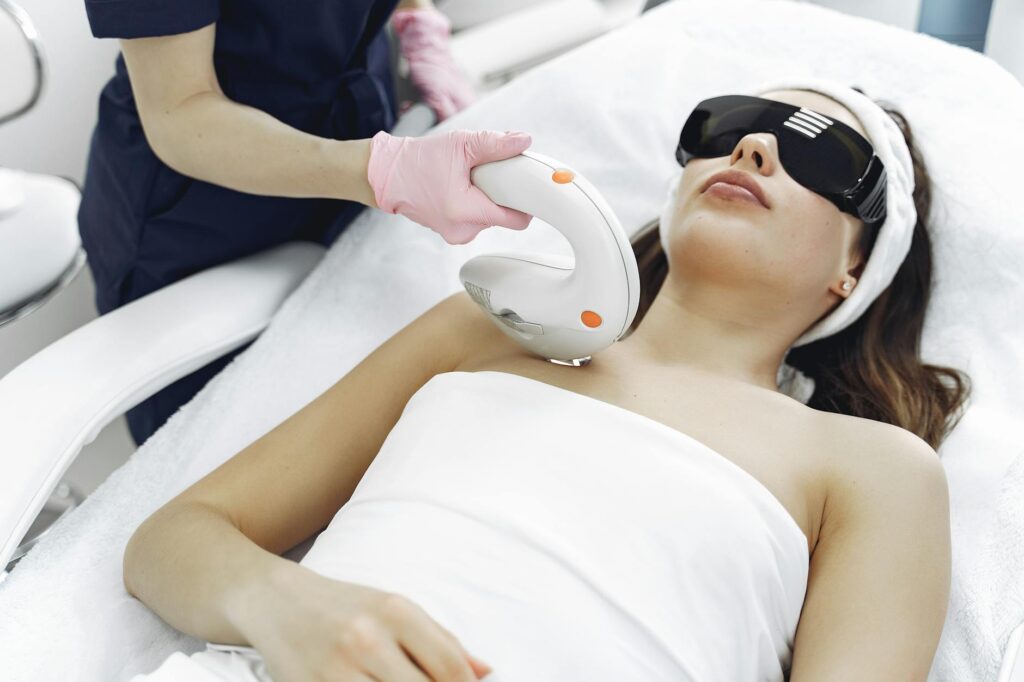
The Hollywood Laser Peel with Spectra is used for acne texture because it specifically targets damaged skin at multiple depths—combining ablative laser energy with advanced wavelength technology to remove scarred tissue, stimulate collagen remodeling, and level out the pitted appearance that remains after breakouts heal. Unlike gentler treatments that only work on the surface, the Spectra’s dual-wavelength approach (1064nm and 532nm) penetrates through the dermis where acne scars actually form, triggering the body’s natural healing response to rebuild smoother skin architecture. For someone with moderate rolling scars or widespread pitting from years of acne, this treatment has become a go-to because results tend to be visible after 3–4 sessions, with progressive improvement as layers of damaged collagen are replaced with fresh, undamaged tissue. This article covers how Spectra’s technology specifically addresses acne texture, what results you can realistically expect, which types of scarring respond best, and the practical considerations—including downtime, cost, and when you might want to combine it with other treatments for better outcomes.
Table of Contents
- How Does Spectra Technology Address Pitted Acne Scars?
- Why Spectra Outperforms Traditional Laser Treatments for Acne Texture
- Different Types of Acne Scars and Spectra Effectiveness
- Realistic Results, Timeline, and Treatment Intervals
- Post-Treatment Healing and Common Complications
- Combining Spectra with Other Acne Scar Treatments
- Long-Term Results and the Evolution of Laser Acne Scar Treatment
- Conclusion
- Frequently Asked Questions
How Does Spectra Technology Address Pitted Acne Scars?
The spectra laser works by delivering rapid, high-energy pulses that fractionally ablate (partially remove) the epidermis and upper dermis, creating controlled micro-injuries. The body responds by flushing out damaged collagen fibers and signaling fibroblasts to lay down new, organized collagen—essentially remodeling the scar architecture from the inside out. The 1064nm wavelength penetrates deeper for structural remodeling, while the 532nm wavelength addresses surface irregularities and pigmentation left behind by acne.
For rolling scars—those wavy, undulating indentations that are the most common type of acne scarring—this dual approach is particularly effective because it physically removes some of the scarred tissue while simultaneously rebuilding the foundation beneath it. A typical patient with rolling acne scars across the cheeks might show 30–40% improvement after three treatments spaced 4–6 weeks apart, with the most noticeable change being a visible smoothing of the skin surface and a reduction in how dramatically light catches the indented areas. Boxcar scars (sharp, defined pits) also respond well, though icepick scars (deep, narrow punctures) may require more sessions or combination with other modalities like subcision or dermal fillers for optimal results.
Why Spectra Outperforms Traditional Laser Treatments for Acne Texture
Traditional non-ablative lasers (like certain IPL or ND:Yag treatments) heat the dermis without removing skin, which means collagen remodeling happens but the scarred tissue itself never gets cleared away—like trying to smooth a wrinkled shirt by applying heat without actually ironing out the wrinkles. The Spectra, being ablative or fractionally ablative depending on settings, actually removes layers of scar tissue, making space for new, healthy collagen to rebuild. The fractional aspect means it doesn’t treat the entire face uniformly; instead, it creates a mosaic pattern of treated and untreated micro-zones, allowing the surrounding untreated skin to support faster healing.
However, if you have very dark skin or a history of keloid formation, Spectra carries a higher risk of post-inflammatory hyperpigmentation or abnormal scarring compared to gentler treatments. The ablative nature that makes it effective also means more downtime—typically 5–7 days of visible redness, peeling, and scabbing versus 1–2 days with non-ablative options. For patients with mild texture issues or those unwilling to take a week off work, a less aggressive approach might be preferable even if results take longer.
Different Types of Acne Scars and Spectra Effectiveness
Acne scars fall into distinct categories, and Spectra’s effectiveness varies by type. Rolling scars—which have sloping, wave-like edges and account for roughly 70% of atrophic scars—respond exceptionally well to Spectra because the fractional ablation removes damaged collagen and allows the skin to settle into a smoother contour. Boxcar scars have sharper, more defined edges similar to chickenpox scars, and also respond well, though they may require slightly more aggressive settings.
Icepick scars are the most challenging; they’re narrow, deep punctures that Spectra can improve but often cannot fully erase without supplementary treatments like punch excision or filler. Tethered or depressed scars that appear sunken because of dermal tethering—where scar tissue is attached to deeper structures—can be partially improved by Spectra, but the physical tethering itself won’t release just from laser. In these cases, a dermatologist might recommend combining Spectra with subcision (a procedure where a needle is inserted under the scar to break the tether) to yield better flattening. Someone with primarily rolling scars across both cheeks would likely see 40–60% improvement with Spectra alone, while someone with dense icepick scarring might see 20–30% improvement and would benefit from combination therapy.

Realistic Results, Timeline, and Treatment Intervals
Results from Spectra for acne scarring are progressive and cumulative—the first session typically produces mild visible improvement, but the real transformation happens across sessions three and four as collagen continues to remodel. Most practitioners recommend spacing treatments 4–6 weeks apart to allow the skin to fully heal and collagen to reorganize between sessions. A standard treatment course is 3–5 sessions, with some patients achieving their desired improvement in three while others need four or five.
The improvement continues even after the final session; the skin keeps remodeling for up to 6 months post-treatment as collagen continues to organize and rebuild. When comparing Spectra to non-ablative fractional laser treatments (like some Nd:Yag or erbium options), Spectra typically delivers faster, more dramatic results—sometimes showing noticeable flattening by week two post-treatment. However, this speed comes at a cost: significantly more downtime and a higher price point (typically $400–800 per session versus $300–600 for non-ablative alternatives). For someone with moderate texture damage who wants results within a few months, Spectra is a pragmatic choice; for someone preferring minimal downtime and willing to wait 6–12 months, a gentler fractional treatment might be appropriate.
Post-Treatment Healing and Common Complications
The week following a Spectra treatment involves more significant healing than lighter laser work. Days 1–3 are typically marked by redness, swelling, and the formation of fine scabs or a bronzed appearance as the epidermis regenerates. By day 5–7, most of the scabs have shed, revealing pink or salmon-colored new skin underneath.
Over the next 3–4 weeks, this new skin gradually becomes indistinguishable from surrounding skin, though sun protection is critical—UV exposure during this window can lock in hyperpigmentation or interfere with collagen remodeling. Post-inflammatory hyperpigmentation (temporary darkening of treated areas) occurs in roughly 10–15% of patients, especially those with medium to dark skin tones, and typically resolves within 3–6 months with diligent sunscreen use. More serious but rare complications include hypertrophic scarring (overgrowth of scar tissue) or persistent erythema (prolonged redness), both of which are more likely if aftercare instructions aren’t followed or if the laser was set too aggressively for that individual’s skin. If you notice unusual swelling, blistering, or persistent warmth beyond 48 hours post-treatment, that warrants immediate contact with your provider rather than waiting to see if it improves on its own.
Combining Spectra with Other Acne Scar Treatments
Spectra works synergistically with several complementary treatments. Many dermatologists will perform subcision first (breaking tethered scar tissue), then follow with Spectra 2–3 weeks later once the subcision site has healed. The combination addresses both the structural tethering and the collagen deficit, producing better flattening than either treatment alone.
Dermal fillers can also be strategically combined—either placed under very deep scars before Spectra treatment, or layered in immediately afterward (below the laser-treated zone) to provide temporary structural support while collagen rebuilds. Chemical peels (particularly TCA cross or glycolic acid) are sometimes used between Spectra sessions to maintain momentum and address any lingering surface irregularities. However, combining them too aggressively risks over-treating the skin and triggering complications. A thoughtful provider spaces these modalities appropriately—for instance, performing Spectra, waiting 4–6 weeks for full healing, then optionally adding a chemical peel, rather than doing them in the same week.
Long-Term Results and the Evolution of Laser Acne Scar Treatment
Spectra results are permanent in the sense that the collagen remodeling doesn’t reverse, but skin continues to age—fine lines may develop, and gravity subtly changes skin architecture over many years. Most patients maintain their improved texture indefinitely unless significant new acne develops and creates additional scarring. Some practitioners suggest a touch-up session every 2–3 years if new minor scars form, but this is preventive rather than necessary for maintaining the original improvement.
Newer fractional laser technologies continue to emerge, with some combining radiofrequency (RF) energy or microneedling alongside laser for enhanced results. Spectra remains a solid, established option with a long track record, but someone researching treatment options might also consider emerging technologies like Morpheus8 (microneedling RF) or newer picosecond lasers that deliver faster pulse speeds. The core principle remains unchanged: fractional ablation drives collagen remodeling and removes scar tissue, and Spectra executes this principle effectively. For most practitioners and patients, it remains the gold standard for moderate to severe atrophic acne scarring.
Conclusion
The Hollywood Laser Peel with Spectra is used for acne texture because it combines fractional ablation and dual-wavelength technology to physically remove damaged scar tissue while triggering the body’s collagen-remodeling response. Over 3–5 treatments spaced 4–6 weeks apart, rolling and boxcar scars typically show 40–60% improvement, with results continuing to progress for months as collagen remodels and reorganizes. The tradeoff is meaningful downtime (5–7 days of visible redness and peeling) and cost, but for anyone with long-standing moderate to severe acne texture, the visible flattening and smoothing often justify both.
If you’re considering Spectra, consult with a board-certified dermatologist or qualified laser specialist who can assess your scar type, skin tone, and realistic expectations. They can also determine whether Spectra alone is your best path or whether combining it with subcision, filler, or other modalities makes sense for your particular scarring pattern. The key is treating it as a structured series rather than expecting dramatic results from a single session—patience and multiple treatments are what deliver the transformation.
Frequently Asked Questions
How many Spectra sessions do I need to see results?
Most people notice visible improvement after the second or third session. A typical course is 3–5 sessions spaced 4–6 weeks apart, with continued improvement for 6 months post-treatment as collagen continues to remodel.
Can Spectra treat all types of acne scars?
Spectra works best on rolling and boxcar scars. Icepick scars improve modestly and may require combination treatment with subcision or punch excision for better results.
How much downtime is there after Spectra?
Expect 5–7 days of visible redness, peeling, and scabbing. Most people can return to light activities within a few days but should avoid sun exposure and strenuous exercise during the healing window.
Is Spectra safe for darker skin tones?
Spectra can be used on darker skin with appropriate settings, but the risk of post-inflammatory hyperpigmentation is higher. Work with a provider experienced in treating diverse skin tones and plan for extended sun protection afterward.
How long do Spectra results last?
Results are permanent—the remodeled collagen doesn’t reverse. However, new acne or natural aging can change skin texture over time. Some people get occasional touch-up sessions years later if minor new scarring occurs.
Can I combine Spectra with other treatments?
Yes. Subcision, dermal fillers, and certain chemical peels can be strategically combined with Spectra. Space treatments appropriately (typically 2–3 weeks apart) to avoid over-treating the skin.