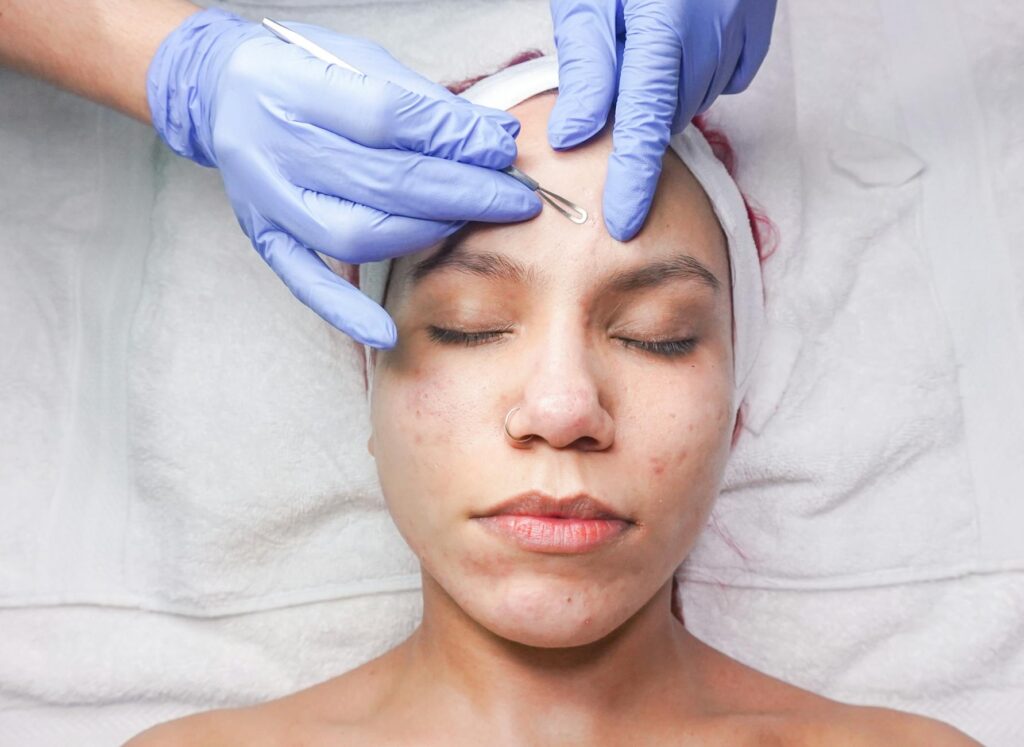
The rise of AI in acne triage reflects broader efforts to scale dermatological care globally, particularly through telemedicine platforms. However, current AI acne-grading systems remain unapproved for routine clinical use, with wide variability in real-world accuracy depending on the algorithm, skin tone, and lesion complexity. Understanding what these tools can and cannot do is essential for anyone considering using them—whether as a patient preparing for a virtual dermatology visit or as a clinic evaluating whether to implement AI-assisted triage.
Table of Contents
- How Do AI Tools Detect and Grade Different Types of Acne Lesions?
- Why Accuracy Varies So Widely Across Different AI Acne Models
- What Role Do AI Tools Play in Teledermatology Triage and Consultation Prioritization?
- The PASSION Dermatology Initiative and Addressing Bias in Acne Detection Across Skin Tones
- Critical Limitation—AI Acne Grading Has Not Yet Achieved Clinical Validation for Real-World Use
- How AI Acceleration Benefits Acne Assessment Despite Ongoing Limitations
- The Future of AI Acne Grading and Ongoing Research Directions
- Conclusion
How Do AI Tools Detect and Grade Different Types of Acne Lesions?
Teledermatology AI tools work by training deep learning models on thousands of labeled skin images to recognize specific acne features. These algorithms identify comedones (blackheads and whiteheads), papules (small red bumps), pustules (bump with white heads), and nodules, then combine these individual lesion counts and severity patterns into an overall acne grade. The algorithms essentially learn visual patterns that correlate with dermatologist-assigned severity scores, allowing them to replicate manual grading without a physician present. Miiskin’s AI system exemplifies this approach—it analyzes a smartphone photo under standardized lighting conditions, counts lesion types across different facial zones, and within 60 seconds outputs a severity score and skin-type assessment alongside treatment recommendations.
The advantage of automated lesion detection is speed and consistency; an AI model doesn’t tire and evaluates every image by the same criteria. However, the challenge is that acne severity is somewhat subjective even among dermatologists, and the “correct answer” the algorithm was trained on depends on the specific dermatologists who labeled the training dataset. If those dermatologists had slightly different grading styles, the algorithm inherits that variation. For example, one expert might count very small microcomedones while another counts only obvious lesions, leading to different severity scores for the same patient—and the AI learns whichever standard its training set reflected.

Why Accuracy Varies So Widely Across Different AI Acne Models
Clinical studies measuring AI acne-grading accuracy have reported results ranging from as low as 20.5 percent to as high as 89.8 percent—a gap that reflects real differences in algorithm design, training data, and testing conditions. A comprehensive systematic review published in 2025, analyzing all available studies from January 2017 through March 2025, confirmed that accuracy varies dramatically across models. The best performers, such as AcneDGNet, achieved 89.8 percent accuracy in controlled offline testing scenarios where images were taken under ideal conditions with consistent lighting and camera positioning. This wide variance occurs because several factors affect real-world performance: the size and diversity of the training dataset, whether the algorithm was tested on the same population it was trained on (which inflates accuracy), skin tone representation in the training data, lesion severity range in the test set, and image quality.
A model trained on mostly mild acne cases will misgrade moderate-to-severe cases. Similarly, an algorithm trained predominantly on lighter skin tones often performs poorly on darker skin—a well-documented problem in medical AI. The 89.8 percent accuracy of AcneDGNet looks exceptional, but that figure comes from controlled conditions; real-world accuracy when used by diverse patients taking photos at home can be significantly lower. This is a critical limitation: accuracy on a research dataset tells you what a model can do in ideal conditions, not what it will actually do in a patient’s bathroom with different lighting.
What Role Do AI Tools Play in Teledermatology Triage and Consultation Prioritization?
In a teledermatology workflow, AI acne assessment sits at the front end: a patient with a skin concern submits photos to a virtual clinic, the AI tool analyzes them within minutes and assigns a severity score and triage level, and dermatologists then review cases in priority order rather than first-come-first-served. A patient with severe nodular acne affecting large areas of the face would be flagged for urgent evaluation, whereas someone with mild comedonal acne might receive initial guidance from the clinic’s educational materials while waiting for the next available specialist consultation. This prioritization is the primary value proposition: accelerating care for those who need it most and optimizing dermatologists’ schedules by front-loading high-severity cases. The triage benefit assumes, however, that the AI correctly identifies severity—and here is where the accuracy variability matters most.
If a patient with moderate acne is undergraded by the algorithm and triaged as mild, they may experience a delay in reaching a dermatologist. Conversely, if the AI overestimates severity, resources are wasted evaluating cases that could have been handled with simpler treatment paths. Some teledermatology platforms acknowledge this by having dermatologists review all AI triage decisions before assigning priority levels—meaning the AI functions as a first-pass screening tool rather than the sole decision-maker. This two-step process reduces risk but also reduces the speed advantage.

The PASSION Dermatology Initiative and Addressing Bias in Acne Detection Across Skin Tones
Recognition that existing AI acne tools perform poorly on darker skin tones has led to research initiatives like PASSION Dermatology, a multi-continent collaboration involving partners in Australia, China, Madagascar, Switzerland, and Tanzania, funded by the Fondation Botnar. This initiative focuses specifically on creating AI-ready datasets that include diverse skin tones and populations, with the explicit goal of reducing algorithmic bias in dermatological diagnosis. One component of PASSION targets building AI systems capable of recognizing the five skin conditions responsible for approximately 80 percent of dermatological cases globally—acne is among the most common conditions being addressed.
The motivation is straightforward but urgent: if an acne-grading AI is trained on images predominantly featuring lighter skin, it will likely underestimate severity in people with darker skin tones, where inflammatory acne and post-inflammatory hyperpigmentation can present differently than in lighter skin. A pustule on brown skin and a pustule on white skin may have different visual characteristics that an undertrained algorithm misses. By building diverse datasets now and testing algorithms across populations, PASSION and similar efforts aim to create tools that work reliably for everyone—not just affluent populations in developed countries where most medical AI training data originates.
Critical Limitation—AI Acne Grading Has Not Yet Achieved Clinical Validation for Real-World Use
Despite promising reported accuracies in research settings, no acne AI-grading algorithm has yet received formal clinical validation for routine clinical practice. This is a crucial distinction. “Clinical validation” means prospective testing in real-world conditions (actual patients, diverse settings, dermatologists’ actual workflows) demonstrating that the tool reliably improves patient outcomes or efficiency. Most published accuracy figures come from retrospective studies—researchers train and test on archived datasets—or from controlled studies where images are taken under ideal conditions.
When an algorithm is deployed in a real clinic with actual patients taking photos on their own phones, in variable lighting, with different camera angles, accuracy often declines. A systematic review of studies from 2017 through March 2025 highlighted another critical gap: most available acne AI research involves small sample sizes, limited populations, and short follow-up periods. Prospective studies that would track whether AI-triaged patients actually achieve better outcomes (faster access to care, more appropriate initial treatments, higher satisfaction) compared to traditional triage remain sparse. Until such evidence exists, medical institutions remain cautious about integrating AI acne grading into standard workflows. For individual users considering AI tools for self-assessment, it’s important to recognize that while these systems can provide useful preliminary information, they should never replace a dermatologist’s clinical judgment, particularly for complex cases or if a patient has darker skin tones.
How AI Acceleration Benefits Acne Assessment Despite Ongoing Limitations
Setting aside the accuracy gaps, the speed benefit of AI acne assessment is genuine and valuable for access. A patient in a remote area with no local dermatologists can take a smartphone photo, upload it through a telemedicine platform, and receive preliminary severity and treatment guidance within an hour—something that would have required either traveling to a city or waiting weeks for a mailed consultation. Miiskin’s 60-second assessment, for example, gives a patient immediate feedback on whether their acne is mild (surface comedones primarily), moderate (scattered papules and pustules), or severe (widespread inflammation or nodules), along with skin-type data that informs over-the-counter treatment options. For mild acne, this preliminary assessment can be sufficient to guide initial self-care; for moderate-to-severe cases, it accelerates the next step of connecting with a dermatologist. The acceleration also benefits clinics struggling with case volume.
Manually reviewing and prioritizing 50 new acne consultations would take a dermatologist several hours; an AI system can score all 50 in minutes, immediately highlighting the three most severe cases requiring urgent evaluation. This sorting function has real value for resource-limited settings where dermatologists are scarce. However, the catch is that this speed advantage only improves care if the AI’s triage is accurate. In settings where dermatologists then manually review all AI triage decisions anyway—which many do to ensure safety—the time savings shrink considerably. The greatest benefit occurs when there is sufficient trust in the system and enough data showing safety that dermatologists can prioritize without re-reviewing the AI assessment.
The Future of AI Acne Grading and Ongoing Research Directions
Current research trends suggest that acne AI tools will improve, driven by larger and more diverse training datasets, more sophisticated model architectures (such as generative adversarial networks), and prospective validation studies now underway. Generative adversarial networks have shown promise in enhancing lesion detection and severity assessment by generating synthetic training examples, effectively expanding the diversity of images the algorithm learns from. Several clinical trials are actively testing AI-assisted acne triage in real-world teledermatology settings, with results expected over the next 2–3 years.
However, improvement alone does not equal adoption. Even if a new acne AI algorithm achieves 95 percent accuracy in research, it will not become a standard tool until clinical validation proves it improves outcomes in routine care, and until regulatory pathways (FDA approval or equivalent) clarify what evidence regulators require. The timeline for this is uncertain; it could be 2–3 years for promising algorithms, or longer if prospective studies reveal unexpected limitations. For now, AI acne tools are best viewed as useful adjuncts to human judgment—particularly valuable in telemedicine settings where speed matters, but not yet replacements for dermatologist expertise.
Conclusion
TeleDerm AI tools provide rapid, automated assessment of acne severity and lesion types by analyzing skin images through deep learning algorithms, with the primary goal of accelerating triage in teledermatology. They work by detecting and counting specific acne lesion types, grading overall severity, and prioritizing consultation schedules. However, current accuracy ranges widely (20.5 to 89.8 percent depending on the algorithm and conditions), no system has yet achieved formal clinical validation for real-world use, and performance on darker skin tones remains a known gap that initiatives like PASSION Dermatology are working to address.
The practical takeaway is that these tools offer real value for speeding initial assessment and improving access to dermatological guidance, especially in remote or underserved areas. But they work best as a complement to dermatologist expertise rather than a replacement for it. If you’re considering using an AI acne-assessment tool, understand that it provides useful preliminary information—similar to what a nurse intake assessment might offer—but should inform rather than override professional medical judgment. Watch for continued research and clinical validation over the next few years, which should clarify which algorithms are safe to use independently and which require dermatologist review.