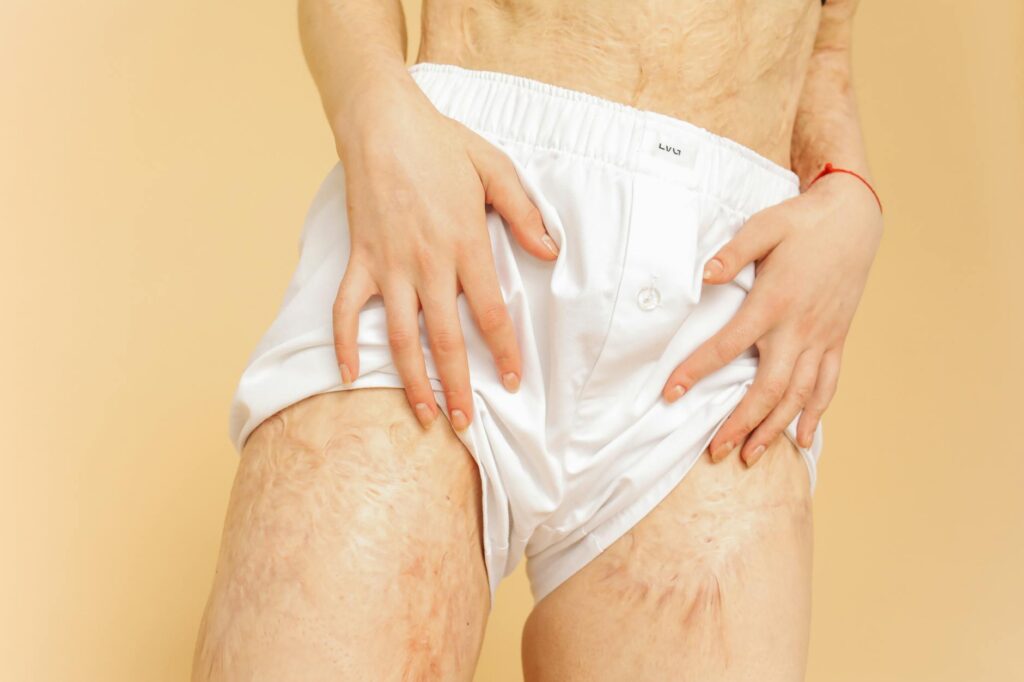
Hypopigmentation from laser scar treatment looks like lighter patches or streaks within and around the treated scar area—zones where your skin has lost pigment and appears noticeably paler than the surrounding skin. Unlike the red or dark marks that fade over weeks or months, true hypopigmentation doesn’t typically become visible until six to twelve months after your treatment, once the initial redness and any temporary darkening have resolved. At that point, if it develops, you’ll notice the scar or treated zone stands out as visibly lighter, sometimes with sharp or blurred boundaries depending on how the laser was applied.
This complication is less common than its opposite (hyperpigmentation), but it remains one of the serious potential side effects of laser resurfacing, particularly in certain patients and circumstances. The risk is not uniform across all skin types or treatment approaches—darker skin tones face higher risk, as do people who receive overly aggressive treatments or who have a history of previous aggressive procedures like dermabrasion. This article covers what hypopigmentation actually looks like, who is most at risk, why it happens, how it can be treated or prevented, and what realistic outcomes you should expect.
Table of Contents
- How Do You Actually See Hypopigmentation Develop After Laser Treatment?
- Why Is True Hypopigmentation Relatively Rare?
- Which Patients Face the Highest Hypopigmentation Risk?
- What Treatment Options Exist If Hypopigmentation Develops?
- How Can You Prevent Hypopigmentation Before It Happens?
- Why Does Hypopigmentation Take So Long to Become Visible?
- What Do Recent Advances Tell Us About Hypopigmentation Risk Going Forward?
- Conclusion
How Do You Actually See Hypopigmentation Develop After Laser Treatment?
Hypopigmentation manifests as patches or streaks of abnormally light skin within the treatment zone. Immediately after your procedure, you won’t see this—your skin will be red, possibly swollen, and possibly darker than normal due to post-inflammatory hyperpigmentation. Over the following two to three months, that redness fades and the post-inflammatory darkening begins to resolve. But if true hypopigmentation is going to develop, it typically becomes apparent once those temporary changes have cleared, usually between six and twelve months post-treatment.
What distinguishes laser-induced hypopigmentation from simple lightness or temporary discoloration is its permanence without intervention and its sharp demarcation from normal skin. You might notice the affected area is uniformly pale, almost blanched, or it might appear as irregular patches. In some cases, the boundary between treated and untreated skin is distinct; in others, there’s a gradual transition. The severity ranges from barely noticeable to quite obvious, depending on your baseline skin tone, the depth of treatment, and individual healing factors. Someone with deeper skin tone will notice hypopigmentation more readily than someone with very fair skin.

Why Is True Hypopigmentation Relatively Rare?
Hypopigmentation is comparatively frequent as a potential complication of laser resurfacing, but true clinical hypopigmentation—the kind that persists and is functionally significant—is actually rare. Most cases are mild, and many never progress to obvious depigmentation. The rarity of severe hypopigmentation is partially because modern laser systems have improved safety profiles, and dermatologists have learned to avoid the aggressive parameters that historically caused it most often.
True persistent hypopigmentation tends to occur most frequently in patients who have undergone very aggressive treatment, especially those who previously had other intense skin procedures like dermabrasion or phenol peeling. It’s also more likely to develop in areas that were treated with excessive energy or prolonged exposure. However, if you receive a single, appropriately calibrated laser treatment from an experienced provider, your risk of developing noticeable hypopigmentation is relatively low. This is one reason why operator experience and appropriate laser settings are so critical—inexperience, excessive treatment intensity, and poor postoperative wound care significantly increase complication risk.
Which Patients Face the Highest Hypopigmentation Risk?
Risk of hypopigmentation and other pigmentation complications is highest in patients with darker skin (Fitzpatrick skin types III through VI) or those who are significantly sun-tanned at the time of treatment. This is a critical disparity: while laser scar treatments are valuable for all skin types, the margin for error is narrower in patients with more melanin, and the consequences of complications are more visible. A hypopigmented patch stands out starkly against darker skin in a way it might not on very fair skin.
Additionally, certain individual characteristics increase overall complication risk: poor postoperative compliance (not protecting treated skin from sun, not following wound care instructions), a history of abnormal scarring or pigmentation disorders, and baseline sun exposure or tanning habits all matter. Someone who tans easily or works outdoors faces higher risk than someone with minimal sun exposure, because UV radiation and inflammation interact with laser injury to influence pigmentation outcomes. If you have darker skin, a history of keloids or abnormal pigmentation, or high sun exposure, discuss these specific risk factors with your dermatologist before any laser procedure.

What Treatment Options Exist If Hypopigmentation Develops?
If hypopigmentation does occur, laser treatment itself can help address it. Recent research shows that a combination approach works best: fractional laser therapy paired with topical prostaglandin analogue application. In one clinical study, 11 of 14 patients (78%) achieved more than 50% improvement in their hypopigmentation within 12 weeks using this combined approach. This dual mechanism—the laser stimulates melanocytes and promotes repigmentation while the prostaglandin analogue enhances the skin’s healing response and pigment production.
The limitation here is that results vary by individual, and not everyone achieves complete repigmentation. Some hypopigmented areas respond beautifully while others improve only partially. Recent technological advances have improved the odds: laser wavelength optimization has increased repigmentation rates by approximately 15%, and AI-powered diagnostic imaging tools have improved diagnostic accuracy by 25%, allowing dermatologists to tailor treatment more precisely. However, treatment can require multiple sessions spread over months, and there is no guaranteed perfect result. Earlier intervention (seeking treatment as soon as hypopigmentation becomes apparent) generally leads to better outcomes than waiting years to address it.
How Can You Prevent Hypopigmentation Before It Happens?
Prevention is far more effective than treatment, so understanding risk reduction strategies is crucial. Sun exposure, both before and after your procedure, is one of the most modifiable risk factors. Avoiding direct sun and using strict sun protection (SPF 50+, protective clothing) for at least three to six months post-treatment significantly reduces dyspigmentation risk. UVA and UVB exposure can trigger irregular pigmentation responses in healing skin, so this is not optional—it’s a core part of preventing complications.
Your dermatologist’s choice of laser technique also matters for prevention. Fractionated laser delivery systems (which treat only a fraction of the skin at a time, leaving untreated bridges between treated zones) reduce risk compared to full-surface ablative approaches, because they preserve some normal skin architecture and healing capacity. Cooling devices used during treatment reduce heat-related damage to melanocytes and surrounding structures. An experienced provider will choose appropriate laser settings and wavelengths for your skin type, avoiding the excessive energy that was common in earlier laser resurfacing practices. Proper postoperative wound care—including gentle cleansing, appropriate moisturization, and avoiding irritants—also influences whether complications develop.

Why Does Hypopigmentation Take So Long to Become Visible?
The delayed onset of hypopigmentation—six to twelve months after treatment rather than appearing immediately—relates to the sequence of post-treatment skin changes. Immediately and in the weeks after laser treatment, your skin experiences post-inflammatory hyperpigmentation (darkening) and erythema (redness) as part of the normal inflammatory response. These changes actually mask any underlying hypopigmentation that may be developing.
Only once the inflammation resolves and the temporary hyperpigmentation fades away does any true loss of pigment become visually apparent. This delay means you cannot assess the full outcome of your laser treatment immediately or even at two or three months post-procedure. It’s one reason why dermatologists recommend waiting six to twelve months before considering any corrective procedures or evaluating whether complications have truly developed. Some mild hypopigmentation may be present early on but improve spontaneously over this window as the skin continues to heal and melanocytes recover function.
What Do Recent Advances Tell Us About Hypopigmentation Risk Going Forward?
The good news is that the landscape of laser scar treatment continues to improve. Newer laser devices incorporate wavelength optimization specifically designed to minimize pigmentation-related complications while maximizing scar improvement. These technological refinements have increased repigmentation success rates by about 15% compared to older systems.
Additionally, AI-powered diagnostic imaging now enables dermatologists to identify patients at higher risk of hypopigmentation before treatment begins, allowing for more conservative approaches or closer monitoring in vulnerable populations. The integration of combination therapies—laser plus topical agents, laser plus LED light, or other synergistic approaches—has also expanded treatment options and improved outcomes for existing hypopigmentation. As dermatology continues to evolve, the goal is not just to treat scars effectively but to do so with minimal risk of secondary complications like hypopigmentation, particularly in patients with darker skin tones who historically bore the burden of these complications most heavily.
Conclusion
Hypopigmentation from laser scar treatment appears as lighter patches or areas within the treated zone, usually becoming visible six to twelve months after your procedure once temporary redness and post-inflammatory darkening have resolved. While it is a relatively rare complication compared to other laser side effects, it is serious when it occurs, more common in darker skin types, and permanent without intervention. The key to managing this risk lies in understanding your individual risk factors, selecting an experienced dermatologist who uses appropriate laser settings and techniques for your skin type, and committing to strict sun protection before and after treatment.
If hypopigmentation does develop despite prevention efforts, modern treatment options—especially fractional laser combined with topical prostaglandins—offer realistic hope for improvement, with approximately 78% of patients achieving significant repigmentation. Before undergoing any laser scar treatment, have a detailed conversation with your dermatologist about your specific risk profile, the precautions they will take, and your expectations for outcomes and potential complications. This informed approach, combined with proper aftercare and sun protection, substantially reduces your risk of developing this complication.