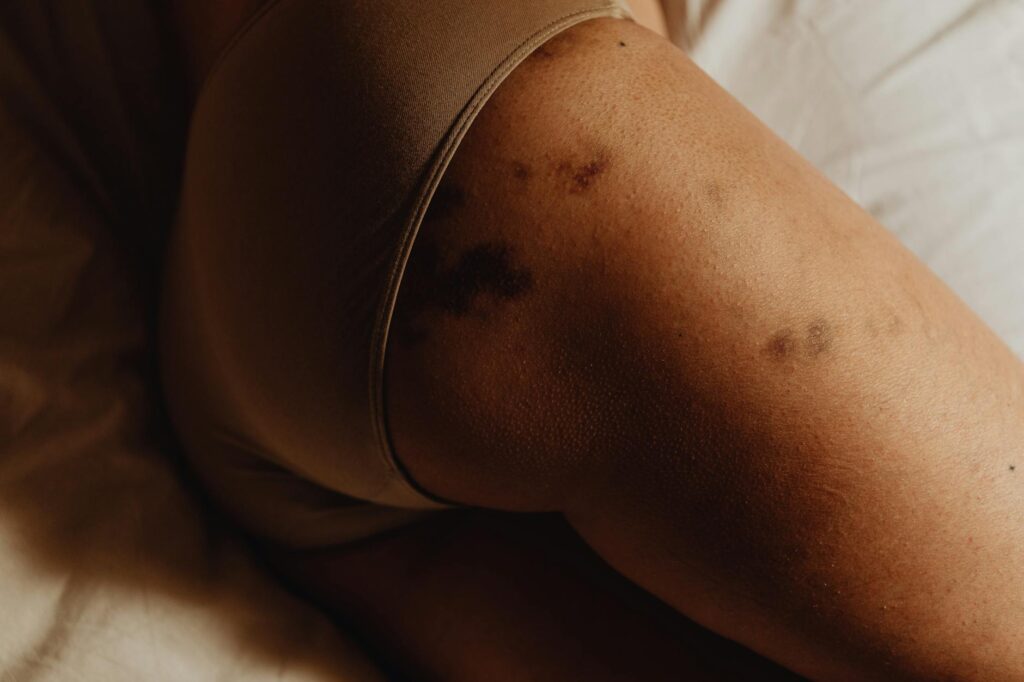
Red marks that appear after acne clears are the result of inflammation and damaged blood vessels beneath the skin’s surface. When a pimple forms, the immune system floods the area with white blood cells and inflammatory compounds to fight bacteria, which causes the surrounding skin to swell and blood vessels to dilate.
Even after the bacteria are gone and the pimple is healed, these blood vessels remain enlarged and the skin hasn’t yet rebuilt the collagen structure that was broken down by the infection, leaving behind a red or pink mark. These post-acne red marks, clinically called post-inflammatory erythema, typically fade on their own over several months as blood vessels gradually constrict and collagen regenerates, though the timeline varies significantly depending on your skin tone, the severity of the original acne, and how well you protect the healing skin from further irritation. This article explores the biological mechanisms behind red marks after acne, how long they typically persist, what factors speed up or slow down healing, and the most effective treatment options available.
Table of Contents
- What Causes Red Discoloration Under the Skin After Acne Heals?
- How Long Do Red Marks After Acne Typically Take to Fade?
- What Happens to Blood Vessels and Collagen During the Healing Process?
- Does the Location of Acne on Your Face Affect How Red Marks Appear and Heal?
- What Factors Speed Up or Slow Down the Fading of Red Marks?
- When Do Red Marks Require Professional Treatment Rather Than Waiting?
- Are Red Marks After Acne Different From Permanent Acne Scars?
- Conclusion
- Frequently Asked Questions
What Causes Red Discoloration Under the Skin After Acne Heals?
The red marks you see are primarily caused by two separate but overlapping mechanisms. First, when acne develops, bacteria stimulate an inflammatory cascade that causes blood vessels in and around the pimple to expand to increase blood flow and deliver immune cells to fight the infection. This vasodilation is why active pimples appear red and inflamed. After the bacterial infection clears—either on its own or through treatment—the immune response gradually subsides, but the blood vessels don’t immediately shrink back to their normal size. They remain dilated for weeks or even months, continuing to deliver extra blood to the area, which is why you see persistent redness even though the pimple itself is gone. The second mechanism involves collagen breakdown.
The bacteria and the inflammatory response both damage the structural proteins in the dermis, the layer of skin beneath the epidermis. As the acne resolves, your body begins producing new collagen to rebuild this damage, but the newly formed collagen is initially less organized and less dense than the original healthy collagen. This incomplete collagen network leaves the area more translucent and allows the dilated blood vessels beneath to show through more prominently. Over time, as collagen rebuilds and becomes more densely packed, and as blood vessels gradually normalize, the redness fades—though the timeline can range from a few weeks for mild marks to many months for more severe inflammation. Interestingly, the depth and severity of the original acne lesion directly correlates with how red and persistent the mark will be. A deep cystic pimple that penetrated multiple skin layers will cause more collagen damage and a more intense inflammatory response than a superficial whitehead, which is why you might notice that marks from your worst breakouts take the longest to fade.
How Long Do Red Marks After Acne Typically Take to Fade?
The timeline for red mark fading is highly variable but generally follows a predictable pattern. Mild redness from superficial acne lesions often fades significantly within 4 to 6 weeks as the initial inflammatory swelling subsides. However, deeper or more severe lesions can leave marks that remain noticeably red for 3 to 6 months, and in some cases up to a year or longer. The variation depends largely on several biological factors: your skin’s natural ability to produce and reorganize collagen, your skin tone (darker skin tends to retain post-inflammatory marks longer and more visibly), how much the area was picked or irritated during healing, and whether you protected the healing skin from sun exposure.
Importantly, the fading isn’t linear—it’s typically fastest in the first 4 to 8 weeks as the acute inflammation resolves, then much slower as collagen remodeling continues over months. This is why a mark that looks impossibly red at two weeks might look only slightly pink at three months, even though full maturation of new collagen can take a year. If you have darker skin tones, post-inflammatory erythema can be particularly stubborn because your skin produces more melanin as a protective response to inflammation, which can make the marks appear darker or more persistent than they do in lighter skin. One critical limitation: while time does heal most red marks, waiting passively means accepting months of visible discoloration. This is where active treatments become valuable for people who want faster results or are dealing with extensive red marks from a major breakout.
What Happens to Blood Vessels and Collagen During the Healing Process?
Understanding the actual biological changes occurring beneath the surface helps clarify why red marks persist and how treatments work. When acne heals, your body enters what dermatologists call the remodeling phase. Blood vessels that became dilated during the inflammatory phase gradually constrict through a process called vasoconstriction, but this happens on a slow timeline—often over 3 to 6 months—because the body doesn’t have a quick “reset” button for blood vessel diameter. The vessels slowly return to normal caliber as the inflammatory signals that caused the dilation decrease. Simultaneously, your skin is actively rebuilding collagen. Fibroblasts, the cells responsible for collagen production, become activated in response to the tissue damage and inflammatory signals.
These cells migrate into the damaged area and begin synthesizing new collagen type I and III. However, the newly formed collagen initially lacks the organized structure of mature collagen—it’s deposited in a somewhat disorganized fashion and hasn’t yet developed the crosslinks that give mature collagen its strength and density. This immature collagen is less effective at hiding the blood vessels beneath, which is another reason the red marks remain visible during early healing. Over weeks and months, the collagen continues to mature and reorganize. The fibroblasts produce enzymes called matrix metalloproteinases that help organize the collagen network, and collagen crosslinks gradually form, making the tissue stronger and denser. As this mature collagen becomes denser and more organized, it becomes more opaque and effectively obscures the blood vessels beneath, allowing the red marks to fade even if the vessels haven’t completely normalized. By 6 to 12 months post-injury, the collagen remodeling is largely complete, though it can continue at a slower rate for up to two years.
Does the Location of Acne on Your Face Affect How Red Marks Appear and Heal?
The location where acne develops significantly influences both the appearance of red marks and their healing timeline. Acne on the face tends to leave more noticeable red marks because facial skin is thinner and has more prominent blood vessels than other areas of the body. The cheeks and chin, where many people experience moderate to severe acne, have particularly reactive skin with abundant blood supply, which means these areas can show very intense redness after acne clears. Additionally, the face is constantly exposed to sun, wind, and environmental irritants, all of which can delay healing and prolong the visibility of red marks.
In contrast, red marks on the back or chest often fade more quickly and less noticeably because the skin in these areas is thicker and has less prominent vascular patterns, which means the underlying blood vessels are less visible through the skin. The tradeoff is that acne on the back and chest tends to leave more pronounced scarring (indented or textured marks) rather than just flat redness, so the healing patterns are different. Facial acne typically leaves purely inflammatory red marks first, which fade relatively quickly if not scarred, while body acne more often progresses to textural damage. For facial acne, the forehead often heals faster than the cheeks because the forehead skin is thicker and has better blood circulation, which paradoxically speeds up the inflammatory resolution phase. However, the T-zone (forehead, nose, chin) experiences more ongoing oil production and environmental exposure, which can irritate healing marks and slow their fading if you don’t protect them carefully.
What Factors Speed Up or Slow Down the Fading of Red Marks?
Several controllable and uncontrollable factors significantly influence how quickly red marks fade. Sun exposure is the most important modifiable factor—UV radiation causes further inflammation and can prevent the normal fading process. If you expose healing red marks to direct sun without protection, they can remain darker and more visible for much longer because UV light stimulates melanin production and can trigger inflammation in the healing tissue. Protecting red marks with SPF 30 or higher sunscreen daily is one of the most evidence-based ways to speed healing. Picking, touching, or physically irritating the healing mark also slows fading. Each time you pick at or squeeze a healing area, you restart the inflammatory cascade, delaying collagen maturation and prolonging the redness. Similarly, using harsh or overly active skincare products on healing marks can irritate the area and slow fading.
However, gentle moisturizing and avoiding unnecessary friction actually support faster healing. Certain topical treatments like vitamin C, niacinamide, and retinoids can also accelerate collagen production and may help marks fade slightly faster, though the evidence is modest. Uncontrollable factors include your age, skin type, and genetics. Younger skin generally produces collagen and repairs inflammation more efficiently, which is why teenagers often see red marks fade faster than people in their 30s and 40s, even from similarly severe acne. Your genetic predisposition to post-inflammatory erythema also plays a role—some people’s skin seems to hold onto red marks for longer regardless of how carefully they treat the area. Skin tone is another significant factor: people with darker skin tones often experience more persistent post-inflammatory erythema because the skin’s natural inflammatory response produces more melanin, which can make marks appear darker and last longer. Additionally, if you have conditions like rosacea or sensitive skin, red marks may take longer to fade because your baseline vascular reactivity is already heightened.

When Do Red Marks Require Professional Treatment Rather Than Waiting?
Most red marks from mild to moderate acne fade adequately within 3 to 6 months with sun protection and gentle skincare, making professional treatment unnecessary. However, professional treatments become valuable when red marks are severe, extensive, or show no signs of improvement after 4 to 6 months. Dermatologists have several effective options depending on the specific characteristics of your marks. Laser treatments, particularly vascular lasers like the PDL (pulsed dye laser) or Nd:YAG laser, can reduce redness by selectively targeting the dilated blood vessels beneath the skin and causing them to collapse. These treatments work best for purely vascular red marks (those caused primarily by enlarged blood vessels rather than collagen loss) and typically show improvement within 1 to 3 sessions.
Light-based treatments like intense pulsed light (IPL) work similarly but are less precise. Chemical peels and microneedling stimulate collagen remodeling and can reduce the appearance of marks, particularly those with slight textural changes. For marks that are taking an unusually long time to fade, treatments like fractional CO2 laser can aggressively stimulate collagen remodeling and may produce faster results, though they require downtime. The decision to pursue professional treatment depends on your tolerance for waiting, the visibility of your marks, and your skin’s response to conservative measures. Some people are happy to wait 6 to 12 months for natural fading, while others prefer to invest in professional treatments to achieve results in 2 to 4 months.
Are Red Marks After Acne Different From Permanent Acne Scars?
A critical distinction that many people miss is the difference between red marks and actual permanent scars. Red marks are post-inflammatory erythema—temporary discoloration caused by dilated blood vessels and incomplete collagen remodeling—and they will fade eventually with time and proper care. Actual acne scars, by contrast, are permanent changes to the skin structure characterized by either indentations (atrophic scars), raised tissue (hypertrophic scars), or rolling waves of texture. These structural scars result from insufficient collagen replacement during healing and require professional treatment to improve. Understanding this distinction is crucial because it affects your timeline expectations and treatment approach. If you’re seeing red marks, you have time and can rely on natural healing.
If you’re seeing indented or textured marks that catch the light or create shadows, these are scarring and won’t improve on their own—they require treatments like laser resurfacing, subcision, or fillers. Many people initially mistake early scarring for red marks and wait months expecting fading that won’t happen. The key difference: press your skin gently with your finger—if the mark looks less visible when you flatten the skin, it’s likely a red mark; if it remains indented or textured regardless, it’s structural scarring. Looking forward, research into collagen regeneration and skin remodeling continues to advance. Emerging treatments focusing on stimulating fibroblast activity and optimizing collagen crosslinking show promise for accelerating both the natural fading of red marks and the treatment of established scars. Regenerative medicine approaches using growth factors and stem cell therapies are being investigated but remain largely experimental outside clinical trials.
Conclusion
Red marks that appear after acne clears are caused by enlarged blood vessels and incomplete collagen remodeling in the dermis, and they represent a temporary—though sometimes frustratingly long—stage of healing. Most red marks fade naturally over 3 to 6 months or longer as blood vessels gradually normalize and new collagen becomes organized and dense. The timeline varies significantly based on the severity of the original acne, your skin tone, sun exposure, and genetic factors, but protecting your healing skin from sun and avoiding irritation are the most effective self-care measures.
If you’re dealing with red marks from acne, the first step is accepting that fading takes time and that sun protection is essential. If marks persist beyond 6 months despite careful sun protection, or if you’re dealing with deep marks from severe cystic acne, consulting a dermatologist about professional treatments like vascular lasers or microneedling can provide faster results. Most importantly, distinguish between red marks and structural scars—the former will eventually fade, while the latter require active treatment. Moving forward, focus on preventing new acne through consistent skincare and, if necessary, prescription treatments, since preventing acne is far more effective than managing the marks it leaves behind.
Frequently Asked Questions
How can I tell if my red marks will fade or if they’ll become permanent scars?
If the mark is completely flat and only appears discolored (red, pink, or purple), it will fade with time. If you can feel a depression or roughness when you run your finger across it, or if it catches the light and creates shadows, it’s likely scarring and will require professional treatment. Time won’t improve structural scarring, so don’t wait if you notice textural changes.
Is it safe to use active skincare ingredients like retinoids or vitamin C on red marks while they’re healing?
Gentle application of proven collagen-stimulating ingredients like retinoids and vitamin C may modestly accelerate healing, but it’s crucial to go slowly. Start with low concentrations and infrequent use on healing marks, as high-strength actives can irritate and actually delay fading. Always prioritize sun protection over active ingredients during the healing phase.
Why do red marks from acne take longer to fade on darker skin?
The inflammatory response in darker skin naturally produces more melanin as a protective mechanism, which can make post-inflammatory marks appear darker and more visible. Additionally, darker skin types show vascular redness less intensely but melanin changes more obviously, which means the marks appear to persist longer even as the underlying blood vessel dilation is improving. This is why sun protection is even more critical for darker skin tones—UV exposure can darken these marks further.
Can I cover red marks with makeup while they’re healing, or will that slow fading?
Covering marks with makeup won’t slow their natural fading, but heavy makeup combined with inadequate cleansing can cause irritation that might delay healing slightly. If you use makeup, ensure you’re cleansing gently but thoroughly, and always apply sun protection before makeup. Mineral sunscreen can actually serve double duty as both sun protection and coverage for red marks.
Are there any supplements or dietary changes that help red marks fade faster?
While antioxidant-rich foods and adequate protein support general skin health, no supplement has strong evidence for specifically accelerating the fading of red marks. The most important factors remain time, sun protection, and avoiding irritation. Staying well-hydrated and maintaining a diet rich in vitamins (particularly vitamin C) supports collagen synthesis, but the effect is modest compared to professional treatments or strict sun protection.
How soon after acne clears should I start considering professional treatment for red marks?
Most dermatologists recommend waiting at least 3 to 4 months before pursuing professional treatment, since many red marks show significant natural improvement during this period. However, if you have extensive marks from severe acne, starting professional treatments around the 3-month mark is reasonable. For marks that show no improvement after 6 months despite sun protection and gentle skincare, professional treatment becomes a sensible option.