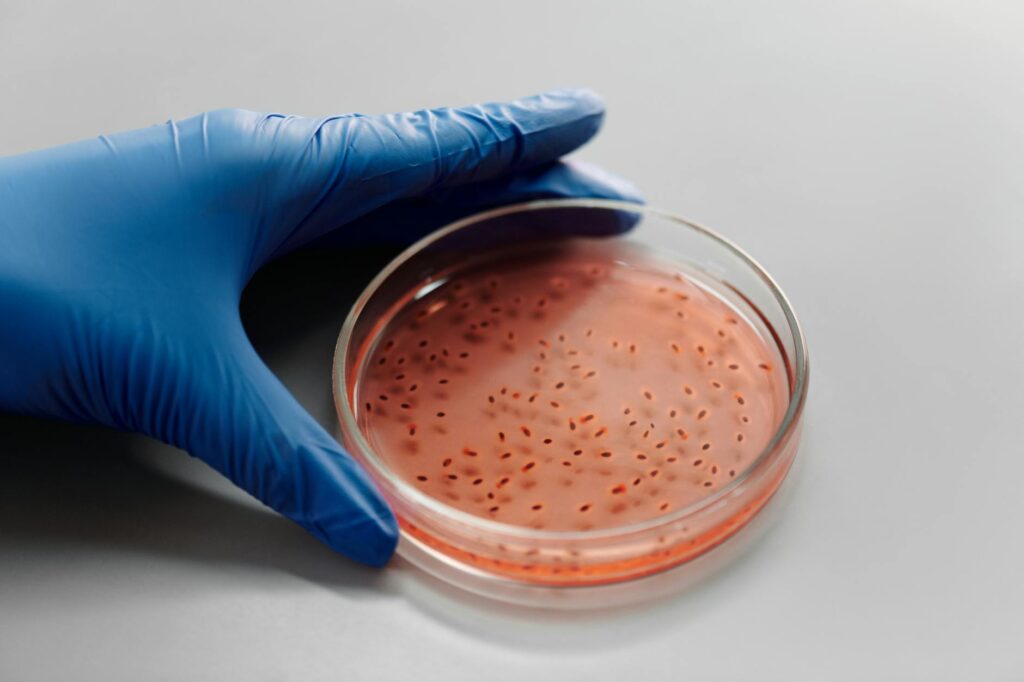
CRISPR research on acne bacteria is showing that it may be possible to selectively destroy the specific strains of Cutibacterium acnes that cause inflammation while leaving beneficial strains untouched — a precision that no antibiotic, benzoyl peroxide, or retinoid has ever achieved. The most advanced effort comes from Paris-based Eligo Bioscience, whose topical drug candidate EB005 uses a programmed CRISPR nuclease to target only pro-inflammatory subpopulations of C. acnes in patients with moderate-to-severe acne. Meanwhile, researchers at Pompeu Fabra University in Barcelona published results in Nature Biotechnology in January 2024 showing they had engineered C. acnes to produce and secrete a protein that reduces sebum production, essentially turning the skin’s most abundant bacterium into a drug delivery vehicle.
These are not theoretical exercises. Eligo has secured a deal with GlaxoSmithKline worth up to €185 million to develop CRISPR-based microbiome treatments, raised $30 million in Series B funding, and is preparing for a Phase 1b/2a clinical trial of EB005. A separate clinical case report published in September 2024 documented successful acne management using a spray containing live CRISPR-positive bacteria. The field is moving from lab benches to human skin faster than many dermatologists expected. This article breaks down what each of these research programs has found, how the different CRISPR approaches work, what limitations and risks remain, and what it all means for people dealing with acne now and in the coming years.
Table of Contents
- What Is CRISPR Doing to Acne Bacteria That Antibiotics Cannot?
- How Eligo Bioscience’s EB005 Works and Where It Stands
- Engineered Bacteria as Living Skin Treatments
- CRISPR-Positive Bacteria Sprays and What the Early Clinical Data Shows
- Why Native CRISPR Systems in Acne Bacteria Complicate Treatment
- What This Means for Moderate-to-Severe Acne Patients Today
- Where CRISPR Acne Research Goes From Here
- Conclusion
- Frequently Asked Questions
What Is CRISPR Doing to Acne Bacteria That Antibiotics Cannot?
The core problem with treating acne through antibiotics is collateral damage. Oral and topical antibiotics kill bacteria broadly, wiping out protective strains alongside the ones driving inflammation. This leads to antibiotic resistance, disrupted skin microbiomes, and treatments that stop working over time. C. acnes represents approximately 80 percent of bacteria on human skin by abundance, so indiscriminate killing is not a minor issue — it fundamentally destabilizes the skin’s ecosystem. CRISPR changes the equation by allowing researchers to program a molecular tool that recognizes and cuts specific DNA sequences. Eligo Bioscience’s EB005 exploits this by encoding a CRISPR nuclease that identifies genetic signatures unique to the pro-inflammatory subtypes of C. acnes. When the nuclease finds its target sequence, it cuts the bacterial DNA, killing that cell.
Strains that lack the target sequence — including the health-associated lineages of C. acnes that help maintain normal skin function — are left alone. No antibiotic in existence can make this distinction. Compare this to isotretinoin (Accutane), which is the current last resort for severe acne. Isotretinoin works by shrinking sebaceous glands and dramatically reducing oil production across the entire face and body, but it comes with a long list of systemic side effects including birth defects, liver changes, and mood disturbances. The Pompeu Fabra approach is instructive here: rather than flooding the body with a drug, the researchers engineered C. acnes bacteria to locally produce NGAL, the very protein that mediates isotretinoin’s sebum-reducing effects. The engineered bacteria were validated in human skin cell lines and successfully engrafted on mouse skin, where they survived and secreted the therapeutic protein. If this translates to humans, it could replicate some of isotretinoin’s benefits without the systemic exposure.
How Eligo Bioscience’s EB005 Works and Where It Stands
EB005 is a topical treatment, meaning it would be applied directly to the skin rather than taken as a pill. The drug uses what Eligo calls a “precision antimicrobial” — a delivery vehicle carrying a CRISPR payload that enters C. acnes cells and destroys only those belonging to pro-inflammatory lineages. The specificity comes from the guide RNA programmed into the CRISPR system, which directs the nuclease to DNA sequences found exclusively in the pathogenic subtypes. The financial backing tells you how seriously the pharmaceutical industry is taking this. GlaxoSmithKline’s deal with Eligo, worth up to approximately $224 million, is not a small exploratory grant — it signals confidence that CRISPR-based microbiome editing could become a commercial therapeutic category. Eligo’s $30 million Series B financing, announced in December 2023, is specifically funding IND-enabling studies and a Phase 1b/2a clinical trial for EB005.
In 2025, the company also secured a $5 million grant from the French government’s France 2030 program to advance its topical gene delivery platform, following publication of its microbiome base-editing work in Nature and the issuance of a key patent covering gene-editing applications to skin disorders. However, there is an important caveat. Phase 1b/2a trials are early-stage. They test safety and preliminary efficacy in small patient groups. Even if EB005 performs well, it would still face Phase 2b and Phase 3 trials, regulatory review, and manufacturing scale-up before reaching pharmacy shelves. Drug development timelines in dermatology typically span several years from Phase 1 to approval. If you are dealing with moderate-to-severe acne right now, EB005 is not an option you can access, and it may not be for some time. The science is promising, but the regulatory path is long and failure rates in clinical development remain high across all therapeutic areas.
Engineered Bacteria as Living Skin Treatments
The Pompeu Fabra University research, published in Nature Biotechnology in January 2024, takes a fundamentally different approach from Eligo. Rather than using CRISPR to kill bad bacteria, the Barcelona team used gene editing to modify C. acnes so it would produce a therapeutic molecule. Specifically, they engineered the bacterium to secrete NGAL (neutrophil gelatinase-associated lipocalin), a protein known to induce death in sebocytes — the oil-producing cells in skin whose overactivity contributes to acne. The concept is elegant: C.
acnes already lives on the skin and colonizes sebaceous follicles, so engineering it to produce a sebum-reducing protein puts the drug precisely where it is needed. The international research team, which included collaborators from Lund University, Aarhus University, and the University of Barcelona, demonstrated that the engineered bacteria could engraft on mouse skin and remain viable while producing the therapeutic protein. This is a meaningful proof of concept because one of the biggest challenges with live biotherapeutics is whether the engineered organisms can actually survive and function in the real environment of human skin. The practical challenge, though, is that engineering a commensal bacterium to secrete a bioactive protein on human skin raises regulatory and safety questions that have no established precedent. How do you control the dose? What happens if the engineered bacteria spread to other body sites or other people? Can you turn off production if there are adverse effects? These are not insurmountable problems, but they mean this approach is likely further from the clinic than a more conventional drug like EB005. The mouse skin results are encouraging, but the gap between mouse engraftment studies and a product someone can actually use remains wide.
CRISPR-Positive Bacteria Sprays and What the Early Clinical Data Shows
A peer-reviewed case report published in September 2024 (PMID: 39355416) documented a different CRISPR-based approach to acne: NeoGenesis MB-1, a topical spray containing live CRISPR-positive nitrifying bacteria. The mechanism here is distinct from both Eligo’s targeted killing and Pompeu Fabra’s engineered protein secretion. Instead of editing acne bacteria directly, the applied bacteria carry functional CRISPR-Cas systems that disable bacteriophage replication — the viruses that infect non-CRISPR strains of skin bacteria. By normalizing the skin microbiome toward CRISPR-containing bacterial strains, the approach aims to reduce phage-driven inflammation linked to acne. This is worth understanding because it highlights a dimension of acne biology that most patients never hear about. Bacteriophages — viruses that infect bacteria — play a role in acne pathogenesis that researchers are still untangling. When phages lyse (burst open) certain C.
acnes cells, the released bacterial contents can trigger inflammatory responses in the skin. If you shift the microbial population toward phage-resistant strains, you may reduce this source of inflammation without killing the bacteria at all. The tradeoff is evidence quality. A single case report is the lowest level of clinical evidence. It demonstrates feasibility and safety in one patient, but it cannot tell you how well the treatment works across a population, whether results are durable, or how it compares to established treatments like benzoyl peroxide or topical retinoids. Controlled trials with adequate sample sizes would need to confirm these findings before any strong conclusions can be drawn. For someone considering this approach, the honest assessment is that the science is biologically interesting but clinically unproven.
Why Native CRISPR Systems in Acne Bacteria Complicate Treatment
One of the less discussed findings in this space comes from genomic research into the CRISPR-Cas systems that C. acnes itself already carries. A 2021 study in Frontiers in Microbiology characterized these native CRISPR systems and found that the spacer sequences — the molecular “memory” of past viral encounters — can be used for genotyping and strain identification, reflecting divergent evolutionary histories from different ancestral lineages. More importantly for treatment, these native CRISPR systems protect C. acnes from viral DNA integration. This is a direct problem for researchers developing phage therapy as an acne treatment. If the target bacteria already have CRISPR-based defenses against phages, the phages may not be able to kill them effectively, and the bacteria may develop resistance.
A September 2025 bioRxiv preprint added further complexity, finding that phage-mediated lysis does not solely determine C. acnes colonization on human skin, meaning the relationship between phages, bacteria, and acne is more nuanced than a simple predator-prey dynamic. The warning here is for anyone following phage therapy as an acne treatment. While phage therapy has attracted interest as an antibiotic alternative, the presence of native CRISPR defenses in C. acnes means these bacteria are not passive targets — they can fight back against phage attack. Any viable phage therapy approach will need to account for this bacterial immune system, potentially requiring engineered phages that can evade CRISPR recognition or combination strategies that suppress CRISPR activity in the target strains. This is a solvable problem, but it adds development time and complexity.

What This Means for Moderate-to-Severe Acne Patients Today
Acne vulgaris in its moderate-to-severe form affects approximately 3 percent of the global population, and current treatment options — topical retinoids, antibiotics, hormonal therapies, and isotretinoin — all carry meaningful limitations. The CRISPR research pipeline does not change what is available to patients right now, but it does signal a directional shift in how the dermatology field thinks about acne. The practical takeaway for current patients: none of these CRISPR approaches are available outside of research settings.
If a company or clinic claims to offer “CRISPR acne treatment” as a consumer product today, approach that claim with significant skepticism. The legitimate research in this space is still in early-stage trials or preclinical development. What patients can do is stay informed about clinical trial opportunities — Eligo’s Phase 1b/2a trial for EB005, when it opens enrollment, would be the most advanced CRISPR-based acne study to watch for.
Where CRISPR Acne Research Goes From Here
The next few years will be decisive. Eligo’s clinical trial results for EB005 will provide the first rigorous human data on whether CRISPR-based precision antimicrobials can clear acne without the collateral damage of antibiotics. If the trial succeeds, expect accelerated interest and investment from other pharmaceutical companies. The Pompeu Fabra engineered-bacteria approach and the CRISPR-positive bacteria strategy represented by NeoGenesis MB-1 are further behind but offer alternative mechanisms that could eventually serve patients who do not respond to targeted killing alone.
The broader significance extends beyond acne. If CRISPR can precisely edit the skin microbiome to treat one condition, the same platform could theoretically address rosacea, eczema-associated microbial imbalances, and other dermatological conditions driven by specific bacterial populations. Eligo’s GSK partnership explicitly covers skin conditions beyond acne, and the company’s government-funded work on topical gene delivery platforms is designed to be modular. Acne may simply be the proving ground for an entirely new category of medicine — one that rewrites the bacteria living on your skin rather than carpet-bombing them.
Conclusion
CRISPR research on acne bacteria has moved well past the theoretical stage. Eligo Bioscience’s EB005 is heading into clinical trials with substantial pharmaceutical backing, Pompeu Fabra’s engineered C. acnes has demonstrated therapeutic protein production on living skin, and early case data on CRISPR-positive bacterial sprays suggest yet another viable mechanism. At the same time, genomic studies of native CRISPR systems in C.
acnes reveal that acne biology is more complex than any single approach assumes, with bacterial immune defenses and phage dynamics adding layers of challenge. For people dealing with acne now, the honest message is that these treatments are not yet available and the timeline to approval remains uncertain. But the direction of the science is clear: the future of acne treatment is moving toward precision — targeting specific bacterial strains, engineering microbes to deliver therapeutics locally, and reshaping the skin microbiome rather than destroying it. The research published in 2024 and 2025 suggests that future may arrive sooner than the field’s traditional pace would predict.
Frequently Asked Questions
What is CRISPR and how does it relate to acne treatment?
CRISPR is a gene-editing technology that allows researchers to target and cut specific DNA sequences. In acne research, it is being used to selectively destroy pro-inflammatory strains of C. acnes bacteria, engineer skin bacteria to produce therapeutic proteins, and shift the skin microbiome toward healthier bacterial populations. The most advanced application is Eligo Bioscience’s EB005, a topical treatment entering Phase 1b/2a clinical trials.
Can I get CRISPR acne treatment right now?
No. As of early 2026, no CRISPR-based acne treatment has received regulatory approval. Eligo Bioscience’s EB005 is the furthest along, currently in early-stage clinical trials. Any product marketed as a commercially available CRISPR acne treatment should be approached with caution, as the legitimate research in this area is still in development.
How is CRISPR acne treatment different from antibiotics?
Antibiotics kill bacteria broadly, destroying both harmful and beneficial strains, which leads to resistance and microbiome disruption. CRISPR-based approaches like EB005 are programmed to target only the specific genetic sequences found in pro-inflammatory C. acnes subtypes, leaving health-associated bacteria intact. This precision is the fundamental advantage over antibiotics.
What did the Pompeu Fabra University study find?
Published in Nature Biotechnology in January 2024, the study showed that researchers could engineer C. acnes to produce and secrete NGAL, a protein that reduces sebum production by inducing death in oil-producing skin cells. The engineered bacteria successfully engrafted on mouse skin and continued producing the protein, demonstrating a proof of concept for using living skin bacteria as drug delivery vehicles.
Could CRISPR make acne bacteria resistant to phage therapy?
Yes, this is a real concern. C. acnes naturally carries CRISPR-Cas systems that protect it from viral DNA integration. A 2021 study in Frontiers in Microbiology showed these systems could enable resistance to bacteriophage-based treatments, meaning phage therapy developers must account for bacterial CRISPR defenses when designing their approaches.
How much funding is behind CRISPR acne research?
Eligo Bioscience alone has secured a deal with GSK worth up to approximately $224 million, raised $30 million in Series B financing, and received a $5 million French government grant — reflecting significant pharmaceutical and public investment in this approach.