What’s particularly striking about Accure is not just the small number of sessions, but the durability. Many patients maintain significant improvements for at least 12 months after their final treatment, with some reporting sustained results nearly three years later. For anyone frustrated with ongoing monthly treatments or topical routines that lose effectiveness over time, this represents a genuinely different category of acne management.
Table of Contents
- How Does Accure Laser Reduce Acne in Just Four Sessions?
- When Will You See Results After Starting Accure Treatment?
- What Do the Clinical Results Actually Show for Accure Acne Treatment?
- What Happens During Accure Treatment Sessions?
- Who Benefits Most From Accure, and When Might Results Disappoint?
- How Accure Compares to Other Acne Treatment Options
- What Happens After Your Four Sessions—Long-Term Results and Maintenance
- Conclusion
How Does Accure Laser Reduce Acne in Just Four Sessions?
Accure uses a 1726 nm infrared laser with proprietary “treat-to-temperature” technology that targets overactive sebaceous glands—the oil-producing structures that malfunction in acne-prone skin. Instead of simply killing surface bacteria or reducing inflammation like some acne treatments, Accure works by thermally remodeling the sebaceous gland itself. This is why the treatment produces such durable results: you’re addressing the underlying dysfunction, not just managing symptoms. The four-session protocol spaces treatments about one month apart, allowing your skin time to heal between sessions while the cumulative thermal damage to sebaceous glands takes hold.
This spaced approach differs markedly from treatments requiring weekly visits or extended daily routines. A typical patient might complete all four sessions within four to five months total, then experience ongoing improvement for months afterward—a dramatically different timeline than topical medications you’d need to apply indefinitely or oral antibiotics that lose effectiveness over time as bacteria develop resistance. The reason four sessions suffice comes down to Accure’s mechanism. Each treatment creates thermal injury to the sebaceous gland structure itself, which then remodels over weeks. The spacing allows cumulative effect: the first session creates 29% average improvement alone, but subsequent sessions build on that foundation rather than each treating acne from scratch.
When Will You See Results After Starting Accure Treatment?
Results begin appearing surprisingly quickly. Most patients notice visible improvement as early as four weeks after their first session, though this is just the beginning of the improvement arc. Maximum clearance typically occurs within four to twelve weeks after your final treatment—meaning by roughly three to four months after starting, many patients have reached their best results. However, the timeline varies based on acne severity and how your skin responds.
Someone with mild inflammatory acne might see dramatic improvement after the first treatment, while someone with more extensive or cystic acne may need the full four sessions before reaching optimal clearing. The data shows a median 79% reduction in inflammatory lesions at 12 weeks post-treatment, declining slightly to 68% by 26 weeks, then recovering to 75% at 39 weeks and 90% by 52 weeks in ongoing studies—suggesting improvement continues subtly even months after your final session. A practical consideration: you’ll need to plan around treatment visibility. Most patients experience mild redness and swelling for 24-48 hours post-treatment, similar to a moderate sunburn. If you have an important event, scheduling treatments with at least one week buffer provides a safety margin, though most redness resolves within 2-3 days.
What Do the Clinical Results Actually Show for Accure Acne Treatment?
The clinical evidence behind Accure is notably strong. In FDA clearance trials, 79% of patients using Boost mode and 90% in Standard mode achieved a 50% or greater reduction in acne lesions—these are substantial “responder rates” indicating the treatment worked meaningfully for most people who tried it. A 50% improvement means going from, say, 60 active lesions to 30, or from severe facial involvement down to moderate scattered breakouts. The 70% average reduction in lesions measured six months after treatment completion represents the middle ground across all patients—meaning some achieved greater improvements while others saw more modest results. This average accounts for variation in skin type, acne severity, and individual healing response.
For inflammatory acne specifically, median reductions climbed dramatically: 79% at 12 weeks, building to 90% by the one-year mark. One limitation to understand: these results apply primarily to inflammatory acne (the red, pustular kind). Accure is FDA-cleared for mild to severe inflammatory acne vulgaris. patients with predominantly comedonal acne (blackheads and whiteheads) or very severe cystic disease may see less dramatic results, though some improvement typically occurs. The treatment targets active sebaceous gland dysfunction, which drives inflammatory lesions more directly than comedone formation.
What Happens During Accure Treatment Sessions?
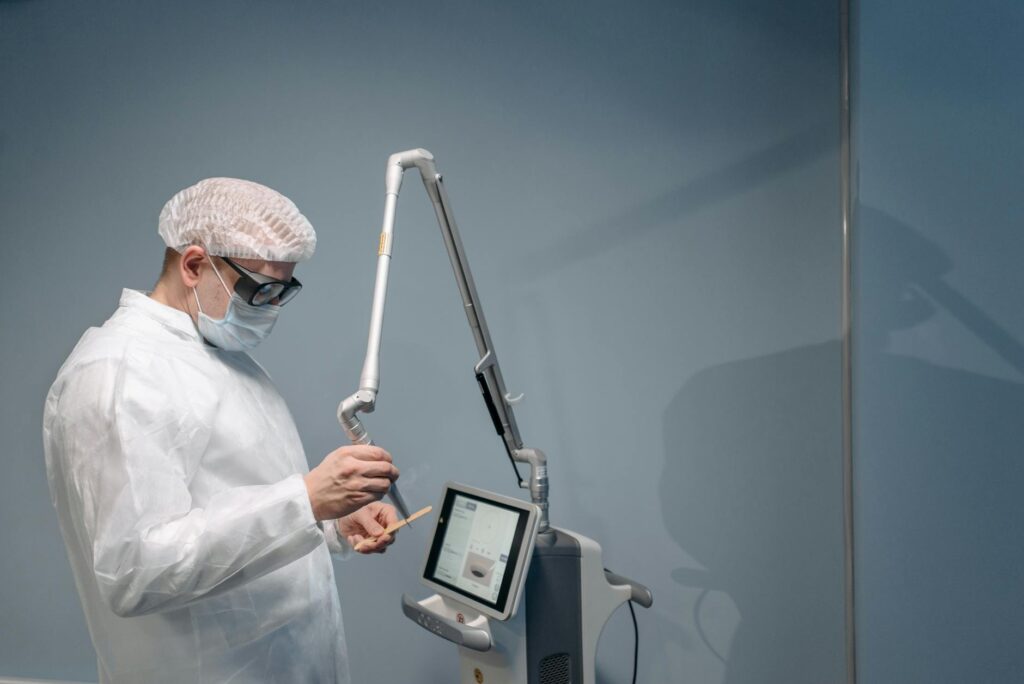
Each Accure treatment takes roughly 20-30 minutes, depending on how much skin area requires treatment. The laser handpiece passes over affected skin, delivering controlled infrared energy. Most patients describe the sensation as warm pressure rather than painful—similar to a deep tissue massage warming your skin. The “treat-to-temperature” monitoring ensures consistent thermal dosing without operator guesswork, which partly explains why Accure produces more consistent results than older laser systems requiring manual power adjustments. Between sessions, you’ll follow standard post-treatment care: sunscreen, gentle cleansing, and usually avoiding active acne medications for a few days while skin heals.
Within a week, most people return to normal activities. There’s no extended downtime like you’d experience with aggressive chemical peels or some dermatological procedures. This practical simplicity—minimal recovery, four brief sessions spread across months—makes Accure far more feasible than treatments requiring multiple weekly appointments or long healing periods. Comparing to alternatives: oral isotretinoin (Accutane) eliminates acne in perhaps 80-90% of patients but requires monthly blood work, strict contraception, and carries significant side effects. Accure achieves comparable clearance rates without systemic effects, though it works only on the treated areas rather than systemically. For someone with facial acne only, Accure’s localized approach makes sense; for someone with acne across chest, back, and face, isotretinoin might be more practical despite its drawbacks.
Who Benefits Most From Accure, and When Might Results Disappoint?
Accure works best for patients with active inflammatory acne—the red bumps, pustules, and nodules that cause the most visible distress. If your acne consists mainly of closed comedones or extremely severe nodular disease, results may be less dramatic. The treatment targets sebaceous gland overactivity; it doesn’t mechanically extract plugged pores or address all acne-driving factors equally. Patient selection matters significantly. The 95% satisfaction rate with an average 4.4/5 rating suggests most people who undergo treatment feel the results justified the effort, but not every patient achieves dramatic clearing.
Someone expecting 100% acne elimination should adjust expectations—70% average improvement and 90% reduction in some studies still mean most treated individuals retain some occasional breakouts. Additionally, if acne is driven primarily by hormonal factors (like menstrual cycle flares), Accure addresses the gland response but not the underlying hormonal stimulus, so breakthrough acne remains possible without additional hormonal management. Unrealistic expectations also matter. If you want results that last forever without any possible future breakouts, Accure isn’t a permanent cure—it’s a very effective long-term management tool. Some patients do maintain excellent results for years; others eventually notice gradual return of acne after 12-24 months and choose maintenance treatments.

How Accure Compares to Other Acne Treatment Options
For someone considering treatment routes, the comparison landscape matters. Topical retinoids and benzoyl peroxide work on surface acne but require indefinite daily application and often prove less effective for inflammatory acne. Oral antibiotics reduce bacteria and inflammation but lose effectiveness as resistance develops, typically effective for only 3-6 months before diminishing returns. Accure differs fundamentally: rather than daily maintenance, you complete four sessions then experience months of ongoing benefit without continued intervention.
Over a 12-month span, this means far less product cost and time investment than topical routines, and better durability than antibiotics. Against oral isotretinoin (the gold standard severe acne treatment), Accure offers comparable clearance rates without systemic side effects but applies only to treated areas. For localized facial acne, many dermatologists now recommend Accure before resorting to isotretinoin’s stricter requirements. Other laser systems exist—blue light therapy, combination devices—but Accure’s 1726 nm wavelength penetrates to sebaceous glands more effectively than shorter wavelengths, which explains its superior efficacy data compared to older LED or shorter-wavelength laser treatments.
What Happens After Your Four Sessions—Long-Term Results and Maintenance
The real-world durability story is where Accure excels. Clinical data shows many patients maintained significant improvements for at least 12 months after final treatment, with some sustaining benefits nearly three years later. This contrasts sharply with topical medications, which stop working within weeks of discontinuation, or antibiotics, which lose effectiveness within months.
Why does improvement persist long after treatment? The thermal remodeling of sebaceous glands doesn’t instantly revert; the structural changes to oil-producing capacity remain relatively stable. Over time, hormonal and genetic factors gradually restore some sebaceous gland activity, which is why occasional breakthrough acne becomes more common 18-24 months post-treatment. However, many patients report that post-treatment acne differs qualitatively—fewer total lesions, shorter duration of breakouts, and faster healing. Some choose maintenance treatments (one laser session annually or every two years) to sustain results, while others are satisfied with the reduction achieved and manage occasional breakouts with topical care.
Conclusion
Accure Laser represents a fundamentally different approach to acne management: instead of daily topical routines or indefinite oral medications, four brief sessions spaced one month apart produce an average 70% reduction in acne lesions, with 95% of patients highly satisfied with results. The treatment targets the underlying sebaceous gland dysfunction driving acne, which explains both its effectiveness and its durability—many patients maintain significant improvements for at least 12 months, with some sustaining results nearly three years later.
Results begin appearing as early as four weeks and reach their maximum within four to twelve weeks after final treatment. If you’re considering Accure, the decision hinges on whether you have inflammatory acne, whether you prefer a time-limited treatment course over indefinite daily maintenance, and whether you value FDA-cleared technology with strong clinical evidence behind it. A consultation with a dermatologist using Accure will determine whether your acne type and severity make you a good candidate and can address specific concerns about your skin’s response.