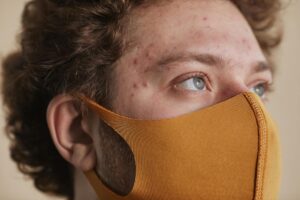
Inflammation doesn’t end when the acne does. Even after your breakouts clear, the inflammatory cascade triggered by acne continues damaging your skin at the cellular level, leaving behind red marks, dark spots, uneven texture, and a compromised barrier that can take months or even years to fully repair. The discoloration you see—whether it’s the purple-red marks or the brown spots that appear later—are direct evidence of ongoing inflammation; post-inflammatory erythema (PIE) alone can persist for months, while dermal hyperpigmentation can take years to fade without treatment.
This article explains how inflammatory acne creates these lasting effects, why recovery takes time even after the blemishes vanish, and what actually works to speed healing. The challenge many people face is that they treat acne aggressively to clear the breakouts, then wonder why their skin still looks damaged weeks or months later. Understanding the timeline of post-inflammatory healing—and the difference between what happens automatically versus what requires intervention—helps you set realistic expectations and choose treatments that actually address the root problem instead of just masking symptoms.
Table of Contents
- Why Does Inflammation Leave Marks on Skin After Acne Heals?
- The Skin Barrier Damage That Extends Recovery Time
- The Timeline of Post-Inflammatory Discoloration Recovery
- Treating Post-Inflammatory Marks vs. Waiting It Out
- Why Skin Sensitivity Increases Even After Acne Clears
- The Role of Ceramides and Barrier Repair
- New Advances in Post-Inflammatory Acne Treatment (2024-2025)
- Conclusion
Why Does Inflammation Leave Marks on Skin After Acne Heals?
When acne forms, it’s not just a surface problem. Inflammatory acne triggers your immune system to release compounds that break down the proteins and lipids holding your skin cells together, compromising the structural integrity of your skin barrier. In severe cases, the follicular wall ruptures completely, allowing bacteria, lipids, and debris to spread deeper into the dermis. This is called perifolliculitis, and it’s what creates the deep, lingering damage that’s harder to reverse than the acne itself.
The marks that remain after acne clears are essentially your skin’s inflammatory scar tissue. Post-inflammatory erythema (those red or purple marks) represents dilated blood vessels and active inflammation in the dermis. Post-inflammatory hyperpigmentation (the brown or dark spots) occurs when melanin-producing cells ramp up production in response to inflammation. These are your skin’s attempted repairs—the problem is that these repair mechanisms often overshoot, leaving visible discoloration long after the bacteria is gone. A critical reality: women with darker skin tones (Fitzpatrick types III-VI) experience post-inflammatory hyperpigmentation at rates as high as 65%, and the marks tend to be significantly darker and more persistent in these skin types, making prevention and early treatment even more important in these populations.

The Skin Barrier Damage That Extends Recovery Time
The inflammatory damage from acne extends beyond visible marks—it creates a weakened skin barrier that’s more sensitive, slower to heal, and more vulnerable to infection and scarring. A compromised barrier loses its ability to retain moisture and filter out irritants, which is why your skin often feels raw, tight, or reactive even after the acne clears. This isn’t something that resolves immediately once you stop getting breakouts; the barrier needs time and specific care to rebuild.
Most people see noticeable barrier improvement within 1-2 weeks of stopping harsh products and following a dermatologist-approved routine. However, if the inflammation was severe—meaning you had cystic acne, aggressive picking, or used very strong treatments—the barrier damage can take 4-6 weeks or longer to substantially repair. The catch is that a damaged barrier delays the overall healing timeline for post-inflammatory marks; your skin simply can’t repair itself efficiently if the barrier isn’t functioning. This is why some people see their red marks fade quickly while others are stuck with visible discoloration for months—it’s often a barrier health problem, not just a mark problem.
The Timeline of Post-Inflammatory Discoloration Recovery
Post-inflammatory erythema has its own healing timeline. The red and purple marks you see immediately after acne clears often darken to brown or black marks over the first 1-6 months, which can feel like your skin is getting worse rather than better—it’s not, it’s just shifting color as the inflammation evolves. The good news is that most people see gradual improvement on their own; post-inflammatory erythema often fades significantly within 3-6 months as blood vessels normalize and inflammation resolves. The difficult news is that some cases persist longer than expected. Without treatment, complete resolution can take 2 or more years, and the timeline depends heavily on the depth of inflammation and your skin type.
Epidermal hyperpigmentation (melanin deposited in the upper layers of skin) typically fades within 6-9 months because skin cells naturally turn over relatively quickly. Dermal hyperpigmentation (melanin deeper in the skin) can take years to fade on its own because those cells turn over much more slowly. The difference matters because it tells you whether patience alone might work or whether you actually need treatment. If the marks are brown and surface-level, waiting may be reasonable. If they’re deep, dark, and persistent after 6 months, intervention usually produces faster results.
Treating Post-Inflammatory Marks vs. Waiting It Out
The decision between treating post-inflammatory marks versus waiting depends on depth, color, and your tolerance for the timeline. If your marks are relatively light and you’re seeing gradual improvement, sun protection and a consistent routine with ceramides (which rebuild the lipid barrier) might be sufficient—many marks genuinely do fade on their own with time. If your marks are dark, deep, or aren’t improving after 6 months, professional treatments offer measurable acceleration.
Energy-based devices have advanced significantly in 2024-2025, offering targeted options like laser therapy and light-based treatments that reduce residual inflammation and stimulate collagen remodeling without damaging your skin further. Topical treatments have also evolved, with newer formulations combining targeted ingredients specifically designed to address post-inflammatory discoloration rather than active acne. A realistic timeline with treatment is typically 6-12+ months for adequate improvement in deeper or more severe marks, but you usually see some changes within 4-8 weeks. The tradeoff is that professional treatments cost money and require multiple sessions, whereas waiting is free but requires patience and carries the risk that some marks never fully resolve on their own.
Why Skin Sensitivity Increases Even After Acne Clears
A frequently overlooked consequence of inflammatory acne is the increased skin sensitivity that persists afterward. Your barrier has been compromised, your skin’s immune response is still ramped up, and even mild irritants—harsh cleansers, active ingredients, physical exfoliation, heat—can trigger reactions. This is why many people find their skin feels more reactive after acne than it did before, even though they’re no longer breaking out. The challenge here is that some acne treatments themselves prevent barrier healing.
If you’re still using benzoyl peroxide, retinoids, or other drying treatments while your barrier is recovering, you’re actively working against healing. This doesn’t mean you should never use these treatments again; it means timing matters. Once active acne is controlled, transitioning to gentler, barrier-focused routines for a few weeks to months allows your skin to stabilize before you reintroduce stronger actives. Continuing aggressive treatment “just in case” the acne comes back often backfires by keeping your barrier damaged and your skin inflamed—the opposite of what you’re trying to achieve.

The Role of Ceramides and Barrier Repair
Your skin barrier is built from ceramides—lipid molecules that form the glue holding skin cells together. Inflammatory acne breaks down this lipid matrix, and your skin can’t rebuild it without external support. This is why dermatologists emphasize ceramide-rich products during recovery; ceramides aren’t just a trend or a buzzword, they’re a direct replacement for what inflammation destroyed.
When you apply products containing ceramides, you’re literally supplying your skin with the raw materials it needs to rebuild its barrier. This accelerates recovery because your skin doesn’t have to synthesize every ceramide from scratch. For barrier repair specifically, look for multiple ceramide types (NP, AP, EOP) in formulations, alongside cholesterol and fatty acids—these three components working together mimic your skin’s natural barrier composition. The timeline for noticing improvement is usually 2-4 weeks of consistent use, and it’s one of the few interventions that measurably speeds barrier healing without additional risk.
New Advances in Post-Inflammatory Acne Treatment (2024-2025)
The treatments available for post-inflammatory marks have evolved significantly in the past year. Energy-based devices have become more precise, allowing dermatologists to target specific depths of discoloration without damaging surrounding skin. Topical formulations have also advanced, moving away from one-size-fits-all approaches toward treatments specifically designed for post-inflammatory hyperpigmentation versus post-inflammatory erythema, which respond differently to intervention.
What’s important to know is that these advances mean faster results if you choose professional treatment, but they don’t change the fundamental reality: barrier repair takes time, and some marks improve more readily than others depending on their depth and color. The future of treatment is moving toward combination approaches—using targeted topicals alongside devices, or sequencing treatments to maximize results—rather than relying on any single intervention. If you’re considering treatment, a consultation with a dermatologist can help you understand which approach matches your specific marks and timeline.
Conclusion
Inflammation from acne creates damage that extends far beyond visible breakouts. The red marks, dark spots, and weakened barrier you’re left with are the result of inflammatory mediators breaking down your skin’s structure, and true recovery requires time and, in many cases, specific interventions.
Most people can expect gradual improvement over 3-6 months if their marks are relatively light and they’re supporting their barrier with ceramides and sun protection; deeper or darker marks often require treatment to speed resolution beyond the 2+ year timeline of waiting alone. The most practical path forward is assessing your marks honestly: are they light and improving on their own, or are they dark and stalled after 6 months? Are you actively damaging your barrier with harsh products, or have you transitioned to barrier-supporting routines? Once you answer these questions, you can decide whether patience and good skincare are enough or whether professional treatment makes sense for your timeline and skin type. Either way, treating post-inflammatory marks is about supporting your skin’s own repair process, not forcing overnight results that aren’t biologically realistic.