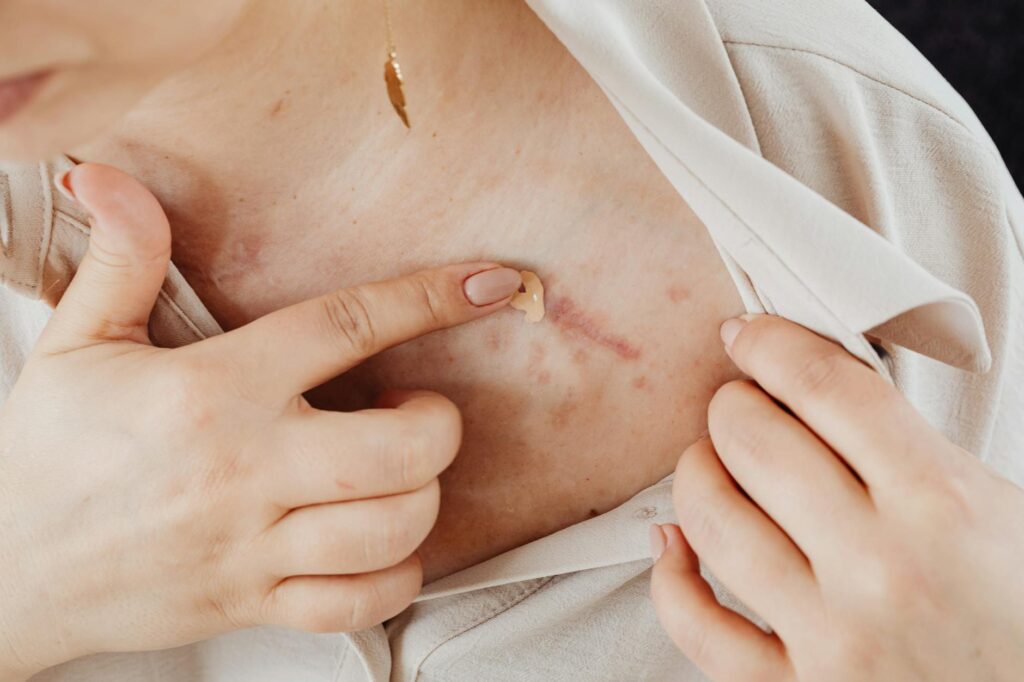
Realistic acne scar treatment goals look like 50 to 70 percent improvement in scar appearance over a series of sessions, not the flawless skin that before-and-after marketing photos suggest. That number might sound underwhelming at first, but consider what it actually means: once scars improve by 60 to 80 percent, they typically stop being the first thing you notice when you look in the mirror. For someone who has spent years avoiding certain lighting or angling their face away from cameras, that shift is genuinely life-changing, even if the skin is not technically perfect. The American Academy of Dermatology puts it plainly: treatment can minimize the appearance of scars, but it takes time for your body to produce new collagen and elastin, and complete removal is generally not a realistic goal.
This is not a failure of modern dermatology. It is an honest acknowledgment that scar tissue behaves differently than normal skin, and different scar types respond to treatment in very different ways. A shallow pigmentation mark from a breakout six months ago can fade almost entirely, while a deep icepick scar from adolescent cystic acne may resist even aggressive treatment and require some degree of acceptance. This article breaks down what specific treatments can realistically deliver, how many sessions you should expect, what the costs look like in 2025 and 2026, and where emerging technologies are headed. The goal is to help you walk into a dermatologist’s office with informed expectations, not inflated ones.
Table of Contents
- What Does 50 to 70 Percent Improvement Actually Look Like?
- Why Your Scar Type Determines Your Ceiling
- How Many Sessions It Actually Takes and What That Timeline Looks Like
- Comparing Treatment Options by Cost, Downtime, and Effectiveness
- Why Maintenance Matters and What Happens When You Stop
- Combination Therapies and the Shift Toward Layered Approaches
- What the Next Few Years Look Like for Acne Scar Treatment
- Conclusion
- Frequently Asked Questions
What Does 50 to 70 Percent Improvement Actually Look Like?
Numbers on a page do not mean much without context. A 50 percent improvement in acne scarring means that roughly half the visible depth, discoloration, or textural irregularity of your scars has been reduced. In practical terms, this is often the difference between scars that are noticeable from a conversational distance and scars that are only visible up close or in harsh overhead lighting. A 70 percent improvement pushes further, smoothing skin texture to a point where most people would describe the complexion as “normal” even if a dermatologist could still identify residual scarring under magnification. To put this in perspective, consider someone with moderate rolling scars across both cheeks. Before treatment, those scars create visible shadows and uneven texture that foundation cannot fully conceal.
After a series of fractional laser sessions achieving 60 percent improvement, the rolling texture has softened enough that the shadows largely disappear, and the skin reads as slightly uneven rather than visibly scarred. That person may still see the remnants of scarring when they look closely in a magnifying mirror, but the scars no longer dominate their appearance. According to a split-face study comparing RF microneedling and fractional CO2 laser, approximately 95 percent of subjects rated themselves satisfied or very satisfied with their results, suggesting that even partial improvement translates into meaningful quality-of-life gains. The important caveat is that improvement is not linear across scar types. Someone with a mix of boxcar scars and post-inflammatory hyperpigmentation may see their pigmentation resolve almost completely while the boxcar scars improve by only 40 percent. The overall number depends heavily on what kind of scarring you are starting with, which is why an individualized assessment matters far more than any single statistic.

Why Your Scar Type Determines Your Ceiling
Not all acne scars are created equal, and expecting the same results across different scar types is one of the most common misconceptions patients bring to consultations. Broadly, acne scars fall into three categories: atrophic scars (icepick, boxcar, and rolling), hypertrophic or keloid scars, and flat pigmentation marks that are technically not scars at all but are often grouped with them. Post-inflammatory hyperpigmentation and erythema, the red or brown marks left after a breakout, respond extremely well to treatment. These marks can fade almost entirely with chemical peels, topical retinoids, or laser therapy because the underlying skin architecture is intact. The discoloration is a surface-level problem. Deep icepick scars sit at the other end of the spectrum. These narrow, deep pits extend into the dermis and sometimes beyond, and they resist most resurfacing treatments because the tissue loss is too severe for collagen remodeling alone to fill.
Even aggressive approaches like CO2 fractional laser resurfacing, which typically yields 50 to 80 percent improvement in atrophic acne scars overall, struggle with true icepick scars. Techniques like TCA CROSS, which involves applying high-concentration trichloroacetic acid directly into individual icepick scars, can improve them, but rarely eliminates them entirely. A combination of 88 percent phenol CROSS with subcision and microneedling has shown consistent improvement across studies, but even this layered approach is working against structural tissue loss. However, if your scarring is primarily rolling or shallow boxcar type, your ceiling for improvement is significantly higher. Rolling scars respond well to subcision, which releases the fibrous bands tethering the scar to deeper tissue, followed by energy-based treatments that stimulate collagen production in the freed tissue. The takeaway is that a realistic goal requires knowing exactly what you are treating. A blanket promise of a specific percentage improvement without first classifying your scars should be treated as a red flag.
How Many Sessions It Actually Takes and What That Timeline Looks Like
The AAD is direct about this: acne scar treatment is rarely one and done. Most patients need three or more treatments for best results, and the timeline stretches over months, not weeks. For mild chemical peels, expect three to five treatments spaced every two to four weeks. For moderate to deep acne scars treated with energy-based devices, the range is typically six to eight treatments, and severe cases may require up to 12. Each session is followed by a healing period during which your skin is producing new collagen, and that process does not happen overnight. Consider a specific example. A patient with moderate rolling and boxcar scars on the cheeks begins a treatment plan with RF microneedling.
Sessions are scheduled four to six weeks apart to allow for adequate healing and collagen remodeling between treatments. After three sessions, the patient notices some textural improvement but the scars are still clearly visible. This is normal and expected. The meaningful visual change typically becomes apparent after the fourth or fifth session, with continued improvement for several months after the final treatment as collagen continues to mature. A picosecond laser at 1,064 nm has been shown to achieve 32 to 45 percent scar volume reduction within three months, with significant scar volume reduction reported in 75 percent of patients, but that three-month mark is the beginning of results, not the end. The psychological challenge of this timeline is real. When you are investing time, money, and discomfort into treatment, slow progress can feel like no progress. Setting your expectations around a six-to-twelve-month treatment arc, with visible results emerging gradually, helps prevent the discouragement that leads some patients to abandon treatment prematurely, right when the cumulative collagen remodeling is starting to pay off.

Comparing Treatment Options by Cost, Downtime, and Effectiveness
Choosing between treatment modalities involves weighing three variables: how well it works, how much it costs, and how much downtime you can afford. Microneedling sits at the accessible end of the spectrum, with sessions ranging from $200 to $800 depending on the provider. An esthetician typically charges $200 to $400, a nurse $300 to $600, and a dermatologist $500 to $1,000. A systematic review of 33 peer-reviewed studies showed consistent improvement with high patient satisfaction, making microneedling a solid option for mild to moderate scarring on a moderate budget. RF microneedling pushes both effectiveness and cost higher, with sessions running up to $2,500 for optimal scar results. The added radiofrequency energy delivers heat to deeper tissue layers, stimulating more aggressive collagen remodeling than mechanical microneedling alone.
In the split-face study comparing the two, 45 percent of participants on the RF microneedling side reported greater than 50 percent improvement compared to 35 percent on the fractional CO2 laser side, though both had high satisfaction rates. Chemical peels offer the most budget-friendly entry point at $100 to $400 per session but are best suited for surface-level irregularities and pigmentation rather than deep structural scars. Laser treatments can run several thousand dollars per session depending on the type and severity being treated. The tradeoff worth understanding is that more aggressive treatments generally deliver faster and more dramatic results but come with longer downtime and higher risk of side effects like prolonged redness or post-inflammatory hyperpigmentation, particularly in darker skin tones. A series of six microneedling sessions may ultimately achieve similar improvement to three fractional CO2 laser sessions, but with less downtime per session and lower risk of complications. The right choice depends on your specific scar types, skin tone, budget, and how much social downtime you can absorb.
Why Maintenance Matters and What Happens When You Stop
One detail that often gets lost in the initial treatment consultation is that improvement from scar treatment is not necessarily permanent. Collagen production declines with age, and without periodic maintenance treatments, some of the improvement you gained can gradually diminish over time. This does not mean your scars return to their original severity, but the skin’s ongoing aging process can cause treated areas to lose some of their renewed firmness and smoothness over the years. This is particularly important for patients in their late thirties and beyond, when the body’s natural collagen production has already begun to slow. A patient who achieves 65 percent improvement at age 30 and does nothing further may find that improvement has softened to 50 percent by age 40, not because the treatment failed but because the biological processes that maintained the results have decelerated.
Periodic maintenance sessions, perhaps one or two per year, can sustain results by periodically stimulating fresh collagen production. The limitation worth acknowledging is that maintenance adds ongoing cost to what is already an expensive treatment journey. If your treatment plan involved RF microneedling at $1,500 to $2,500 per session, even annual maintenance represents a significant long-term financial commitment. This should factor into your initial goal-setting: the most realistic treatment plan is one you can sustain, not just initiate. For some patients, this means choosing a slightly less aggressive initial treatment that they can afford to maintain, rather than an intensive protocol that delivers dramatic results they cannot preserve.
Combination Therapies and the Shift Toward Layered Approaches
Dermatologists increasingly favor combination or layered approaches over single-modality treatment, and the research supports this shift. Rather than relying on one technology to do everything, combining treatments that target different aspects of scarring produces synergistic results. For example, subcision can release deep tethered scars, followed by RF microneedling to stimulate collagen in the released tissue, followed by a superficial chemical peel to refine surface texture.
Each step addresses a different layer of the problem. The 2025 and 2026 treatment landscape reflects this philosophy. Hybrid platforms that combine fractional laser energy with RF microneedling in a single device are emerging as a leading innovation, capable of addressing both surface irregularities and deeper fibrotic bands in one session. Meanwhile, autologous cell-based therapies like PRP and stem cell treatments are being studied with updated systematic reviews and meta-analyses published as recently as 2026, suggesting that the field is actively working to push that 50 to 70 percent improvement ceiling higher.
What the Next Few Years Look Like for Acne Scar Treatment
The trajectory of acne scar treatment points toward increasingly personalized and layered protocols. The hybrid platforms combining multiple energy types in a single device represent a practical advance: fewer total sessions, less cumulative downtime, and potentially better outcomes than sequential single-modality treatments. Autologous cell-based therapies, if the emerging research holds up, could eventually provide a biological boost that makes collagen remodeling more robust and longer-lasting than what current energy-based devices achieve alone. But even with these advances, the fundamental reality is unlikely to change in the near future.
Acne scarring involves structural tissue loss and remodeling that cannot be fully reversed. The goal remains meaningful improvement, not perfection. What is changing is our ability to achieve that improvement more efficiently, with less downtime, and across a broader range of skin types. For the 95 percent of acne patients who develop some degree of scarring, that progress matters enormously, even if it never reaches 100 percent.
Conclusion
Realistic acne scar treatment goals center on meaningful improvement, not elimination. The 50 to 70 percent improvement range that most patients achieve represents a genuine transformation in how scars look and how they affect daily life. Once improvement crosses the 60 to 80 percent threshold, scars typically fade from being a defining feature to a minor detail.
Getting there requires patience with a multi-session treatment timeline, honest assessment of your specific scar types, and a financial plan that accounts for both initial treatment and ongoing maintenance. The most productive step you can take is to consult with a board-certified dermatologist who will evaluate your specific scarring, classify each scar type, and develop an individualized treatment plan using more than one modality. Walk in knowing that three to eight or more sessions over several months is the norm, that different scar types will respond differently, and that some residual scarring, particularly from deep icepick scars, may need to be accepted rather than fought. That informed starting point, grounded in real numbers rather than marketing promises, gives you the best chance of ending treatment genuinely satisfied with results that are significant, lasting, and worth the investment.
Frequently Asked Questions
Can acne scars be completely removed?
In most cases, no. The AAD states that complete removal is generally not a realistic goal. Most treatments achieve 50 to 70 percent improvement. Flat pigmentation marks can fade almost entirely, but structural scars like icepick and deep boxcar types typically retain some residual visibility even after aggressive treatment.
How many treatment sessions will I need for acne scars?
It depends on severity. Mild scarring treated with chemical peels may need three to five sessions every two to four weeks. Moderate to deep scarring often requires six to eight sessions, and severe cases can require up to 12 treatments. The AAD describes acne scar treatment as rarely one and done.
How much does acne scar treatment cost in total?
Costs vary widely by modality. Microneedling runs $200 to $800 per session, RF microneedling up to $2,500, chemical peels $100 to $400, and laser treatments can reach several thousand dollars per session. Multiply by the number of sessions needed and add periodic maintenance, and total costs can range from under $1,000 for mild cases to $15,000 or more for severe scarring treated aggressively.
Which acne scar treatment works best?
No single treatment is universally best. CO2 fractional laser resurfacing typically yields 50 to 80 percent improvement in atrophic scars. RF microneedling and fractional CO2 laser showed similar satisfaction rates of roughly 95 percent in a split-face study. Dermatologists increasingly recommend combination approaches tailored to your specific scar types rather than any single modality.
Do acne scar treatment results last permanently?
Results are long-lasting but not necessarily permanent. Collagen production declines with age, and without periodic maintenance treatments, some improvement can gradually diminish. Annual maintenance sessions can help sustain results over the long term.
Is microneedling effective for acne scars?
Yes. A systematic review of 33 peer-reviewed studies showed consistent improvement in acne scarring with high patient satisfaction from microneedling. It is particularly effective for mild to moderate rolling and boxcar scars and offers a lower-cost, lower-downtime alternative to laser treatments, though deeper scars may require more aggressive modalities.