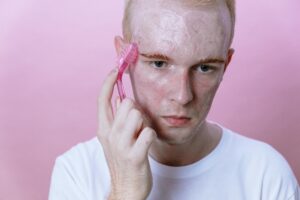
Acne mechanica is a specific type of acne triggered by friction, pressure, heat, and occlusion against the skin — not by hormones, genetics, or poor hygiene. If you have ever broken out along the edge of a helmet, under a backpack strap, or beneath a face mask, that is acne mechanica. It develops wherever something repeatedly rubs, stretches, pinches, or traps heat against your skin, and it can happen whether or not you already deal with regular acne.
The people most likely to develop it are athletes, soldiers, healthcare workers, and anyone whose daily routine involves prolonged contact between gear and skin. A football player who breaks out along the jawline from a chin strap and a nurse who develops “maskne” after a twelve-hour shift are dealing with the same underlying mechanism. During the COVID-19 pandemic, this condition surged across the general population, with studies reporting mask-related acne prevalence anywhere from 17% to 56% depending on the group studied. This article covers what makes acne mechanica different from other forms of acne, who is most at risk and why, the specific triggers and symptoms to watch for, and what actually works to treat and prevent it — including when over-the-counter products are not enough.
Table of Contents
- What Exactly Is Acne Mechanica and How Does It Differ From Regular Acne?
- Who Gets Acne Mechanica and Why Some People Are More Vulnerable
- The Maskne Surge and What the Research Actually Shows
- How to Identify Acne Mechanica and Track Its Progression
- Treatment Options and When Over-the-Counter Products Fall Short
- Prevention Strategies That Actually Work
- The Outlook for Acne Mechanica Awareness and Management
- Conclusion
- Frequently Asked Questions
What Exactly Is Acne Mechanica and How Does It Differ From Regular Acne?
acne mechanica is defined as any acneiform eruption in areas of mechanical stress — rubbing, stretching, pinching, or occlusion — regardless of whether pre-existing acne is present. That last part is important. Unlike hormonal acne, which is driven by internal factors like androgen levels and sebum production, acne mechanica is caused entirely by external physical forces. You could have perfectly clear skin and still develop it if you start wearing a tight helmet every day. It can also layer on top of existing acne, making an already frustrating condition significantly worse. The key visual difference is distribution. Hormonal acne tends to cluster around the chin, jawline, and lower cheeks in patterns tied to oil gland density.
Acne mechanica, by contrast, tends to follow a linear distribution that maps directly to the friction source. Breakouts will line up with a helmet edge, trace the path of a strap, or fill in the exact area covered by a mask. That pattern is often the clearest diagnostic clue. If your breakouts form a shape that matches something you wear, friction is almost certainly the driver. Another distinction is how it responds to treatment. Because the root cause is external, acne mechanica generally clears more quickly than hormonal or cystic acne once the friction source is removed or modified. That is both good news and bad news — good because the solution is often straightforward, bad because many people cannot simply stop wearing the equipment causing the problem.
Who Gets Acne Mechanica and Why Some People Are More Vulnerable
Athletes are the most commonly affected group. Football and hockey players frequently develop breakouts on the chin, forehead, and shoulders from helmets, chin straps, and shoulder pads. The American Academy of Dermatology specifically flags sports equipment as a leading cause. Other sports are not exempt — cycling helmets, lacrosse gear, and even the back of an auto racing seat can trigger it. Dermatology Times has documented cases across nearly every contact and equipment-heavy sport. Beyond athletics, soldiers in warm climates develop acne mechanica from uniforms and tactical equipment that constantly rub against sweaty skin. Truck drivers and others who spend long hours with their backs pressed against seats are also at risk.
During the pandemic, healthcare workers bore the brunt of mask-induced acne mechanica: an Indian study published in the International Journal of Clinical and Experimental Dermatology found that 34.98% of healthcare workers developed maskne, compared to 17.36% of non-healthcare workers. A Johns Hopkins Medicine survey of 227 medical students, residents, and nursing students found an even higher rate — 68.7% reported developing maskne. However, susceptibility is not uniform. Men tend to be more prone because they produce more sebum, which compounds the pore-clogging effect of friction. Young adults under 30 and those wearing masks more than eight hours per day face higher risk as well. That said, acne mechanica can affect all skin types because the external mechanical factors are the primary driver, not individual skin chemistry. Someone with dry, non-acne-prone skin can still break out under a tight chin strap if the friction and heat are persistent enough.
The Maskne Surge and What the Research Actually Shows
The COVID-19 pandemic turned acne mechanica from a niche athletic concern into a widespread public health issue almost overnight. A systematic review of 37 studies covering 29,557 participants found mask-related facial dermatoses in 55% of wearers, with acne specifically hitting a pooled prevalence of 31%. That means roughly one in three people wearing masks regularly developed acne as a direct result. Individual studies paint an even sharper picture in certain populations. A Turkish university study found that 61% of students developed acne after mask use — 40.5% were entirely new-onset cases and 20.5% were exacerbations of existing acne.
A cross-sectional study in Jeddah reported mask-acne prevalence ranging from 17% to 56% depending on the population sampled. These numbers are not trivial. For millions of people, what started as a public health compliance measure created a secondary dermatological problem that, in some cases, persisted well after mask mandates ended. The maskne data also revealed something useful about acne mechanica more broadly: duration of contact matters enormously. Studies consistently showed that people wearing masks more than eight hours per day had significantly higher rates of breakouts than those with shorter wear times. This dose-response relationship confirms what dermatologists have long observed in athletes — the longer and more constant the friction, the worse the acne gets.

How to Identify Acne Mechanica and Track Its Progression
Acne mechanica typically begins as small, rough bumps called papules. These are often skin-colored or slightly red, and they may feel like sandpaper before they are visually obvious. If the friction source continues, those papules progress to whiteheads and blackheads. In more severe cases, particularly when gear continues to press against already-inflamed skin, deep cysts can develop. The progression is relatively predictable: mild texture changes first, then comedones, then potentially painful inflammatory lesions.
The most reliable way to confirm acne mechanica rather than another type is to look at location and pattern. Breakouts that follow the outline of a piece of equipment — a band across the forehead matching a helmet rim, clusters along the jawline matching a chin strap, patches on the shoulders matching pad edges — are almost certainly mechanical in origin. If you remove the equipment for a week or two and the breakouts begin to clear without any change in skincare routine, that further confirms the diagnosis. One warning worth noting: if left untreated, acne mechanica can leave dark spots or post-inflammatory hyperpigmentation, which is particularly noticeable in darker skin tones. This is not scarring in the traditional sense, but the discoloration can take months to fade. People with deeper skin tones should be especially proactive about treatment, because even mild acne mechanica that would be cosmetically minor on lighter skin can leave lasting visible marks.
Treatment Options and When Over-the-Counter Products Fall Short
First-line treatment for acne mechanica includes salicylic acid to unclog pores, benzoyl peroxide to kill acne-causing bacteria, topical retinoids to accelerate cell turnover, and in some cases topical or systemic antibiotics. The good news, again, is that acne mechanica tends to clear more quickly than hormonal acne because you can address the root cause directly. Remove or modify the friction source, apply appropriate topical treatment, and most cases resolve within a few weeks. The tradeoff, however, is practical. A football player in the middle of a season cannot stop wearing a helmet. A surgeon cannot ditch the mask mid-procedure. In these cases, treatment becomes about mitigation rather than elimination: applying a thin layer of benzoyl peroxide wash before gearing up, using moisture-wicking fabrics as a barrier between skin and equipment, and showering immediately after activity. Salicylic acid is generally better tolerated for daily preventive use because it is less drying than benzoyl peroxide, but benzoyl peroxide is more effective against active inflammatory breakouts.
Many dermatologists recommend alternating between the two. If over-the-counter treatments have not produced improvement after six to eight weeks, the American Academy of Dermatology recommends seeing a dermatologist. At that point, prescription-strength retinoids or oral antibiotics may be necessary. As Dr. Karim of U.S. Dermatology Partners has noted, “Acne mechanica can be extremely stubborn and difficult to treat. Breakouts worsen as student athletes continue to engage in sports… It’s harder to treat this form of acne than it is to prevent it.”.
Prevention Strategies That Actually Work
Prevention is more effective than treatment for acne mechanica, and the strategies are straightforward even if they require discipline. Moisture-wicking fabrics worn under equipment reduce both friction and trapped sweat. Clean padding placed between gear and skin — a fresh cotton liner under a helmet, for example — creates a buffer that absorbs moisture rather than letting it sit against pores.
Showering immediately after activity, rather than waiting even thirty minutes, removes the sweat-and-bacteria mix that accelerates breakouts. For mask-related acne mechanica specifically, choosing a well-fitting mask that does not shift and rub with every jaw movement makes a measurable difference. Washing reusable masks after every use and switching disposable masks at least once during an extended shift reduces bacterial buildup. Some dermatologists recommend applying a lightweight, non-comedogenic moisturizer before masking to reduce friction — though heavy or occlusive moisturizers can make the problem worse by further trapping heat.
The Outlook for Acne Mechanica Awareness and Management
Acne mechanica was historically undertreated because it was seen as a minor, self-resolving inconvenience. The pandemic changed that perception. With tens of millions of people experiencing mask-induced breakouts for the first time, research funding and clinical attention increased substantially.
The result is a much better evidence base for prevention and treatment than existed even five years ago. Looking forward, the growing recognition that external mechanical factors can cause or worsen acne — independent of hormones, diet, or genetics — is shifting how dermatologists approach treatment in athletes, military personnel, and workers in protective equipment. The emphasis is moving toward prevention protocols built into training and workplace guidelines rather than after-the-fact treatment. For anyone dealing with acne mechanica now, the core message is simple: this is a solvable problem with a known cause, and addressing the friction is always the first step.
Conclusion
Acne mechanica is acne caused by friction, pressure, heat, and occlusion — not by internal factors. It affects athletes, soldiers, healthcare workers, truck drivers, and anyone who wears tight-fitting gear or masks for extended periods. The pandemic revealed just how common it is, with studies showing mask-related acne prevalence reaching 31% across large populations and as high as 68.7% among healthcare trainees.
The condition follows a predictable pattern: small bumps first, then comedones, then potentially deeper inflammatory lesions if the friction continues. The most effective approach is prevention — moisture-wicking barriers, clean equipment, immediate post-activity cleansing. When treatment is needed, salicylic acid and benzoyl peroxide are reliable first-line options, with dermatologist referral recommended if there is no improvement within six to eight weeks. If you are breaking out in patterns that match your gear, you are almost certainly dealing with acne mechanica, and the fix starts with addressing the friction.
Frequently Asked Questions
Can acne mechanica happen even if I have never had acne before?
Yes. Acne mechanica can occur as an independent condition without any underlying acne history. The external friction and occlusion are sufficient to trigger breakouts on their own, regardless of your skin type or previous experience with acne.
How long does acne mechanica take to clear once I stop wearing the equipment causing it?
Most mild cases begin improving within one to two weeks of removing the friction source. With the addition of salicylic acid or benzoyl peroxide, resolution is typically faster. However, any post-inflammatory hyperpigmentation may take several months to fully fade.
Is maskne the same thing as acne mechanica?
Maskne is a colloquial term for mask-induced acne, which is a specific form of acne mechanica. The mechanism is the same — friction, pressure, heat, and occlusion from a mask trigger breakouts in the covered area.
Should I pop acne mechanica bumps?
No. Popping or squeezing bumps increases the risk of infection, worsens inflammation, and significantly raises the chance of scarring or hyperpigmentation. This is especially important for people with darker skin tones, where post-inflammatory dark spots can be persistent.
Can I still play sports if I have acne mechanica from my equipment?
Yes, but you need to take preventive steps. Use clean cotton liners under helmets, apply a salicylic acid cleanser before and after activity, shower immediately after practice or games, and wash all equipment padding regularly. If breakouts persist despite these measures, see a dermatologist for prescription options.