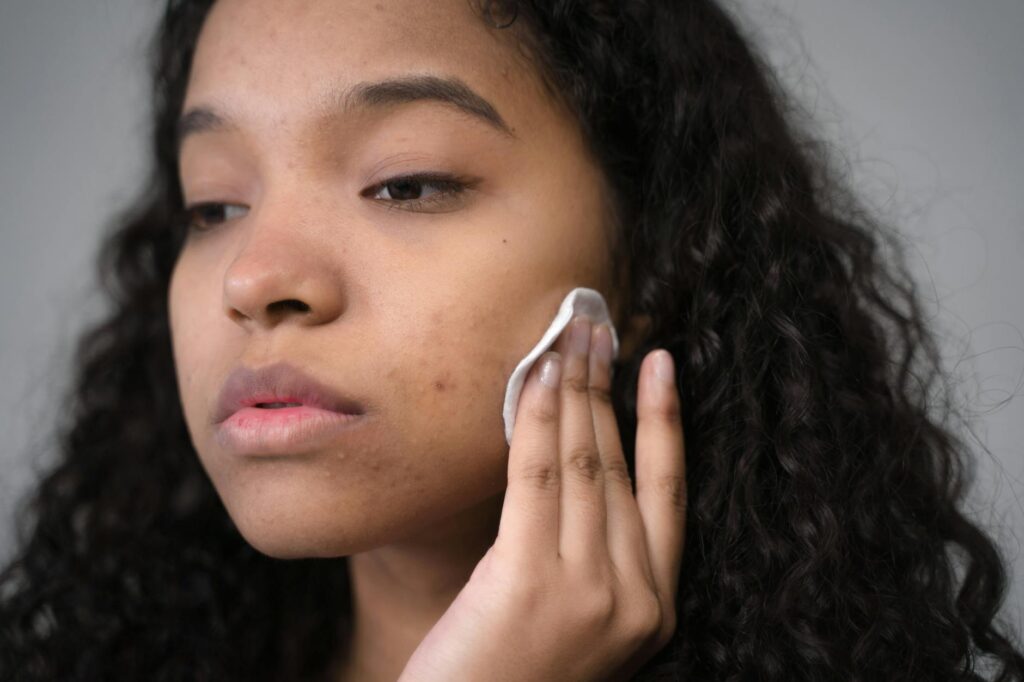
Temple acne almost always traces back to one of three culprits: hair products migrating onto your skin, the pressure and friction from glasses or headphones, or hormonal fluctuations that hit the T-zone periphery especially hard. Unlike breakouts on your chin or jawline, temple acne tends to involve comedonal plugs — small, stubborn bumps that form when oil mixes with product residue or dead skin in an area you probably touch more than you realize. If you switched shampoos or started wearing over-ear headphones regularly and noticed new bumps cropping up near your hairline, that connection is probably not a coincidence.
The temples sit at a crossroads between your hairline and your face, which makes them uniquely vulnerable to a type of breakout dermatologists call “acne cosmetica” — acne triggered by cosmetic or grooming products rather than by the usual hormonal or bacterial pathways. This matters because treating temple acne with aggressive acne medications often misses the point. If the root cause is your styling gel or your dirty pillowcase pressing against that area, no amount of benzoyl peroxide will fix the problem until you address the source. This article covers the most common and overlooked causes of temple breakouts, how to tell which one applies to you, and what actually works to clear them up without making your skin worse.
Table of Contents
- What Causes Acne Specifically on the Temples?
- How Hair Products and Skincare Create a Breakout Cycle at the Hairline
- The Role of Friction, Pressure, and Daily Habits
- How to Treat Temple Acne Without Overdoing It
- When Temple Acne Signals Something Deeper
- Pillow Hygiene and Sleep Position as Overlooked Factors
- What Dermatology Research Suggests About Targeted Temple Acne Treatment
- Conclusion
- Frequently Asked Questions
What Causes Acne Specifically on the Temples?
The temples have a higher concentration of sebaceous glands than most people assume. They are part of the extended T-zone, which arcs across the forehead and down the nose, but the temples also border the hairline — a zone constantly exposed to hair oils, both natural and synthetic. When sebum production combines with pore-clogging ingredients from shampoos, conditioners, pomades, or hairsprays, you get a perfect environment for comedones. These often present as clusters of small flesh-colored bumps rather than the red, inflamed pimples you might associate with hormonal acne on the chin.
One useful comparison: chin and jawline acne tends to be deeper, cystic, and clearly tied to menstrual cycles or androgen fluctuations. Temple acne, by contrast, is more often superficial, widespread, and linked to external factors. A 28-year-old who suddenly develops temple breakouts after switching to a new leave-in conditioner is dealing with a fundamentally different mechanism than someone with persistent hormonal cysts. The treatment approach should reflect that difference. Dermatologists often start by asking about product changes before prescribing anything, because eliminating the offending product can resolve temple acne within a few weeks without any medication at all.

How Hair Products and Skincare Create a Breakout Cycle at the Hairline
The ingredients most responsible for hairline and temple acne are comedogenic oils and silicones found in styling products. Coconut oil, cocoa butter, certain silicones like dimethicone in high concentrations, and heavy waxes are frequent offenders. These ingredients are fine for your hair shaft, but when they migrate — through sweat, gravity, or your hands — onto the skin of your temples, they sit inside pores that were never meant to handle that kind of occlusion. Dry shampoo is another increasingly common trigger, because it deposits powder and oil-absorbing agents right at the hairline where temple skin begins.
However, if you have already stripped your routine down to bare essentials and the breakouts persist, the cause may not be product-related at all. Some people develop fungal acne (malassezia folliculitis) at the temples, which looks nearly identical to comedonal acne but does not respond to standard acne treatments. Fungal acne tends to present as uniform, itchy bumps and worsens in humid conditions. If you have been treating temple bumps for weeks with salicylic acid or benzoyl peroxide and nothing has changed, it is worth asking a dermatologist about a fungal component. An antifungal like ketoconazole shampoo used as a face wash can sometimes clear what months of traditional acne treatment could not.
The Role of Friction, Pressure, and Daily Habits
Acne mechanica — breakouts caused by repeated pressure, friction, or heat — is one of the most underdiagnosed causes of temple acne. Glasses, sunglasses, headphones, hard hats, helmets, and even the habit of resting your head on your hand while working at a desk all create sustained pressure on the temples. That pressure traps sweat and oil against the skin and physically irritates the follicle, creating an environment where bacteria thrive and pores clog faster than they can clear.
A common real-world example: someone who works from home and wears over-ear headphones for eight hours a day on calls starts developing acne exclusively where the headphone cushion contacts their temples and upper jaw. They try every acne product on the shelf, but the breakouts keep returning because the mechanical cause is never addressed. The fix is not a better cleanser — it is cleaning the headphone pads regularly, switching to earbuds for part of the day, or using a headphone model with less clamping force. Similarly, people who wear glasses should clean the frames daily and ensure they are not too tight, as even slight, constant pressure over hours can trigger breakouts along the temples and the bridge of the nose.
How to Treat Temple Acne Without Overdoing It
The instinct when you notice persistent breakouts is to escalate — stronger cleansers, more exfoliation, layering multiple actives. At the temples, this approach tends to backfire. The skin there is thinner and more sensitive than on the forehead or cheeks, and over-treating it leads to irritation, a damaged moisture barrier, and paradoxically more breakouts as the skin tries to compensate by producing extra oil. A measured approach works better.
Start with a gentle, non-comedogenic cleanser and make sure you are actually washing the temple area thoroughly — many people focus their face wash on the center of their face and barely touch the hairline. A leave-on salicylic acid treatment at two percent concentration, applied specifically to the temples a few times a week, is usually enough to keep pores clear without causing dryness. Compare that to benzoyl peroxide, which is more effective against inflammatory and bacterial acne but also more drying and likely to bleach your hair at the temples if you are not careful with application. For most temple acne, salicylic acid is the better starting point, with benzoyl peroxide reserved for cases where red, inflamed pimples — not just clogged bumps — are the main issue.
When Temple Acne Signals Something Deeper
Persistent, treatment-resistant acne at the temples sometimes points to an underlying hormonal imbalance, particularly when accompanied by other signs like thinning hair at the temples, irregular periods, or increased facial hair. Polycystic ovary syndrome (PCOS) is one condition that can drive acne in the temple region as part of a broader pattern of androgen excess. In these cases, topical treatments alone rarely resolve the problem, and systemic approaches — spironolactone, oral contraceptives, or other hormonal therapies — may be necessary. A limitation worth noting: hormonal testing is not always definitive for acne.
Testosterone and DHEA-S levels can come back within normal ranges even when androgens are playing a role in breakouts, because skin sensitivity to androgens varies between individuals. If your dermatologist suspects a hormonal component but your bloodwork looks normal, that does not necessarily rule out a hormonal cause. It may mean your skin’s androgen receptors are more reactive than average, which is a recognized phenomenon but one that cannot be measured with a standard blood panel. This is why dermatologists sometimes prescribe anti-androgen therapy empirically — based on the clinical picture rather than lab numbers alone.

Pillow Hygiene and Sleep Position as Overlooked Factors
Side sleepers consistently develop more acne on the temple and cheek that presses into the pillow. The mechanism is straightforward: hours of contact with a surface that accumulates skin oil, product residue, saliva, and bacteria creates a nightly re-inoculation of the skin.
One practical test is to notice whether your breakouts are worse on one side of your face. If they are, your pillow is likely a contributing factor. Switching to a silk or satin pillowcase reduces friction and absorbs less product residue than cotton, and changing pillowcases every two to three days — or flipping the pillow nightly — can make a noticeable difference within a few weeks.
What Dermatology Research Suggests About Targeted Temple Acne Treatment
Emerging research in dermatology is paying closer attention to the microbiome of different facial zones, recognizing that the bacterial and fungal communities at the hairline differ meaningfully from those at the center of the face. This supports what many people discover anecdotally — that a product which works beautifully for forehead or nose acne does nothing for temple breakouts, or vice versa.
Future acne treatments may become more zone-specific, with formulations designed for the unique microbial and sebum profile of the hairline area. For now, the practical takeaway is that treating your temples as a distinct zone with its own triggers and responses, rather than applying a one-size-fits-all acne regimen to your entire face, is the approach most likely to get results.
Conclusion
Temple acne is one of the more solvable forms of acne precisely because its causes tend to be identifiable and modifiable. Hair products, friction from glasses or headphones, inadequate cleansing at the hairline, and pillowcase hygiene account for the majority of cases. Systematically eliminating these factors — changing one variable at a time and giving each change two to three weeks to show results — will resolve most temple breakouts without prescription treatment.
If you have addressed all the external factors and the acne persists, especially if it is deep, painful, or accompanied by other hormonal symptoms, see a dermatologist. Temple acne that does not respond to topical treatment and lifestyle changes may need systemic therapy, or it may not be acne at all. Fungal folliculitis, contact dermatitis, and seborrheic dermatitis can all mimic acne at the temples, and each requires a different treatment approach. Getting the diagnosis right matters more than finding the strongest product.
Frequently Asked Questions
Can temple acne be caused by stress?
Stress can worsen acne anywhere on the face by increasing cortisol, which stimulates oil production. However, stress alone rarely causes acne isolated to the temples. If stress were the primary driver, you would typically see breakouts across the entire T-zone or face, not just the temples. Temple-specific acne almost always has a local trigger — product, friction, or hygiene — on top of any systemic factors like stress.
Should I stop using all hair products if I have temple acne?
You do not need to eliminate everything. Start by switching to non-comedogenic or water-based styling products and applying them away from the hairline. If you use hairspray, shield your face with your hand or a cloth. The goal is to reduce what migrates onto your skin, not to abandon hair care entirely.
How long does it take for temple acne to clear up?
If the cause is product-related and you eliminate the offending product, you should see improvement within two to four weeks as existing clogged pores work themselves out. Acne mechanica from glasses or headphones may take longer because the friction source is harder to fully eliminate. Hormonal temple acne can take two to three months of treatment before meaningful improvement appears.
Is temple acne the same as fungal acne?
They can look nearly identical, which is part of the problem. Fungal acne (malassezia folliculitis) tends to appear as uniform, small, sometimes itchy bumps and does not respond to antibacterial acne treatments. If standard acne products are not working after several weeks, ask your dermatologist to evaluate for a fungal component. A simple KOH test or skin scraping can usually distinguish between the two.
Does diet affect temple acne specifically?
Diet can influence acne systemically — high-glycemic foods and dairy have the most evidence behind them — but there is no research linking specific foods to temple acne in particular. If you notice temple breakouts worsening after dietary changes, it is more likely a coincidence with another trigger, or part of a broader acne flare across multiple zones.