
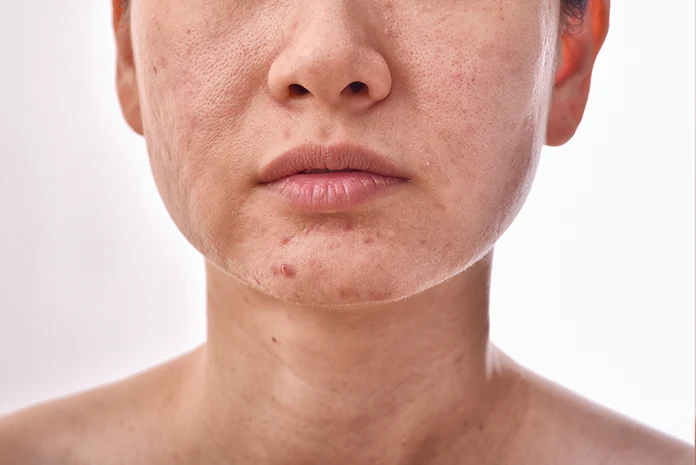
How to Treat Fungal Acne on Forehead at Home
Table of Contents
- 1. INTRODUCTION
- 2. What Is “Fungal Acne” on the Forehead, Really?
- 3. What Causes Fungal Acne on the Forehead?
- 4. How Can You Tell If Forehead Bumps Are Fungal, Not Regular Acne?
- 5. Which Ingredients Help Fungal Acne on the Forehead?
- 6. # 1. Antifungal washes (often dandruff shampoos)
- 7. # 2. Topical antifungal creams
- 8. # 3. Supportive actives for oil and texture
INTRODUCTION
Fungal acne on the forehead can be especially frustrating: it’s visible, often itchy, and seems to ignore traditional acne treatments. Many people double down on benzoyl peroxide, retinoids, or antibiotics, only to find the bumps get worse or spread. That’s because “fungal acne” is not true acne at all, but a yeast-driven condition that needs a different strategy.[5][8]
This article explains what fungal acne on the forehead really is, how to recognize it, and how to treat it safely at home. You’ll learn which ingredients help (and which make it worse), how to build a simple routine, realistic timelines for improvement, and when it is time to see a dermatologist. The goal is to give you clear, practical guidance you can start using today—without marketing language or quick-fix promises.
—
What Is “Fungal Acne” on the Forehead, Really?
Despite the name, **fungal acne** is not classic acne; it’s usually **Malassezia (pityrosporum) folliculitis**, an overgrowth of yeast in the hair follicles.[5][8] This yeast naturally lives on everyone’s skin but can multiply under certain conditions.
Typical features on the forehead include:
- Small, **uniform, itchy bumps** (papules and pustules)
- Clusters of bumps along the **hairline, temples, and T-zone**
- Breakouts that **don’t respond** to usual acne treatments or antibiotics[5][9]
Because the bumps look like acne, it’s easy to misdiagnose and overuse oily products or antibiotics, which can worsen the yeast overgrowth.[5][9]
—
What Causes Fungal Acne on the Forehead?
Fungal acne is driven by **yeast overgrowth plus the right environment**—warm, moist, and oily.[5][8]
Common contributing factors include:
- **Excess sweat and heat**
- Hot climates, intense workouts, helmets, hats, or headscarves
- Sweat left on the skin for long periods[2][6]
- **Oily or occlusive products**
- Heavy creams, balms, and some facial oils
- Products high in certain fatty acids, esters, and polysorbates that feed Malassezia[2][7]
- **Prolonged antibiotics or steroid use**
- Long-term oral or topical antibiotics can disrupt normal skin flora and allow yeast to overgrow.[5][9]
- **Compromised skin barrier or immune changes**
- Conditions that alter sebum composition or immune response can increase risk.[8]
Understanding these triggers helps guide effective home treatment: you need to **reduce yeast** and **change the environment** it thrives in.
—
How Can You Tell If Forehead Bumps Are Fungal, Not Regular Acne?
Only a healthcare provider can definitively diagnose with a skin exam or microscope test, but several clues point toward fungal acne:[5][8][9]
**More likely fungal acne if:**
- Bumps are **all similar in size**, 1–3 mm, and appear in clusters
- There is **significant itch or burning**
- Breakouts worsen with **heat, sweating, or occlusive headwear**
- Traditional acne treatments (retinoids, benzoyl peroxide, antibiotics) **do little or make things worse**[5]
- You also have **dandruff or seborrheic dermatitis** (flaky scalp, brows, sides of nose)[8]
**More likely classic acne if:**
- Lesions vary in size, with **whiteheads, blackheads, cysts**, and deeper nodules
- More pain than itch
- Strong hormonal pattern (worse around the jawline, cycle-related)
If you’re unsure after 4–6 weeks of careful home care, a dermatologist can examine the bumps and confirm the diagnosis.
—
Which Ingredients Help Fungal Acne on the Forehead?
At home, the main strategies are to **reduce yeast**, **control oil**, and **avoid feeding Malassezia**.
1. Antifungal washes (often dandruff shampoos)
Dermatologists frequently recommend **dandruff shampoos used as face washes** because their ingredients directly target yeast:[5][7][8]
Look for:
- **Ketoconazole 1–2%**
- **Selenium sulfide 1–2.5%**
- **Zinc pyrithione 1–2%**[2][7][8]
These are backed by clinical use for Malassezia-related conditions like dandruff and seborrheic dermatitis.[8] You can lather them over the forehead, leave for a few minutes, then rinse.
2. Topical antifungal creams
Over-the-counter **antifungal creams or gels** can be useful for spot-treating the forehead:[2][7][8]
Common active ingredients:
- **Clotrimazole 1%**
- **Miconazole 1–2%**
- **Terbinafine 1%**
They work by **inhibiting or killing yeast** within the follicles.[2][8] These are often used once or twice daily for several weeks.
3. Supportive actives for oil and texture
These don’t kill yeast but help manage the environment:
- **Salicylic acid (BHA) 0.5–2%**
- Helps unclog follicles and reduce excess sebum without feeding yeast.[2][7]
- **Azelaic acid 10–20%**
- Has **antimicrobial and anti-inflammatory** properties and is considered safe for Malassezia-prone skin.[1]
- **Niacinamide 2–5%**
- Supports the skin barrier and regulates sebum; generally well-tolerated in fungal acne routines.[7]
4. Natural adjuncts (useful but milder)
Evidence is more limited, but some natural ingredients show antifungal or soothing activity:
- **Tea tree oil** – antifungal and antiseptic; must be diluted before use to avoid irritation.[1][2][3][4][9]
- **Apple cider vinegar (ACV)** – when diluted, may help restore skin pH and mildly inhibit yeast growth.[1][2][3][4]
- **Aloe vera** – soothing and anti-inflammatory; can calm redness and irritation.[2][3][7]
- **Turmeric** – shows antifungal and anti-inflammatory activity in some studies and traditional use.[1][3]
These are **adjuncts**, not replacements, for proven antifungal agents.
—
What Should You Avoid If You Have Fungal Acne?
To give antifungal treatments the best chance to work, avoid products and habits that worsen yeast overgrowth.
1. Heavy, oily, or occlusive products
Limit or avoid:
- Thick creams and balms
- Straight **coconut oil**, olive oil, and rich plant oils on the forehead
- Products with **fatty acids, esters, and polysorbates** that Malassezia can use as a food source[2][7]
Choose **lightweight, gel-based, non-comedogenic moisturizers and sunscreens** instead.[2][7]
2. Prolonged sweat and friction
- Remove sweat on the forehead **as soon as possible** after workouts or heat exposure.[2][6]
- Minimize tight hats, headbands, and helmets when feasible; wash them regularly.
- If you must wear them, gently cleanse the forehead afterward.
3. Overuse of antibiotics and steroids
Long-term topical or oral antibiotics and topical steroids can worsen or unmask fungal acne by altering the skin microbiome.[5][9] This is something to discuss with your prescriber if you have persistent forehead bumps.
4. Harsh scrubs and over-exfoliation
- Avoid **rough physical scrubs**, which can irritate follicles and weaken the barrier.
- Stick to **gentle chemical exfoliation** once or twice weekly at most.[2][7]
—
How Long Does It Take to See Improvement?
Timelines vary, but general expectations:
- With consistent **antifungal wash + cream**, many people see **noticeable improvement in 2–4 weeks**.[7][8]
- More stubborn or long-standing cases can take **6–8 weeks** or longer to clear.
- Recurrences are common if triggers (heat, sweat, heavy products) return, so **maintenance** is often needed.[5][7]
If there is **no improvement** after 4–6 weeks of diligent home treatment, or the rash is spreading or very inflamed, seek professional care. Oral antifungals prescribed by a dermatologist have the highest efficacy for severe or resistant cases.[5][7][8]
—
HOW TO PREPARE, USE, AND APPLY HOME TREATMENTS
Below is a practical, step-by-step routine you can adapt. Patch test any new product on a small area for 24 hours first.
Step 1: Morning cleanse
If your dermatologist has advised it, you may use an antifungal shampoo as a cleanser in the **evening** instead of morning.
Step 2: Antifungal wash (once daily or a few times a week)
Step 3: Apply topical antifungal cream
Step 4: Moisturize with fungal-acne-friendly products
Step 5: Sun protection
Optional: Gentle exfoliation (1–2 times per week)
Optional: Natural adjuncts (use cautiously)
**Diluted tea tree oil**
- Mix **1 drop tea tree oil** in at least **10–12 drops of a neutral, lightweight carrier** (e.g., squalane or a non-Malassezia-feeding oil; avoid rich coconut oil on the forehead).[1][2][3][4][9]
- Apply only to small areas 1–2 times daily for a limited period if tolerated.
**Diluted apple cider vinegar (ACV) toner**
- Mix **1 part ACV with 3–4 parts water**.[2][3][4]
- Apply with a cotton pad to the forehead, leave for 5–10 minutes, then rinse.
- Use **no more than once daily** and stop if irritation occurs.
**Aloe vera gel**
- Apply a thin layer of **pure aloe vera gel** after cleansing and before antifungal cream or moisturizer to calm irritation.[2][3][7]
Always stop any product that stings severely, burns, or worsens redness.
—
NEXT STEPS: HOW TO MAINTAIN CLEARER SKIN
Once your forehead starts to improve, your focus shifts to **prevention and maintenance**:
- **Maintain a simple routine**
- Continue an **antifungal wash 1–3 times per week** as maintenance, especially in hot or humid seasons.[5][7]
- Keep using lightweight, non-comedogenic products.
- **Manage sweat and heat**
- Rinse or gently cleanse your forehead soon after workouts.
- Blot sweat with a clean towel; avoid letting it dry on the skin.[2][6]
- **Clean personal items regularly**
- Wash pillowcases, hats, headbands, and helmet liners frequently.
- Avoid sharing headwear.
- **Watch for pattern changes**
- If bumps return quickly whenever you stop antifungal products, or spread beyond the forehead, note this pattern.
- Consider seeing a dermatologist for a tailored plan and to rule out other folliculitis causes.
- **Know when to seek professional help**
- No improvement after **4–6 weeks** of careful home treatment
- Severe itch, pain, or widespread rash
- Signs of infection (pus, crusting, fever)
- Strong impact on mood or self-esteem
A dermatologist can prescribe **oral antifungals**, which show the highest efficacy for stubborn or extensive fungal acne.[5][7][8]
—
FAQ: Fungal Acne on the Forehead
1. Can I cure fungal acne on my forehead at home without seeing a dermatologist?
Mild to moderate fungal acne often **improves significantly at home** with consistent use of antifungal washes and creams, plus lifestyle adjustments like managing sweat and avoiding heavy products.[2][6][7][8] However, “cure” can be misleading—Malassezia is part of normal skin flora, so recurrence is possible. If you see no improvement after 4–6 weeks or symptoms are severe, professional evaluation is recommended, as oral antifungals may be needed.[5][7][8]
2. Are common acne products like benzoyl peroxide and retinoids helpful for fungal acne?
For pure fungal acne, **benzoyl peroxide, topical antibiotics, and retinoids do not target yeast** and may sometimes irritate the skin or worsen the imbalance if used aggressively.[5][9] They can still be useful if you have **both** fungal and traditional acne, but they should not be your main treatment for Malassezia folliculitis. Prioritize antifungal ingredients and add classic acne treatments later, under guidance, if needed.
3. Is it safe to use dandruff shampoo on my forehead?
When used correctly, **dandruff shampoos with ketoconazole, selenium sulfide, or zinc pyrithione** can be safe and effective as short-contact facial washes and are widely used for Malassezia-related skin issues.[2][7][8] Key tips:
- Avoid the eyes and mucous membranes.
- Leave on for only a few minutes before rinsing.
- Start **2–3 times weekly**, then adjust based on tolerance.
- Follow with a gentle, light moisturizer if skin feels dry.
Stop if you experience intense irritation, peeling, or severe redness.
4. Does diet affect fungal acne?
Research is more established for systemic yeast infections than for superficial Malassezia folliculitis, but some experts suggest that **high-sugar and high-alcohol diets may promote yeast overgrowth** or worsen inflammation.[6] While diet alone is unlikely to cure fungal acne, reducing **excess sugar and alcohol**, eating a balanced diet, and supporting overall skin and gut health may complement topical treatment.
5. How can I prevent fungal acne from coming back once it clears?
Prevention focuses on controlling yeast growth and avoiding its favorite conditions:
- Use an **antifungal wash 1–3 times per week** as maintenance, especially in warm, humid weather.[5][7]
- Stick to **lightweight, non-comedogenic, low-oil products** and avoid heavy creams and occlusive oils on the forehead.[2][7]
- Cleanse or rinse your forehead after **sweating or wearing tight headwear**.[2][6]
- Wash pillowcases and hats frequently.
- Avoid long, unnecessary courses of **antibiotics or strong topical steroids** on the face without medical supervision.[5][9]
If recurrences are frequent or severe despite these steps, consult a dermatologist to discuss longer-term maintenance, including possible pulsed oral antifungal therapy.[5][7]
You Might Also Like
Categories: Acne Treatment |
Skincare |
Skin Health