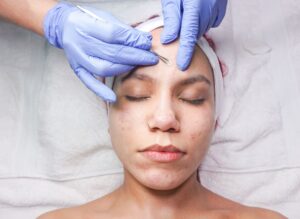
When a woman in her thirties develops acne for the first time—especially on areas like the chest, neck, and upper back—it’s often a sign that something systemic is happening in her body rather than just surface-level skin issues. Adult-onset acne that appears suddenly without a clear external trigger frequently points to hormonal imbalances, and thyroid dysfunction is one of the most overlooked culprits. An endocrinologist evaluation can reveal what’s really driving the breakouts, as thyroid autoimmunity shows up at significantly higher rates in women with post-adolescent acne than in the general population.
This connection isn’t coincidental—it’s rooted in how thyroid hormones regulate skin health, sebum production, and the inflammatory cascades that lead to acne formation. The statistics bear this out: research shows that 42.5% of female acne patients with positive thyroid antibodies receive intervention after an endocrinologist referral, indicating that thyroid issues are both common and treatable in this population. For women who suddenly find themselves breaking out in their thirties after decades of clear skin, getting thyroid function tested should be as routine as seeing a dermatologist—because the real problem may not be on the surface of the skin at all.
Table of Contents
- Why Does Thyroid Dysfunction Trigger Adult-Onset Acne?
- Where Does Thyroid-Related Acne Typically Appear?
- The Role of Thyroid Autoimmunity in Acne Development
- Diagnostic Testing and What to Expect
- Why Standard Acne Treatments Fall Short
- Other Symptoms That Often Appear Alongside Acne
- Long-Term Management and Future Outlook
- Conclusion
Why Does Thyroid Dysfunction Trigger Adult-Onset Acne?
Thyroid hormones control metabolic rate, immune function, and how your body regulates inflammation. When thyroid function is compromised—whether through autoimmune thyroiditis, hypothyroidism, or Hashimoto’s disease—the cascade of effects extends well beyond metabolism. These hormonal imbalances amplify sebum production, increase skin inflammation, and impair the skin’s natural healing mechanisms. Women are particularly vulnerable to thyroid autoimmunity, which is why adult-onset acne hits this demographic hardest.
The condition typically manifests years after initial thyroid dysfunction begins, often catching people off guard when acne suddenly appears in their thirties or forties despite never having struggled with skin problems before. The connection becomes even clearer when you understand that thyroid antibodies directly influence skin barrier function and immune response in the skin. Elevated levels of these antibodies trigger inflammatory pathways that mirror acne-prone conditions, leading to the characteristic breakouts. Unlike teenage acne driven by puberty hormones, adult-onset acne from thyroid issues tends to be more persistent and resistant to standard topical treatments because the root cause is systemic rather than localized.

Where Does Thyroid-Related Acne Typically Appear?
Thyroid-related acne follows a distinctive pattern that differs from typical teenage acne distribution. Rather than concentrating on the face, it commonly appears on the chest, neck, upper back, and shoulders—areas that reflect the systemic nature of the condition. This presentation pattern actually serves as a diagnostic clue: if you’re breaking out in these less typical zones simultaneously, thyroid dysfunction should be on your medical radar. The reason acne spreads to these areas relates to how thyroid hormones affect skin throughout the entire body, not just the face.
One important limitation to understand: not all chest and upper back acne is thyroid-related. Friction from clothing, sweat accumulation during exercise, and pityrosporum folliculitis (a fungal condition) can mimic thyroid-driven breakouts. This is why professional evaluation—not just self-diagnosis—is essential. An endocrinologist can run thyroid panel tests (TSH, free T3, free T4, thyroid peroxidase antibodies) to determine whether your acne is truly hormone-driven or if another factor is at play. Without testing, you risk spending months or years treating the symptom instead of the cause.
The Role of Thyroid Autoimmunity in Acne Development
Thyroid autoimmunity—where the immune system mistakenly attacks thyroid tissue—appears at notably higher rates in women with adult-onset acne than in the general population. This isn’t a minor statistical quirk; it’s a meaningful correlation that changes how dermatologists and endocrinologists should approach treatment. When thyroid peroxidase (TPO) antibodies are present, they trigger chronic inflammation throughout the body, including in the skin. This inflammatory state makes acne worse and makes it harder for the skin to heal once breakouts occur.
The specific scenario of a woman developing sudden chest acne in her thirties often reflects a progression of undiagnosed thyroid autoimmunity that’s been building for years. The immune system has been quietly attacking thyroid tissue, gradually reducing hormone production and increasing antibody levels. Eventually, the inflammation becomes obvious through skin symptoms—breakouts that won’t respond to benzoyl peroxide or salicylic acid because no amount of topical treatment can address the underlying autoimmune process. This is precisely why endocrinologist referral becomes necessary; dermatologists can clear the skin temporarily, but only thyroid treatment can resolve the root issue.

Diagnostic Testing and What to Expect
If you suspect thyroid dysfunction is behind your acne, your primary care doctor or dermatologist can order a basic thyroid screening, though an endocrinologist will provide more comprehensive testing. Standard labs include TSH (thyroid stimulating hormone) and free T4, but if you have risk factors for autoimmunity or a family history of thyroid disease, insist on thyroid peroxidase (TPO) antibody testing—this is the test that reveals autoimmune thyroiditis. Many women get initial TSH testing, find it “normal,” and assume their thyroid is fine, when in reality TPO antibodies could be elevated, indicating early or developing autoimmune disease.
The tradeoff in testing is between speed and comprehensiveness. A standard primary care visit might involve basic TSH testing (quick, often covered by insurance) versus a full endocrinologist workup (more thorough, might take longer to schedule, may involve more out-of-pocket costs). However, the cost and time investment of comprehensive testing typically pays off because it prevents months of ineffective acne treatment. Once thyroid autoimmunity is confirmed, thyroid replacement therapy (usually levothyroxine) can begin, and acne improvement often follows within 2-3 months as hormonal balance is restored.
Why Standard Acne Treatments Fall Short
When acne is driven by thyroid dysfunction, conventional dermatological treatments produce disappointing results. Retinoids, antibiotics, hormonal birth control, and topical actives may improve appearance slightly, but they cannot address the systemic hormonal imbalance fueling breakouts. This creates a frustrating cycle where women apply increasingly strong treatments to their skin while the underlying thyroid autoimmunity continues unchecked. A critical warning: prolonging this cycle delays the actual diagnosis and treatment that could resolve the problem.
Another limitation worth understanding is that even after thyroid treatment begins, skin may take time to clear. Thyroid hormone levels must be optimized—not just brought into the “normal range” but fine-tuned to the individual’s needs. TSH levels around 1.0-2.0 appear optimal for many women, but some feel better with different numbers. During the adjustment period (often 6-12 weeks), acne may initially worsen as hormone levels fluctuate. Patience and continued communication with both your endocrinologist and dermatologist is necessary to navigate this transition effectively.

Other Symptoms That Often Appear Alongside Acne
Adult-onset acne from thyroid dysfunction rarely appears in isolation. Women typically experience a constellation of other symptoms that, in hindsight, all point to thyroid disease: fatigue, weight gain despite normal eating habits, hair loss or thinning, dry skin, cold intolerance, and irregular menstrual cycles. When acne shows up alongside even one or two of these symptoms, thyroid testing becomes urgent rather than optional.
For example, a woman might attribute her sudden 15-pound weight gain and exhaustion to aging or stress while simultaneously developing chest acne—all three are thyroid-related, but without connecting the dots, she might pursue acne treatment alone and miss the real diagnosis. The skin symptoms can also extend beyond acne: increased dryness, eczema flares, or general sensitivity to products that previously worked fine. This broader pattern of skin and systemic changes strengthens the case for endocrinologist referral.
Long-Term Management and Future Outlook
Once thyroid autoimmunity is diagnosed and treatment begins, the acne typically improves dramatically—but thyroid disease is a chronic condition requiring ongoing management. Regular monitoring of thyroid labs, medication adjustments as needed, and lifestyle support (stress management, adequate sleep, anti-inflammatory nutrition) all contribute to keeping both thyroid function and skin health stable. The positive outlook is significant: properly treated thyroid autoimmunity resolves not just the acne but the fatigue, weight issues, and other symptoms, often transforming overall quality of life.
Looking forward, awareness of the thyroid-acne connection continues to grow in both dermatology and endocrinology. More practitioners are recognizing that adult-onset acne, especially in women over 30, warrants thyroid investigation before escalating to aggressive skin treatments. This shift in approach—treating the cause rather than just the symptom—represents meaningful progress for millions of women who’ve experienced the frustration of unexplained adult acne.
Conclusion
The emergence of acne in a woman’s thirties, particularly on the chest and upper back, is frequently a red flag for underlying thyroid dysfunction rather than a dermatological problem requiring intensive skin care. The connection between thyroid autoimmunity and adult-onset acne is well-established, with research showing that 42.5% of female acne patients with thyroid antibodies receive intervention after endocrinologist referral—and most experience significant improvement in skin once their thyroid is properly treated. The key is recognizing this pattern early and pursuing comprehensive thyroid testing rather than endlessly trying new acne treatments.
If you’ve developed sudden acne in adulthood, especially accompanied by fatigue, weight changes, hair loss, or cold sensitivity, request thyroid antibody testing from your doctor. An endocrinologist can provide the specialized evaluation needed to determine whether your skin symptoms are driven by thyroid disease. Once the underlying condition is identified and treated, your skin often clears naturally as hormonal balance is restored—a far more effective solution than managing the acne alone.
You Might Also Like
- She Was a Bride Who Developed Stress Acne 2 Weeks Before Her Wedding…Emergency Cortisone Injections Saved the Day
- She Was Told Her Acne Was Too Mild for Accutane…3 Years Later Her Dermatologist Said She’d Waited Too Long to Prevent Scarring
- She Was a Pediatrician Who Couldn’t Treat Her Own Daughter’s Acne…Referred Her to a Dermatologist